🕊️🧾🪶 Erased from the Aggressor’s Records | Peaceful Life#
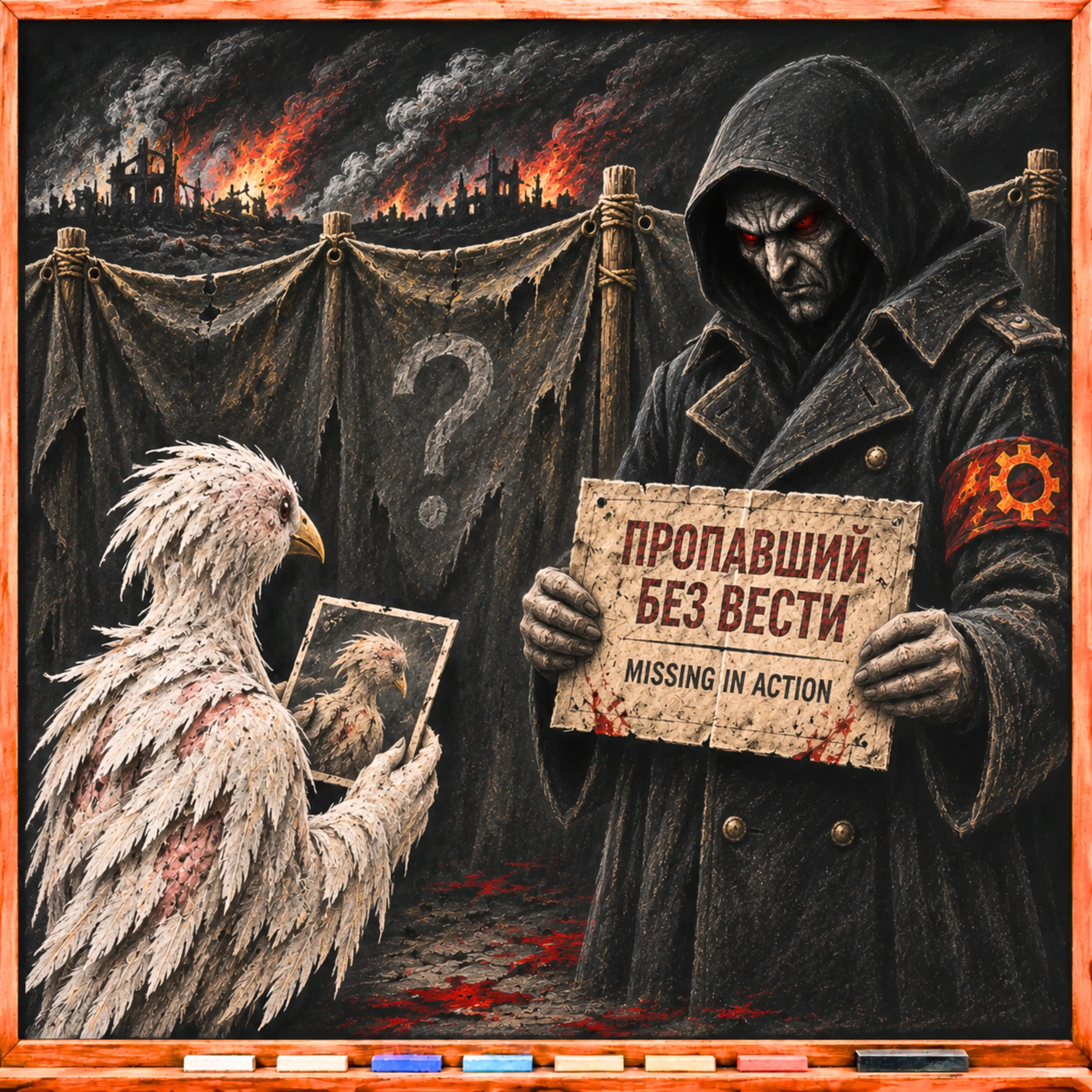
When the aggressor system no longer wishes to face the consequences of its actions, it can make the people who paid the price for the war disappear from its records.
A person sent to war can disappear twice: first by failing to return from the battlefield, and then from the records that should establish what happened to them. The phrase “missing in action” may describe genuine uncertainty, but it can also become a convenient status when a system has no intention of confronting the fate of those it has used.
Behind a brief official formula, a family is left without confirmation, a name remains suspended between life and death, and the machinery of war continues. It is important to understand what kind of system sends people to die and then refuses to account for their deaths.
What We See#
A dusty, ragged bird stands in the foreground, seen from behind and slightly to one side. It holds a photograph of another exhausted, plucked bird. The bird holding the photograph is somewhat cleaner and lighter, but its feathers are not pure white.
Facing it is a dark military figure with a black bird’s head, red eyes, and a shadowed human face. A red armband bearing a fiery cog symbol marks its sleeve. In its hands is a document carrying the Russian inscription “ПРОПАВШИЙ БЕЗ ВЕСТИ” (the English translation “MISSING IN ACTION” beneath it.)
Between the two birds and the distant battlefield stands a rough military screen. A question mark is visible on its surface, while the barrier blocks the view beyond. Behind it, the devastated ground is scattered with dead, dirty, plucked birds. Explosions, smoke, fire, ruins, and traces of blood complete the scene.
What It Reveals#
The status “missing in action” can describe a real situation in which a person’s fate has not yet been established. But in the hands of the aggressor system unwilling to acknowledge the consequences of its own war, uncertainty can become something else: a convenient way to avoid recording deaths.
The system sends people into danger, uses their lives as a resource, and then has an interest in leaving their fate unresolved. A name that remains in an ambiguous category does not have to become an acknowledged death. A death that is not officially recognised is easier to exclude from figures, reports, obligations, and public memory.
The military screen represents more than the absence of information. It is the barrier between the family seeking an answer and the reality the system does not wish to acknowledge. The question mark captures the uncertainty imposed on those left behind. Meanwhile, the document in the official’s hands offers a ready-made label instead of an answer.
The dark figure combines an inhuman bird-like appearance with a human face. This is not merely an abstract machine acting by itself. Human beings make decisions, issue orders, maintain institutions, and carry out policies. The system may be impersonal in its procedures, but responsibility does not arise in a vacuum.
The central contradiction is stark: people are considered valuable enough to be sent to war, yet their deaths can become inconvenient to recognise. They are counted as resources while useful, and erased from the record when acknowledging their fate becomes a burden.
What We Choose#
Any humane society does not treat people as disposable material for a war. It does not confuse a person with a military function, a number, or a temporary entry in a report.
The responsibility towards the dead does not end when the fighting stops. The aggressor’s system may leave the bodies of its own military personnel on the battlefield, fail to retrieve them and make little effort to establish their identities. The victimised side, by contrast, collects the remains, packages them, stores them under appropriate conditions and keeps records to enable identification and the possible return of bodies through exchanges. Even the bodies of enemy servicemen are not excluded from this responsibility.
This is not a matter of sympathy for the enemy. It is a matter of responsible treatment of the dead, respect for human remains and adherence to humanitarian standards during war. When one side refuses to retrieve its dead while the other takes responsibility for their registration and preservation, the difference between them becomes visible not in declarations, but in concrete actions.
The system that sends people to war erases them from its records when acknowledging their deaths becomes inconvenient.
What does a system reveal about its own values when it can demand human lives for war but refuses to acknowledge the people who never return?
Erased from the record · Missing in action · Wartime disappearance · Military casualties · Bureaucratic erasure · Denial of death · Expendable soldiers · State accountability · Human dignity
Before: People are sent to war and treated as resources whose fate can be left unresolved.
After: The mechanism becomes visible: uncertainty can serve the system by keeping deaths outside official recognition and public accounting.
Transition: The question moves beyond the missing person’s status to the responsibility of those who make disappearance administratively convenient.
Being officially listed as missing does not, by itself, prove that a death has been concealed or deliberately falsified. A person’s fate may genuinely be unknown. This work examines a different mechanism: the deliberate use of uncertainty by a system that avoids acknowledging deaths and the consequences of its own decisions.
Responsibility must also be assigned precisely. It belongs to those who initiate, direct, support, and knowingly sustain aggression.
When a system erases the people it has used, the missing are not the only ones left without an answer. The record itself becomes evidence of what that system is willing to conceal.
Alt-text:
A dusty, ragged bird holds a photograph of another plucked bird while facing a dark military figure with a black bird’s head and shadowed human face, who holds a document marked “ПРОПАВШИЙ БЕЗ ВЕСТИ” and “MISSING IN ACTION”; a military screen separates them from a devastated battlefield scattered with dead birds, amid smoke, explosions, ruins, and blood on the ground.
Peaceful Life. Erased from the Aggressor’s Records. AP | Pivtorak.Studio. 03.11.2026
© Anna Pivtorak (Kostyuk)