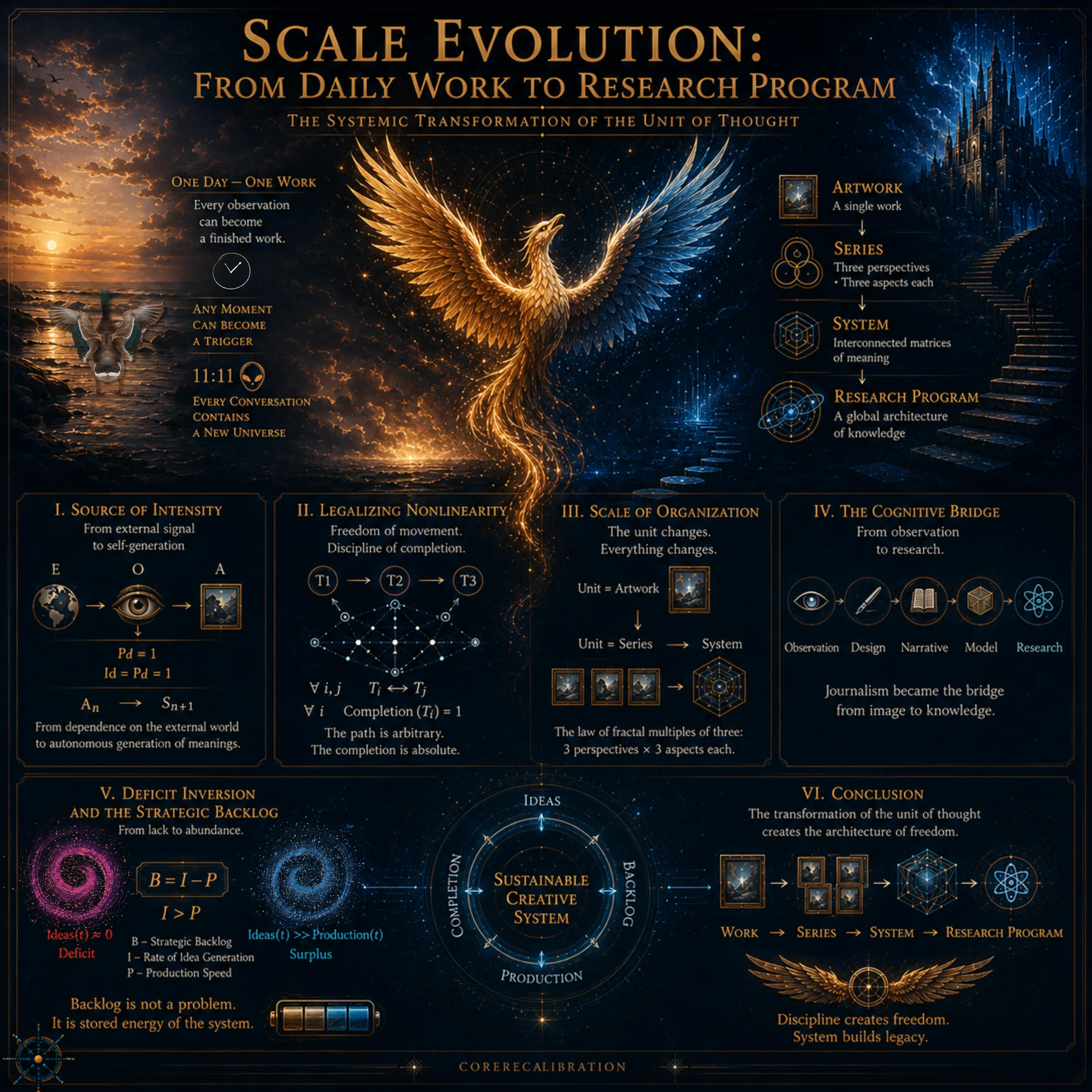
Scale Evolution. From Daily Work to Research Program | ⟡ Core Recalibration#
The Systemic Transformation of the Unit of Thought
One Day — One Work#
Long ago, I established a simple yet uncompromising discipline for myself: to create one finished work every single day. At that point, I no longer spent time mastering tools — Photoshop, Illustrator, InDesign, and AutoCAD had already become my natural environment, an extension of my hands. The only living question that arose every morning was: “What will the idea be today?”
One day, I walked out to the ocean without the slightest look ahead at what I would eventually create. I wasn’t intentionally searching for a plot — I was just walking along the coast and got caught in a light rain. On my way back, by the riverbank, I noticed ducks standing with their wings raised upward, drying their feathers in the wind. It was a moment of pure, natural preparation for flight.
That is how the work “Drying Wings” was born, becoming a part of the Design Moments series:
Drying Wings, Polishing Work
Every great design, like nature’s perfection, needs time to prepare before it takes flight. Have you ever noticed birds standing still with their wings spread, drying their feathers in the wind? It’s a moment of care and preparation. In design, we do the same — polishing, refining, and ensuring every detail is just right before our work is ready to soar.
At the time, it felt like I had merely created another beautiful image. In reality, my system of thinking was learning at that exact moment to perceive and capture the hidden patterns of the world.
Shortly after, following a conversation with my husband about the hidden meanings behind various digital codes and the mystical alignments of clock hands, I created “Mystical Portal,” which laid the foundation for a new major series — Alien Chronicles:
11:11 👽 Mystical Portal 🌀
Step in, but don’t forget your cosmic passport! 😎
Somewhere beyond the stars, a spiral leads the way to infinite possibilities.
Any random event could become a trigger. A walk, a sudden rain, an evening conversation, a shadow on the wall, or a bird in the sky — everything automatically became raw material. This practice brilliantly trained the ability to instantly transform a raw observation into a completed artifact. Eventually, however, this process inevitably had to evolve.
I. The First Recalibration: The Source of Intensity#
At the initial stage, the system was entirely dependent on an external signal. The surrounding world acted as the primary generator of themes, a process that can be described by a linear chain:
$$E \longrightarrow O \longrightarrow A$$
In this model, the impulse is transmitted sequentially: the environment ($E$) shapes the conditions, which, through my observation ($O$), are transformed into a finished artwork ($A$).
The main limitation of this mode lay in its rigid attachment to the daily cycle. The daily productivity parameter ($P_d$, the number of completed works per day) was strictly capped at one:
$$P_d = 1$$
This meant that the speed of finding new ideas ($I_d$) had to precisely match the output rate of the finished product: $I_d = P_d = 1$. Each new day demanded a completely fresh external stimulus.
Over time, as the critical mass of works crossed a certain threshold, a qualitative leap occurred — the system transitioned to an autonomous generation of meanings, governed by the formula:
$$A_n \longrightarrow S_{n+1}$$
New works ($A_n$) are no longer born from the chaos of the external environment; instead, they serve as building blocks for creating more complex systems of the next order ($S_{n+1}$). The products began interacting with one another, launching a self-contained concept production loop that functions independently of the outside world.
II. The Second Recalibration: Legalizing Nonlinearity#
As ideas began to pour in from everywhere, every new thought demanded the creation of a separate series. For a moment, it felt as though my page and workspace were rapidly descending into chaos. An attempt to process this state resulted in the conceptual work “Brownian Motion”:
BROWNIAN MOTION
Brownian motion occurs due to the constant collisions of tiny particles with the molecules of the surrounding medium.
Brownian motion as Anna Pivtorak’s work style: It is the ability to switch flexibly between tasks while maintaining an overall structure and bringing each to a final result. This speaks to her high adaptability, creativity, and ability to find order in chaos. The uniqueness of this style lies in the ability to combine randomness and structure, which makes her artistic style particularly effective and interesting.
This work did not create a new style — it gave it a name and legalized it. Up to that point, there was a rigid, linear internal expectation that proper process development must occur along a straight trajectory:
$$T_1 \longrightarrow T_2 \longrightarrow T_3$$
where active tasks ($T_i$) line up in a strict queue. Trying to move “correctly” created intense cognitive constriction.
The recalibration opened up a space for dynamic nonlinearity, where direct and reverse transitions between any active tasks of the system ($T_i, T_j$) became possible:
$$\forall i,j, \quad T_i \longleftrightarrow T_j$$
The system gained full freedom to switch between contexts, because the randomness of Brownian motion at the micro-level is now counterbalanced by an iron discipline of completion at the macro-level. The primary condition of the system is absolute:
$$\forall i, \quad \text{Completion}(T_i) = 1$$
The degree of completion for every single task taken into work ($\text{Completion}$) must reach one. The trajectory can be entirely arbitrary, but the final execution is guaranteed.
III. The Third Recalibration: The Scale of Organization#
For a long time, the foundational unit of organization for my entire creative process ($\text{Unit}$) was a discrete standalone artifact:
$$\text{Unit} = \text{Artwork}$$
The ultimate goal was a specific image or a local piece of text. The real scalar shift occurred when I implemented the law of fractal multiples of three. The unit of measurement instantly scaled upward:
$$\text{Unit} = \text{Series} \longrightarrow \text{System}$$
Since then, every major topic is examined from three different perspectives, and each perspective unfolds through three specific aspects. The unit of thought ceased to be point-like. Instead of generating isolated images, the system began to produce multi-dimensional, stable matrices of meaning, where each work supports and illuminates its neighbor.
IV. The Fourth Recalibration: The Cognitive Bridge#
The final stage of transformation was the transition between different types of activity and mediums of expression. The primary axis of system development passed through five consecutive stages:
$$\text{Observation} \longrightarrow \text{Design} \longrightarrow \text{Narrative} \longrightarrow \text{Model} \longrightarrow \text{Research}$$
Journalism played the role of the vital intermediate bridge. It pushed the system beyond the boundaries of purely visual design, training it not just to capture an aesthetic image, but to dissect phenomena, construct deep narratives, and clearly formulate causal relationships.
It was this experience that allowed the transformation of an applied design space into a domain of fundamental scientific research. The evolution of the organizational unit sealed the global loop:
$$\text{Artwork} \longrightarrow \text{Series} \longrightarrow \text{System} \longrightarrow \text{Research Program}$$
V. Deficit Inversion and the Strategic Backlog#
This fundamental shift in the scale of thinking ultimately led to a complete inversion of the system’s primary constraint. At the very beginning of my journey, I experienced a constant deficit of ideas, where the stock of unrealized concepts at any given time $t$ approached zero:
$$\text{Ideas}(t) \approx 0$$
Today, following the deployment of fractal systems, the situation has reversed. The system exists in a state of chronic surplus — the number of completed concepts massively exceeds the physical speed of their engineering implementation ($\text{Production}(t)$):
$$\text{Ideas}(t) \gg \text{Production}(t)$$
The bottleneck of the process shifted from finding inspiration to the pure speed of assembling the finished product. This structural gap forms our strategic backlog ($B$):
$$B = I - P$$
where $I$ is the rate of new concept generation and $P$ is the speed of their final engineering release. Given the condition that $I > P$, the accumulated backlog ($B$) completely loses its negative cognitive context (it is no longer a sign of procrastination or incompleteness). The backlog is recalibrated into the primary strategic resource — a stable, autonomous fuel loop that keeps the production pipeline supplied with work for years to come.
VI. Conclusion#
The most significant change along my creative path did not occur in the speed of my work or in the number of closed projects. It occurred in the systemic transformation of the unit of thought itself.
First, I created individual works. Then, they grew into series. Later, those series structured themselves into autonomous systems. Today, it has become evident that even these complex systems are merely component parts of a much larger, global research program. This is how a daily creative discipline, which once began with the spread wings of ducks on the ocean shore, unnoticed by myself, transformed into the rigorous architecture of independent scientific research.
Alt-text:
Scale Evolution infographic illustrating the transformation from daily creative work to an autonomous research program through systemic evolution of the unit of thought.
Scale Evolution. From Daily Work to Research Program. AP | Pivtorak.Studio. 30.06.2026
© Anna Pivtorak (Kostyuk)