👨⚖️ Author’s Declaration
This publication is part of an authorial research and artistic project created by an Independent Researcher and Creator (Analyst-Artist).
The material is based on the analysis of open sources and reflects the author’s personal research perspective.
Metaphors, imagery, symbols, and conceptual models may have an allegorical character and are used as tools of philosophical and systemic analysis.
This material is not a legal accusation, a journalistic investigation, or an official conclusion of any institution.
📋 Methodological Note
This series is an exercise in civilizational modeling.
The use of the present tense does not indicate an existing political reality, a prediction, or a factual statement.
The texts describe desirable systemic configurations and ethical horizons toward which societies may consciously choose to move.
The works function as architectural blueprints for possible futures rather than as descriptions of current events.
The purpose of the project is not to predict history, but to design coherent models of civilization that may serve as long-term reference systems for public reflection, institutional design, and human agency.
Every work in this series should therefore be understood simultaneously as a manifesto, a systems design exercise, and a civilizational hypothesis.
✯ Extra Credit Problem (The Asterisk Problem)
Iran – Persia: A Civilizational Transition
From the Dismantling of a Regime to the Revival of Civilization
VI. Desacralization of Fear. Exposing Vulnerability#
🔔 Ethical Resonance#
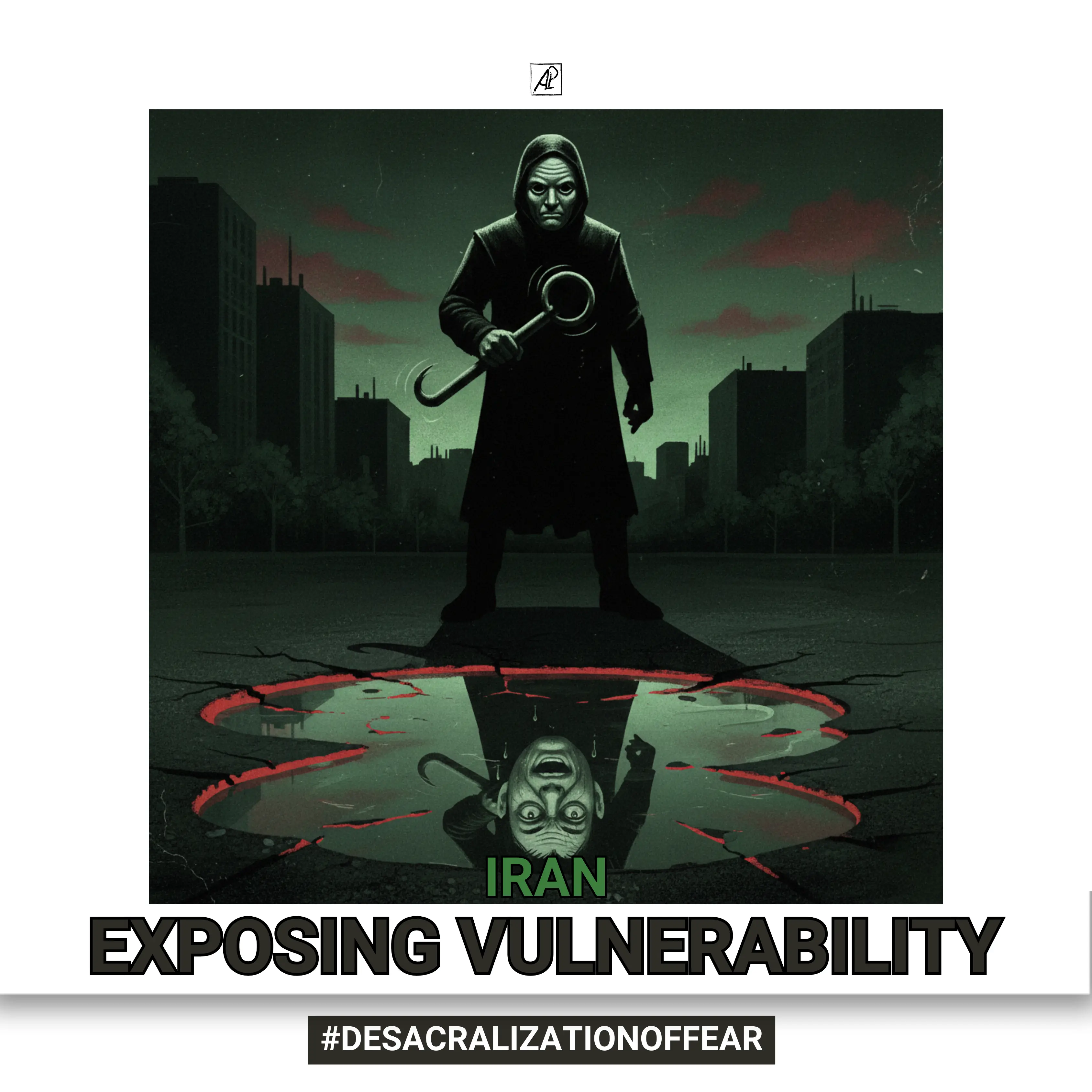
A deserted city at night. A figure in a black hooded cloak stands beside a puddle, where a trembling hand is reflected.
Look at this masked figure. It seems formidable, almost superhuman in its cruelty. But look lower—to where reality is reflected in a dirty puddle. Do you see how the fingers twitch on the hilt? Can you hear that uneven breath beneath the black fabric?
This is the great secret of all terror: the one who comes to torture is more afraid than the one standing before him. The mask is not a symbol of power; it is armor for a coward. He hides his eyes because he knows: there is no truth in them, only emptiness and icy horror of a future where every action must be answered for.
A repressive system is sustained not by strength, but by the circulation of fear. Fear moves from the center outward until someone agrees to carry it. A mask does not create power — it conceals panic. When fear stops flowing in one direction, the mechanism breaks: control no longer transmits, commands lose weight, and discipline collapses from within.
The puddle records a moment of malfunction. The reflection enlarges the face, revealing not determination but terror. Instruments no longer guarantee dominance — they mark dependence on a system that no longer protects its executors. The apparatus reveals itself as a collection of individuals, each afraid of facing consequences alone.
In this silence, fear changes ownership. The figure feels cold, isolation, and the clarity of a moment with nowhere left to hide. This is not redemption or remorse — it is the registration point where the myth of power stops functioning.
Today, we are not just tearing the mask from a face, but the mystique from violence. We see vulnerability where we once saw strength. When you turn to face your fear, you take away its source of energy. A shadow is only long when the sun is low. But now—it is the high noon of our will. And the shadow at the executioner’s feet is vanishing.
Fear is but a shadow that vanishes when you turn to face it.
📐 Systemic Solution Manifesto#
[GIVEN]:#
Dictatorship relies on the myth of the monolith and fearlessness of its punitive organs. The system tries to convince society that executioners are soulless machines, devoid of doubt and weakness.
Facts: In Iran 2026, the desacralization of fear began the moment the face of the repressive machine flinched. We record a private but fateful moment: a masked executioner, accustomed to absolute power, suddenly feels a cold sweat. His hand trembles, and this tremor is revealed by a puddle beneath his feet. This is not just a physiological reaction—it is the realization of the inevitability of retribution. When the victim stops being afraid, the executioner has no choice but to take that fear for himself. The mask no longer protects—it only emphasizes the vulnerability of the one hiding behind it.
[PARAMETERS OF ASYMMETRY]:#
- Myth vs. Reality: The image of the “iron hand” crumbles before the fact of ordinary human cowardice.
- The Gaze vs. The Mask: The executioner needs the mask not for intimidation, but to hide his own terror from those he tries to subdue.
- Strength vs. Trembling: True strength lies with the one who looks fear in the eye, not the one who holds a weapon with a shaking hand.
[ANALYSIS]:#
“Exposing Vulnerability” is the point of no return for tyranny. We demonstrate that the repressive apparatus is not a monolith, but a collection of frightened individuals clinging to the system only out of fear of retribution. The moment society sees the executioner’s trembling hand is the moment of its final victory. The shadow of dictatorship disappears because we have finally turned on the light of truth.
Key Phrase: “Fear is but a shadow that vanishes when you turn to face it.”
[CONCLUSION]:#
We diagnose a stage of moral decay in the punitive system.
The executioners have lost their “sacred” invulnerability.
Now they are just vulnerable people who found themselves on the wrong side of history.
Alt-text:
A deserted city at night. A figure in a black hooded cloak stands beside a puddle. His hand is trembling. The puddle reflects an enlarged, frightened face. The edges of the puddle are tinted red. Grotesque style.
✯ Extra Credit Problem (The Asterisk Problem). Iran – Persia: A Civilizational Transition.
VI. Desacralization of Fear. Exposing Vulnerability. AP | Pivtorak.Studio. 25.01.2026
© Anna Pivtorak (Kostyuk)
🛡️ This publication is part of an authorial research and artistic project.
The material is based on the analysis of open sources and contains the author’s interpretations, metaphors, and conceptual models.
The described images and concepts may be allegorical in nature and do not constitute legal accusations or official conclusions regarding any individuals, organizations, or states.