👨⚖️ Author’s Declaration
This publication is part of an authorial research and artistic project created by an Independent Researcher and Creator (Analyst-Artist).
The material is based on the analysis of open sources and reflects the author’s personal research perspective.
Metaphors, imagery, symbols, and conceptual models may have an allegorical character and are used as tools of philosophical and systemic analysis.
This material is not a legal accusation, a journalistic investigation, or an official conclusion of any institution.
📋 Methodological Note
This series is an exercise in civilizational modeling.
The use of the present tense does not indicate an existing political reality, a prediction, or a factual statement.
The texts describe desirable systemic configurations and ethical horizons toward which societies may consciously choose to move.
The works function as architectural blueprints for possible futures rather than as descriptions of current events.
The purpose of the project is not to predict history, but to design coherent models of civilization that may serve as long-term reference systems for public reflection, institutional design, and human agency.
Every work in this series should therefore be understood simultaneously as a manifesto, a systems design exercise, and a civilizational hypothesis.
✯ Extra Credit Problem (The Asterisk Problem)
Iran – Persia: A Civilizational Transition
From the Dismantling of a Regime to the Revival of Civilization
VI. Desacralization of Fear. Loss of Subjectivity#
🔔 Ethical Resonance#
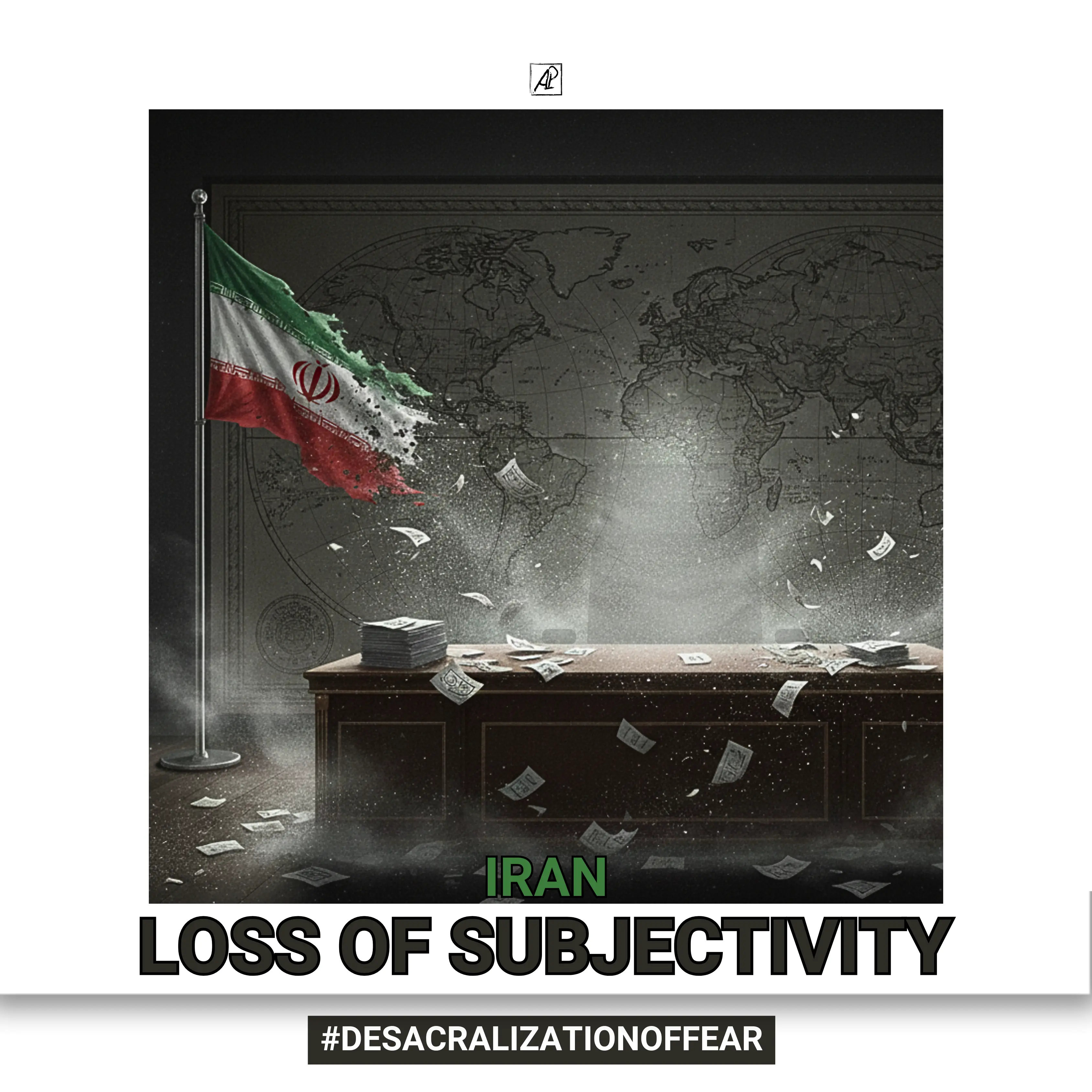
An empty office. Light falls on a dust-covered desk and a chair that seems to dissolve, losing its solidity. The air is still. Orders lie scattered on the table — the same papers that only yesterday could alter lives. Look at the flag in the corner: it is not just old; it is disintegrating into dust because the energy of hatred that held its threads together has vanished.
Symbols are not destroyed — they lose energy. The gravity of fear no longer functions.
Power here is no longer assembled. The ideology that once gave weight to sound has disintegrated, leaving behind inert language.
Power is not a building or a title. It is your consent to be governed. When you withdraw that consent, the tyrant loses his subjectivity. He becomes no one. And his order—nothing but meaningless noise drowning in the silence of your new freedom.
This is the moment of truth for every executor. An order flies through space, but it no longer has weight. It does not reach the hands because the “great idea” that justified the crime has disappeared. You realize: the dictatorship was only a shadow on the wall. You stopped believing in the shadow—and it vanished, leaving behind only an empty room.
Authority reveals itself not as a chair or a title, but as a network of relationships. When people exit that network, the “president” becomes a phantom in an empty room. The space remains, but the subject is absent.
The observer feels no triumph. Only silence and clarity — the moment when an order finally becomes nothing more than sound.
When no one believes in the ‘great idea,’ the executioner’s order becomes mere sound.
📐 Systemic Solution Manifesto#
[GIVEN]:#
Every tyranny relies on the belief in its inevitability and the “sacredness” of its orders. When this belief vanishes, the administrative apparatus turns into a hollow shell. An order not backed by social consent or fear loses its physical weight.
Facts: In Iran 2026, a disintegration of the power vertical has occurred. The president’s office—a symbol of bureaucratic violence—stands empty. The ideological flag that choked the country for decades crumbles into ash at the breath of the wind of change. We capture the moment an order to suppress protests hangs in the air and dissolves before reaching the executor. The system loses its ability to act because its subjectivity (the right to command) was an illusion built on the silence of the subjects. Now, that silence has become a collective verdict.
[PARAMETERS OF ASYMMETRY]:#
- Sound vs. Substance: The dictator’s words remain mere vibrations in the air, losing the ability to become action.
- Emptiness vs. Presence: The absence of the figure in the presidential chair becomes more powerful than its presence; it is evidence of the end of an era.
- Decay vs. Monolith: An ideology that seemed eternal turns out to be nothing but rusty dust.
[ANALYSIS]:#
“Loss of Subjectivity” is the final stage of a regime’s degradation. We demonstrate that power is not a chair or a paper with a seal, but a relationship between people. When people step out of that relationship, the “president” becomes a ghost in an empty office. This is the demystification of dictatorship: without belief in it, it simply does not exist.
Key Phrase: “When no one believes in the ‘great idea,’ the executioner’s order becomes mere sound.”
[CONCLUSION]:#
We diagnose the collapse of the ideological field.
The system no longer possesses the will for self-preservation.
It is a vacuum, already prepared to be filled with new meanings and a new identity.
Alt-text:
An empty Iranian presidential office: a dusty desk, scattered written orders, a chair visually fading away, and a flag in the corner disintegrating into dust. No people present.
✯ Extra Credit Problem (The Asterisk Problem). Iran – Persia: A Civilizational Transition.
VI. Desacralization of Fear. Loss of Subjectivity. AP | Pivtorak.Studio. 25.01.2026
© Anna Pivtorak (Kostyuk)
🛡️ This publication is part of an authorial research and artistic project.
The material is based on the analysis of open sources and contains the author’s interpretations, metaphors, and conceptual models.
The described images and concepts may be allegorical in nature and do not constitute legal accusations or official conclusions regarding any individuals, organizations, or states.