⟳⇄ Resonant Rotation | The Majestic Discipline#
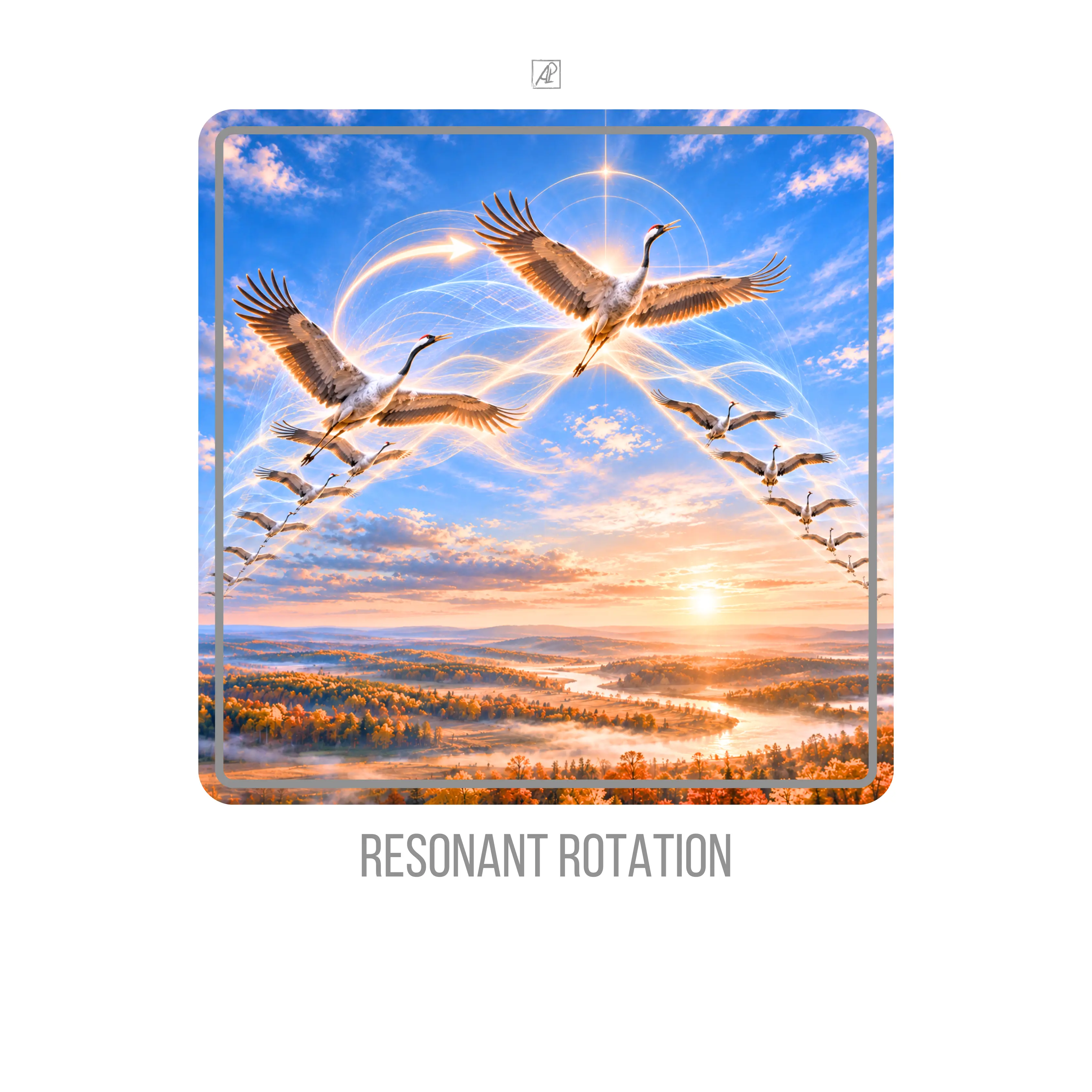
Resonant Rotation is the principle by which collective movement does not depend on one unchanging leader, but on the system’s ability to redistribute roles, effort and responsibility at the right moment.
Within a migrating crane formation, a change of position becomes part of a complex coordination process: one bird yields the leading position, another takes the direction, and the formation continues moving as a coherent whole. True synergy emerges when leadership can be transferred without disrupting rhythm, alignment or the shared flight path.
The Symbol#
At the centre of the composition, two cranes exchange the leading position within a V-shaped formation. One bird gently moves aside, making room for another to take the apex, while luminous lines and rhythmic waves form a unified geometry of interaction between them. This is not an image of competition for first place, but a symbol of continuity in which every participant can lead and support the movement of others.
The aerodynamic structure of the formation reminds us that each bird’s position matters to the overall configuration of flight. Airflow around the wings produces regions of upwash and downwash, and appropriate relative positioning allows following birds to make use of favourable air currents. The luminous network transforms this otherwise invisible physical interaction into an image of collective intelligence.
The Philosophy of the Strategy#
A system becomes mature not when it finds one irreplaceable leader, but when it can sustain movement through mutual trust and distributed responsibility. Role rotation reduces dependence on permanent precedence and allows participants to alternate effort according to the needs of the shared task. In this model, leadership is neither property nor title nor privilege: it is a temporary function assumed when the system requires it.
Scientific observations of migrating Northern bald ibises (Geronticus eremita) found that the birds frequently changed positions, and that time spent leading was associated with time spent in an advantageous position behind another bird. The researchers interpreted these findings as evidence of reciprocal turn-taking in the leading position. Other research into formation flight has shown that birds can coordinate the timing of their wingbeats with the spatial positions of their neighbours, making use of favourable regions of airflow. Collective efficiency, therefore, depends not only on the strength of an individual, but also on the precision of mutual coordination.
In human systems, this principle can be seen in teams, organisations, partnerships and communities. Competence lies not only in the ability to lead, but also in knowing when to pass the initiative, accept support and avoid interpreting a change of role as a loss of significance. Ego seeks to hold the apex; discipline understands when the apex must be yielded. This flexibility allows a system to preserve speed, precision and cohesion even as its internal configuration changes.
role rotation, distributed leadership, reciprocity, continuity of movement, aerodynamic coordination, systemic synergy
Inner State#
The inner discipline of rotation begins with the ability to separate personal worth from the position one occupies. Being at the front does not make someone more important; yielding a position does not make someone weaker. There is no need to constantly prove one’s precedence, because every participant understands that their contribution matters at different points in the shared movement.
True confidence makes it possible to accept change without resentment, transfer responsibility without fear and support another without hidden rivalry. When the struggle to retain a permanent position disappears, space opens for coordination. Synergy then becomes not an accidental alignment of efforts, but an intentional quality of the system.
The strength of the formation lies not in one bird, but in the system’s ability to change its apex without interrupting flight
Rotation teaches us that no position should become a permanent condition of strength, and no participant should become the single point on which the future of the whole depends. The next stage of this strategy is the ability to preserve a shared direction and rise higher without losing inner balance.
Alt-text:
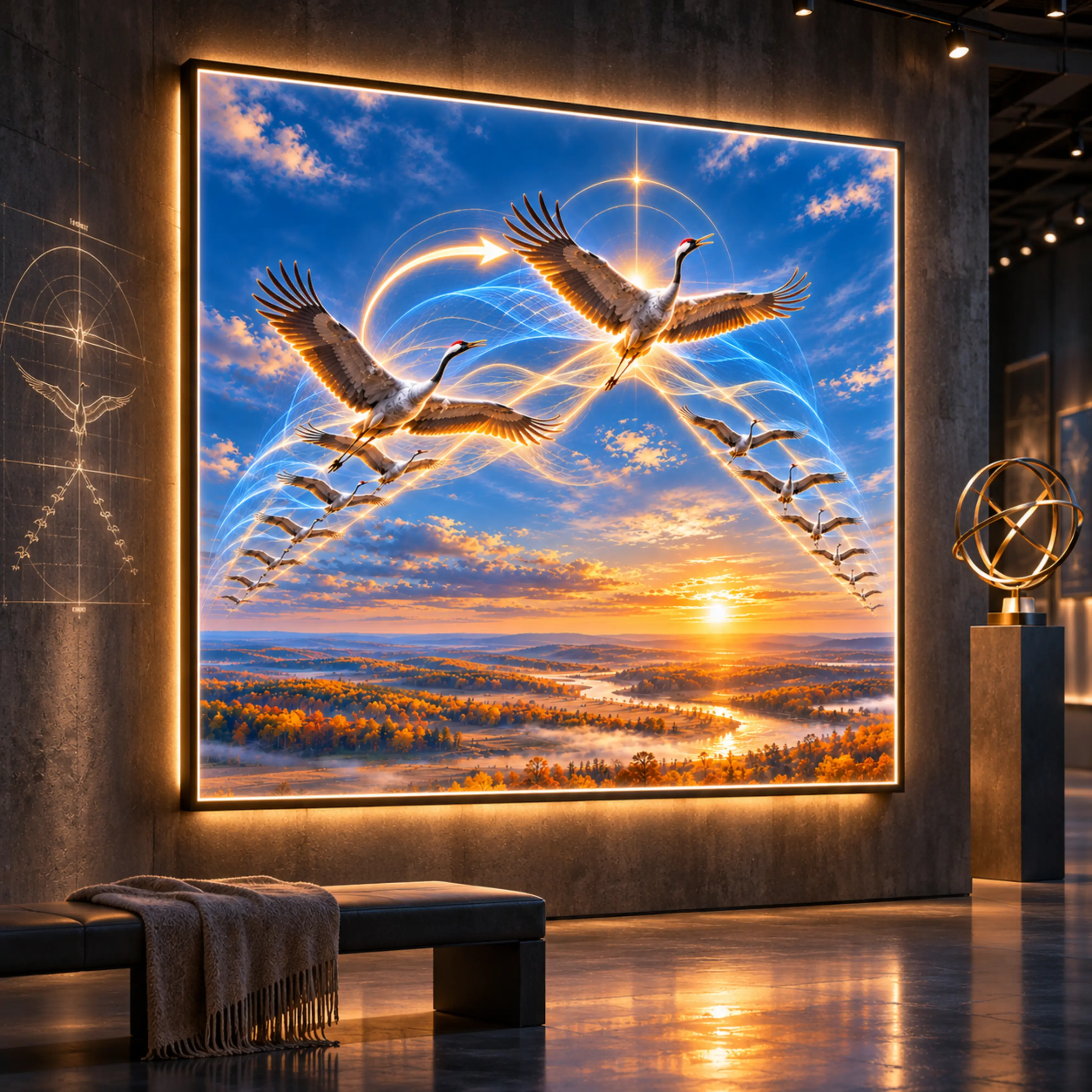
Grey Cranes exchange leading positions in a V-shaped flight formation, with golden and blue luminous lines forming a geometric network of synchronised movement between their outstretched wings against an autumn sky at sunset.
The Majestic Discipline. Resonant Rotation. AP | Pivtorak.Studio. 31.10.2026
© Anna Pivtorak (Kostyuk)