👨⚖️ Author’s Declaration
This publication is part of an authorial research and artistic project created by an Independent Researcher and Creator (Analyst-Artist).
The material is based on the analysis of open sources and reflects the author’s personal research perspective.
Metaphors, imagery, symbols, and conceptual models may have an allegorical character and are used as tools of philosophical and systemic analysis.
This material is not a legal accusation, a journalistic investigation, or an official conclusion of any institution.
📋 Methodological Note
This series is an exercise in civilizational modeling.
The use of the present tense does not indicate an existing political reality, a prediction, or a factual statement.
The texts describe desirable systemic configurations and ethical horizons toward which societies may consciously choose to move.
The works function as architectural blueprints for possible futures rather than as descriptions of current events.
The purpose of the project is not to predict history, but to design coherent models of civilization that may serve as long-term reference systems for public reflection, institutional design, and human agency.
Every work in this series should therefore be understood simultaneously as a manifesto, a systems design exercise, and a civilizational hypothesis.
✯ Extra Credit Problem (The Asterisk Problem)
Iran – Persia: A Civilizational Transition
From the Dismantling of a Regime to the Revival of Civilization
V. Protest Environment. Social Sabotage#
🔔 Ethical Resonance#
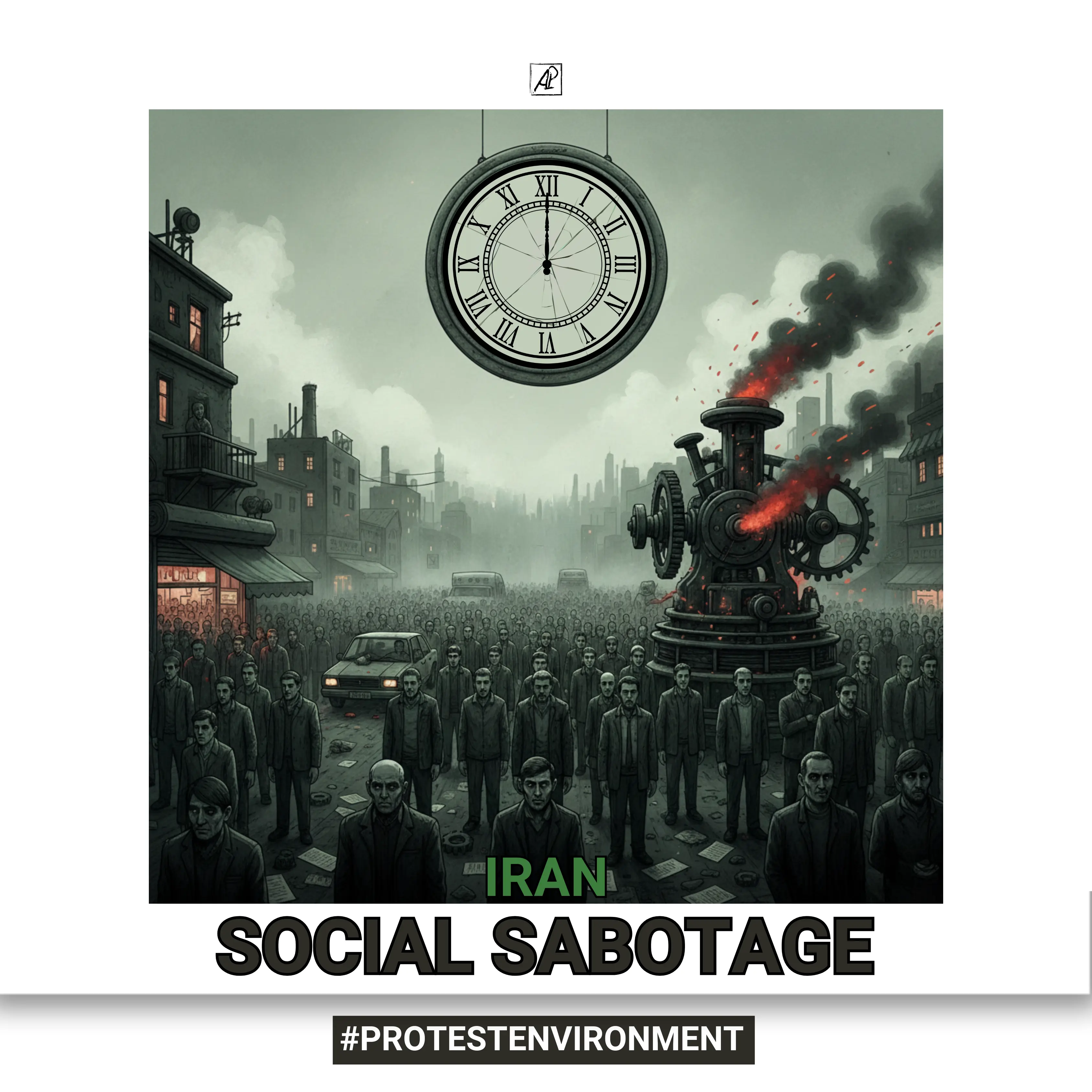
The city has stopped. Clocks in public squares froze at the same second, their hands suspended as if time itself had lost its function. People stand in streets and factories in silence, not touching the levers, switches, and panels that once kept the system in motion.
The system is designed for resistance, but it is not designed for a lack of participation. It knows how to break those who run, but it doesn’t know how to budge those who have decided to no longer be its fuel. When every “cog”—from the clerk to the railway worker—freezes in their right to inaction, the giant machine begins to smoke from its own absurdity.
In the absence of action, dependency becomes visible. A repressive system cannot exist without constant feeding — commands, execution, participation. It does not collapse from impact; it erodes through pause. What was designed to function automatically suddenly requires consent, and that consent is gone. Power continues to speak, but nothing answers.
Social sabotage produces no heroes and needs no slogans. It operates at the level of physics: without rotation, force is not transmitted. Factories fall silent, services fail to lock into chains, control fragments into isolated gestures. The system still exists formally, but it no longer functions.
Fear recedes. Clarity emerges: the power was never in the machine, but in participation. At this point, a person feels the incredible power of their silence. It is the state of a sensor showing: there is no more current. This is a moment of truth when you realize that all the “might” of those at the top is only a mirror reflection of your willingness to work for them. Today, the clock stands still. And in this immobility, true freedom is born.
The machine stalls when the cogs refuse to turn.
📐 Systemic Solution Manifesto#
[GIVEN]:#
Any dictatorship functions only as long as its mechanisms receive energy from the daily labor and obedience of millions. The system expects people to keep pedaling its machine even under the whip.
Facts: In January 2026, Iran was gripped by a wave of “silent stoppage.” It’s not about barricades; it’s about empty workplaces, unfiled reports, closed shops, and drivers stopping their cars in the middle of roads. When millions of people simultaneously say “no” through their actions (or rather, their absence), the punitive apparatus loses its meaning. It is impossible to arrest a city that has simply stopped. The machine of repression suffocates because it no longer has fuel—human resources.
[PARAMETERS OF ASYMMETRY]:#
- Violence vs. Inaction: Bullets are powerless against a person who simply didn’t show up for work.
- Movement vs. Pause: The system is tuned to suppress movement, but it has no idea what to do with absolute stillness.
- Order vs. Void: When an order is issued into a silence where no one intends to follow it, the dictator loses their status.
[ANALYSIS]:#
“Social Sabotage” is a strategy of exhausting tyranny. It is the moment when society realizes: we don’t have to defeat the system in battle; we just have to stop being its parts. Stopping the clocks is a metaphor for exiting the dictatorship’s control of time. When the cogs refuse to turn, the majestic structure of the regime turns into a pile of scrap metal.
Key Phrase: “The machine stalls when the cogs refuse to turn.”
[CONCLUSION]:#
We record a phase of total failure.
Society has moved from reacting to dictating terms through the “great pause.”
This is a silence that rings louder than any slogans.
Alt-text:
An urban environment where all clocks have stopped simultaneously. People stand motionless near factories, administrative buildings, and transport hubs, deliberately not interacting with any mechanisms or control levers.
✯ Extra Credit Problem (The Asterisk Problem). Iran – Persia: A Civilizational Transition.
V. Protest Environment. Social Sabotage. AP | Pivtorak.Studio. 23.01.2026
© Anna Pivtorak (Kostyuk)
🛡️ This publication is part of an authorial research and artistic project.
The material is based on the analysis of open sources and contains the author’s interpretations, metaphors, and conceptual models.
The described images and concepts may be allegorical in nature and do not constitute legal accusations or official conclusions regarding any individuals, organizations, or states.