👨⚖️ Author’s Declaration
This publication is part of an authorial research and artistic project created by an Independent Researcher and Creator (Analyst-Artist).
The material is based on the analysis of open sources and reflects the author’s personal research perspective.
Metaphors, imagery, symbols, and conceptual models may have an allegorical character and are used as tools of philosophical and systemic analysis.
This material is not a legal accusation, a journalistic investigation, or an official conclusion of any institution.
📋 Methodological Note
This series is an exercise in civilizational modeling.
The use of the present tense does not indicate an existing political reality, a prediction, or a factual statement.
The texts describe desirable systemic configurations and ethical horizons toward which societies may consciously choose to move.
The works function as architectural blueprints for possible futures rather than as descriptions of current events.
The purpose of the project is not to predict history, but to design coherent models of civilization that may serve as long-term reference systems for public reflection, institutional design, and human agency.
Every work in this series should therefore be understood simultaneously as a manifesto, a systems design exercise, and a civilizational hypothesis.
✯ Extra Credit Problem (The Asterisk Problem)
Iran – Persia: A Civilizational Transition
From the Dismantling of a Regime to the Revival of Civilization
VII. Revival of Identity. Call of the Ancestors (Faravahar)#
🔔 Ethical Resonance#
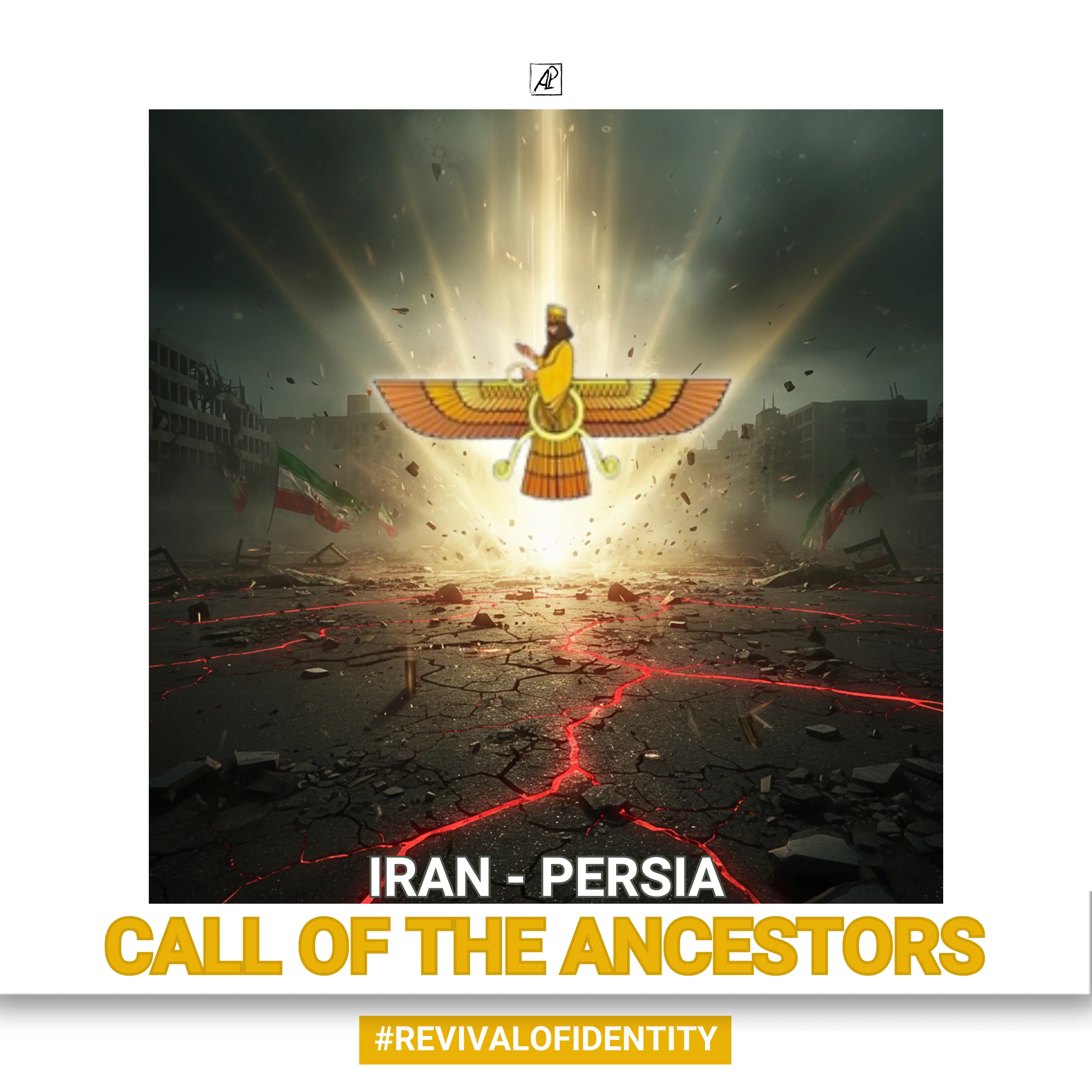
Darkness still hangs over the ruined city. Torn banners of the old regime lie scattered in the dust, the concrete is cracked, and a dull red glow rises from within the asphalt.
Through the cracks in the asphalt, through the ash of false ideologies, a golden glow emerges. This is the Faravahar. It has been waiting for you for thousands of years. You see what cannot be burned or erased.
A system built on fear does not vanish instantly — it exhausts itself. Its symbols lose weight, its language stops functioning, its signs no longer produce obedience. When the sacred aura of violence dissolves, space opens for a deeper layer of memory that is not created by regimes and cannot be destroyed by them.
This is not just a symbol of the past. It is a mirror of your soul. It reminds you: your dignity was not granted by the authorities, and therefore, the authorities cannot take it away. You are the descendants of those who built gardens in the desert and wrote the first laws of justice. You are not orphans in search of a new master; you are the masters of your own fate, finally returning home.
Faravahar appears not as a new emblem and not as a replacement. It functions as an access point to civilizational depth, where identity requires no permission. This is not restoration of the past and not nostalgia, but the recovery of continuity in which time does not break, even under tyranny.
Today, we are not building on a void. We are clearing the rubble to see beneath it the shining truth of our identity. Returning to our origins is not a step backward. It is the flight of a bird that has finally felt the strength of its wings.
Within this space, the human no longer searches for external support. Calm emerges not because danger has disappeared, but because doubt in one’s own root has ended. Awareness arrives quietly, like stabilization after prolonged displacement.
We do not start from scratch; we return to our greatness.
📐 Systemic Solution Manifesto#
[GIVEN]:#
For decades, the ideological machine tried to replace the millennia-old history of Persia with artificial constructs. It sought to erase the memory of greatness, replacing it with obedience.
Facts: In Iran 2026, as the dust from the regime’s collapse began to settle, what was found beneath was not chaos, but a foundation. The golden Faravahar—the embodiment of good thoughts, good words, and good deeds—emerges through the ash of modernity. This is not merely a religious or historical artifact. It is the DNA of the nation. We capture the moment of identity restoration: the people are not searching for new idols; they are remembering their true selves. The call of the ancestors proves louder than propaganda because it is written in the genetic code of everyone standing on this land.
[PARAMETERS OF ASYMMETRY]:#
- Temporal vs. Eternal: Tyranny was but an episode; the Faravahar is a constant.
- Ash vs. Gold: The smoke of modern strife dissipates, exposing the unchanging value of spiritual heritage.
- Zero vs. Grandeur: Revolution is not destruction to the ground, but the liberation of greatness that was always there.
[ANALYSIS]:#
“Call of the Ancestors” is the point of support. We assert that the revival of Persia is based on deep roots. The Faravahar becomes a compass leading the nation from the darkness of repression to the light of its own dignity. This is the moment when the past becomes fuel for the future.
Key Phrase: “We do not start from scratch; we return to our greatness.”
[CONCLUSION]:#
We initiate the process of returning subjectivity through identity.
The nation remembers that it is the heir to a great civilization, not just a resource for a regime.
Alt-text: A dark ruined cityscape with torn banners of the old regime on the ground, a crack in the asphalt glowing red from within, a beam of light rising upward, revealing a golden Faravahar symbol.
✯ Extra Credit Problem (The Asterisk Problem). Iran – Persia: A Civilizational Transition.
VII. Revival of Identity. Call of the Ancestors (Faravahar). AP | Pivtorak.Studio. 26.01.2026
© Anna Pivtorak (Kostyuk)
🛡️ This publication is part of an authorial research and artistic project.
The material is based on the analysis of open sources and contains the author’s interpretations, metaphors, and conceptual models.
The described images and concepts may be allegorical in nature and do not constitute legal accusations or official conclusions regarding any individuals, organizations, or states.