Wire Gauge Converter#
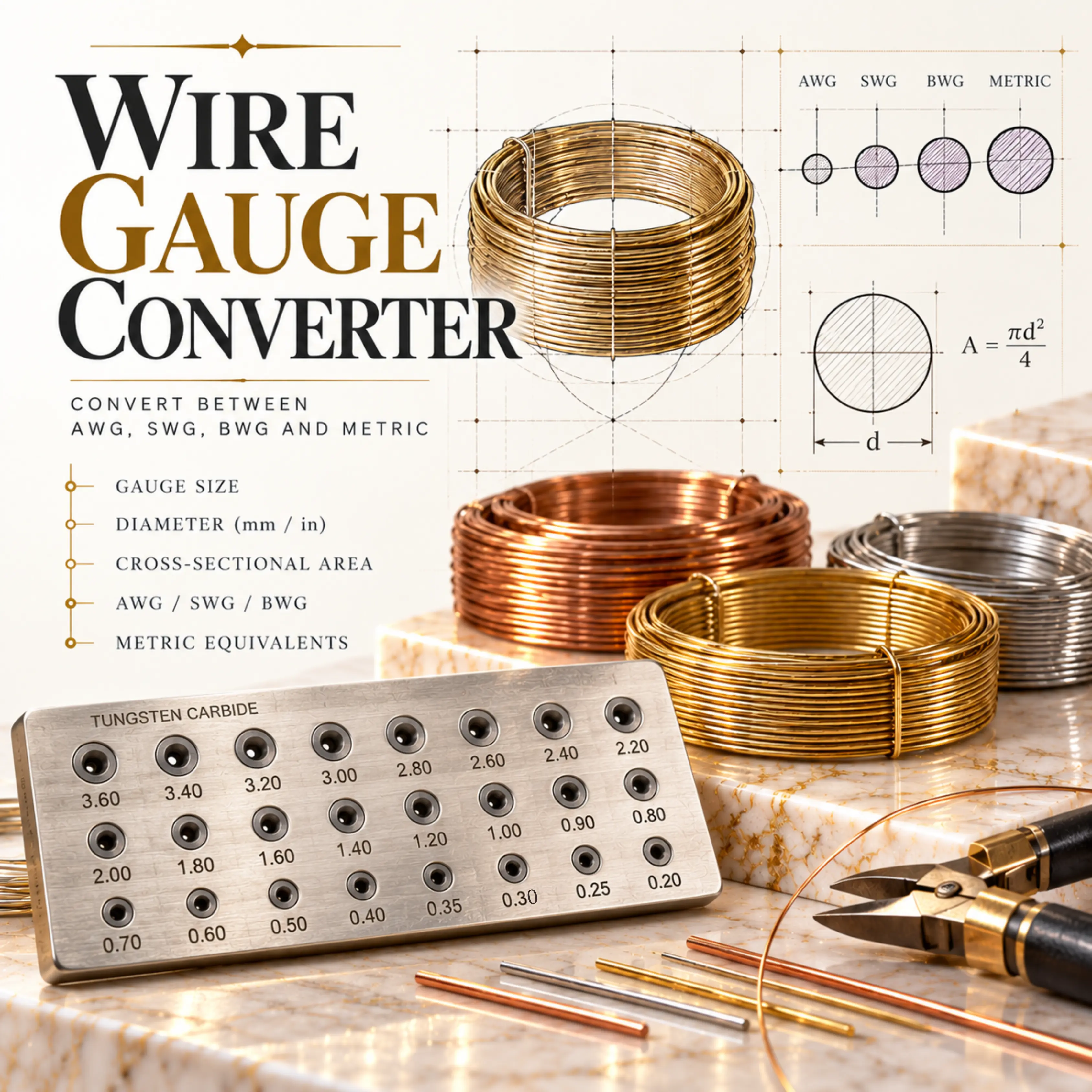
Convert wire gauge sizes between AWG, SWG, BWG and metric diameter in millimetres. Compare nominal wire diameters and solid-round cross-sectional areas, with approximate cross-system matches where a sufficiently close standard size is available. This converter is useful when working with technical specifications, jewellery wire, metalworking materials and reference charts that use different sizing conventions. Since gauge numbers do not have the same meaning across all systems, comparing the actual nominal diameter provides a more reliable basis for selecting or identifying a wire size.
This tool is useful for comparing wire sizes across standards when selecting materials for jewellery making, metalworking or technical applications.
How to use the converter#
Select the input system and the target system. Enter an AWG size from 0000 through 40 (the larger AWG sizes may also be entered as 4/0, 3/0, 2/0 or 1/0); a listed SWG size from 7/0 through 26, plus 28 or 30; a listed BWG size from 28 through 36; or a metric diameter from 0.001 to 100 mm. Gauge labels are not interchangeable between systems. A target gauge is shown only when its tabulated nominal diameter is within 2% of the input diameter; otherwise the converter reports that no close size is available. The initial input system is AWG.
Model and limits#
For AWG, the nominal diameter is d_mm = 0.127 × 92^((36 − n)/39), where n is the AWG number (0000 is represented by n = −3; ordinary sizes use 0–40). SWG and BWG use the listed diameter tables; no AWG formula is applied to them. Metric input is already a diameter in millimetres. For every system, the solid-round area is A_mm² = π × d_mm² / 4. Inches are derived using d_in = d_mm / 25.4 and A_in² = A_mm² / 25.4².
Diameters are nominal; real wire can differ by manufacturing tolerance, material and measurement method. The area assumes a solid circular cross-section and does not describe stranded wire, insulation, tube wall thickness or electrical current capacity. Cross-system matching uses the nearest available nominal diameter, with a strict 2% threshold; a match remains approximate.
Sources#
- AWG defining relationship and standard values: ASTM B258, Standard Specification for Standard Nominal Diameters and Cross-Sectional Areas of AWG Sizes.
- SWG listed diameters: My Local Components, AWG and SWG diameter chart, which identifies the SWG figures as BS 3737 table values. Only the entries listed in the calculator are accepted.
- BWG sizes 28–36: Thai Yazaki technical data, wire gauges, explicitly headed “Birmingham Iron Wire Gauge” in its wire-gauge section. Tube wall-thickness charts are not used.
- Solid circular area and inch conversion are geometric/unit conversions:
A = πd²/4;1 in = 25.4 mm.
Alt-text:
Wire Gauge Converter — AWG, SWG, BWG and metric wire sizes illustrated with brass gauge plate, coiled metal wires, diameter diagrams and cross-sectional area formula.
Converters. Jewelry Converters. Wire Gauge Converter. AP | Pivtorak.Studio. 23.10.2026
© Anna Pivtorak (Kostyuk)