👨⚖️ Author’s Declaration
This publication is part of an authorial research and artistic project created by an Independent Researcher and Creator (Analyst-Artist).
The material is based on the analysis of open sources and reflects the author’s personal research perspective.
Metaphors, imagery, symbols, and conceptual models may have an allegorical character and are used as tools of philosophical and systemic analysis.
This material is not a legal accusation, a journalistic investigation, or an official conclusion of any institution.
📋 Methodological Note
This series is an exercise in civilizational modeling.
The use of the present tense does not indicate an existing political reality, a prediction, or a factual statement.
The texts describe desirable systemic configurations and ethical horizons toward which societies may consciously choose to move.
The works function as architectural blueprints for possible futures rather than as descriptions of current events.
The purpose of the project is not to predict history, but to design coherent models of civilization that may serve as long-term reference systems for public reflection, institutional design, and human agency.
Every work in this series should therefore be understood simultaneously as a manifesto, a systems design exercise, and a civilizational hypothesis.
✯ Extra Credit Problem (The Asterisk Problem)
Iran – Persia: A Civilizational Transition
From the Dismantling of a Regime to the Revival of Civilization
IV. Vulnerability Point. Economic Overload#
🔔 Ethical Resonance#
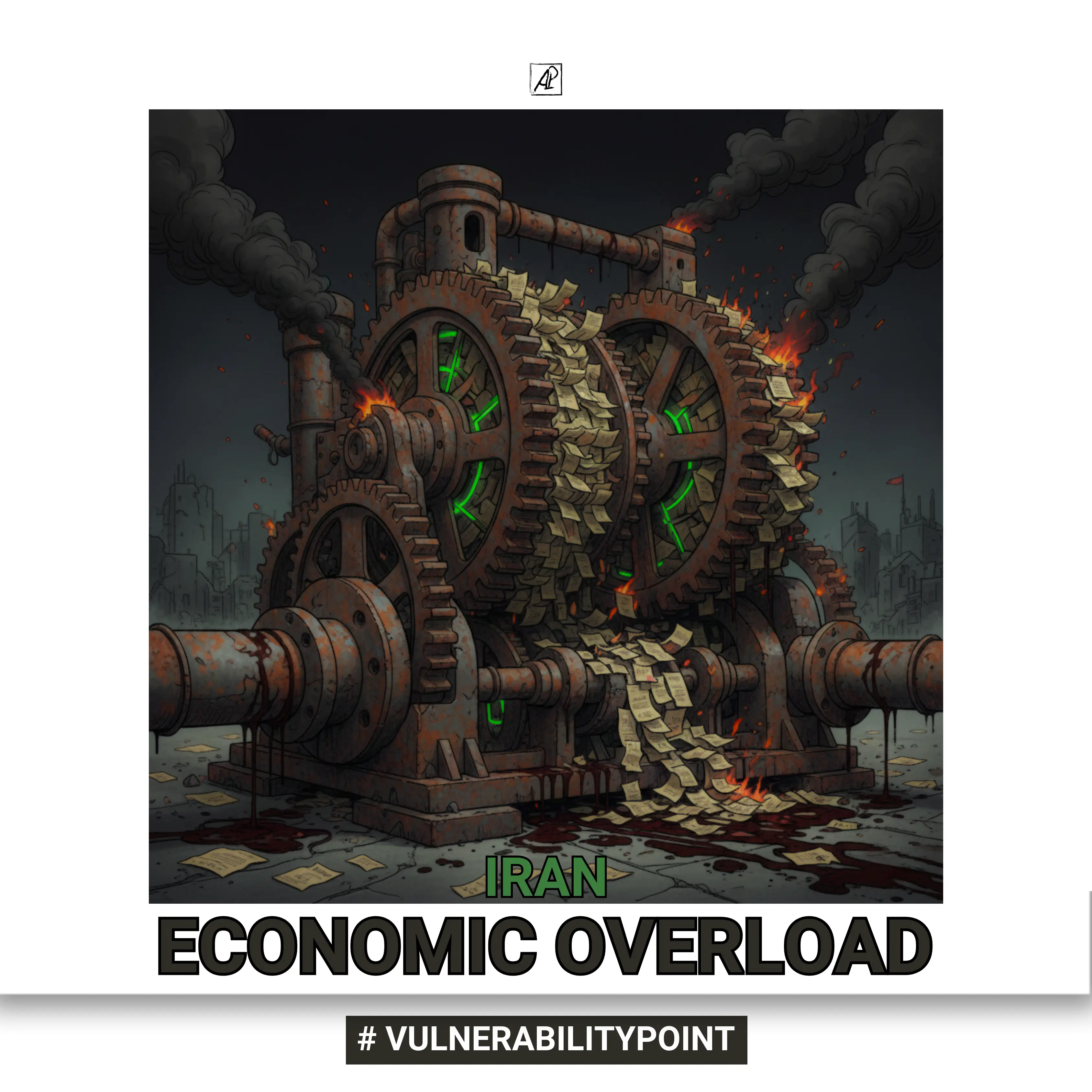
Before you is a giant, rusty machine of repression. It is working at the limit of its capacity, trying to grind down the will of millions. But if you look closely at its joints, you see not oil, but paper—thousands upon thousands of unpaid bills, receipts, and debts. The bolts smoke and screech because the energy that should have gone toward the nation’s life is being burned in the fire of fear.
Tyranny always appears monolithic as long as it has the means to pay the executioners. But violence is the most expensive commodity in the world. It requires constant investment; it creates no added value; it only consumes. And when the source runs dry and the people refuse to feed their killer, the machine begins to jam. The metal tires from the friction, and the system tires from the impossibility of buying one more hour of existence.
A repressive system operates as an engineering structure that requires constant resources. Salaries for enforcers, equipment, fuel, maintenance of fear — all of it has a cost. When ideology can no longer compensate for an empty wallet, the system enters overload. Violence ceases to be a “duty” and becomes an expense no one can afford.
Hyperinflation consumes the enforcer’s wage before it reaches his hands. Sabotage emerges not as protest, but as a physical strategy for survival. Unpaid bills accumulate inside the system the way rust eats through metal. This is not a crisis of belief. It is a final invoice. Evil has become too expensive.
At this point, a person feels the cold calculation of history. It is the state of a sensor that sees: the resource is spent, the limit is reached. There is a realization that fear is a credit that the regime can no longer service.
Tyranny is a luxury that cannot be paid for forever.
📐 Systemic Solution Manifesto#
[GIVEN]:#
Repression is a resource-intensive process. Maintaining an army of security forces, a network of spies, prisons, and a propaganda machine requires colossal funds that the regime is forced to strip from the country’s vital sectors.
Facts: In January 2026, Iran’s economy shows signs of critical overheating. Hyperinflation and mass tax sabotage undermine the regime’s ability to pay for the loyalty of its “cogs.” When a security officer receives a salary that cannot feed his family, the machinery of repression begins to smoke from internal friction. Corruption within the system acts like sand in the gears.
[PARAMETERS OF ASYMMETRY]:#
- Costs vs. Effect: Each new step in suppressing protests costs ten times more than the previous one but yields diminishing results.
- Loyalty vs. Price: Loyalty in this system has a market price. When money runs out, loyalty evaporates.
- Mechanism vs. Wear: The gears of the repression system are not designed for 24/7 operation without proper resource lubrication.
[ANALYSIS]:#
“Economic Overload” is the point where tyranny meets mathematics. We see that the government is spending the country’s future to maintain a horrific present. It is the arithmetic of self-destruction. As the unpaid bills for violence pile up, the system begins to consume itself. Local sabotage—from non-payment of utilities to factory shutdowns—creates a deficit that cannot be covered by terror.
Key Phrase: “Tyranny is a luxury that cannot be paid for forever.”
[CONCLUSION]:#
We diagnose a stage of irreversible wear and tear.
The regime’s economic foundation is crumbling under the weight of its own punitive apparatus.
This is not just a crisis; it is the final bill that the system has no way to settle.
Alt-text:
A giant rusted repression machine. Instead of lubricant, thousands of unpaid bills, receipts, and debt papers clog the mechanism. Screws smoke and grind from friction as the system operates at the brink of collapse.
✯ Extra Credit Problem (The Asterisk Problem). Iran – Persia: A Civilizational Transition.
IV. Vulnerability Point. Economic Overload. AP | Pivtorak.Studio. 21.01.2026
© Anna Pivtorak (Kostyuk)
🛡️ This publication is part of an authorial research and artistic project.
The material is based on the analysis of open sources and contains the author’s interpretations, metaphors, and conceptual models.
The described images and concepts may be allegorical in nature and do not constitute legal accusations or official conclusions regarding any individuals, organizations, or states.