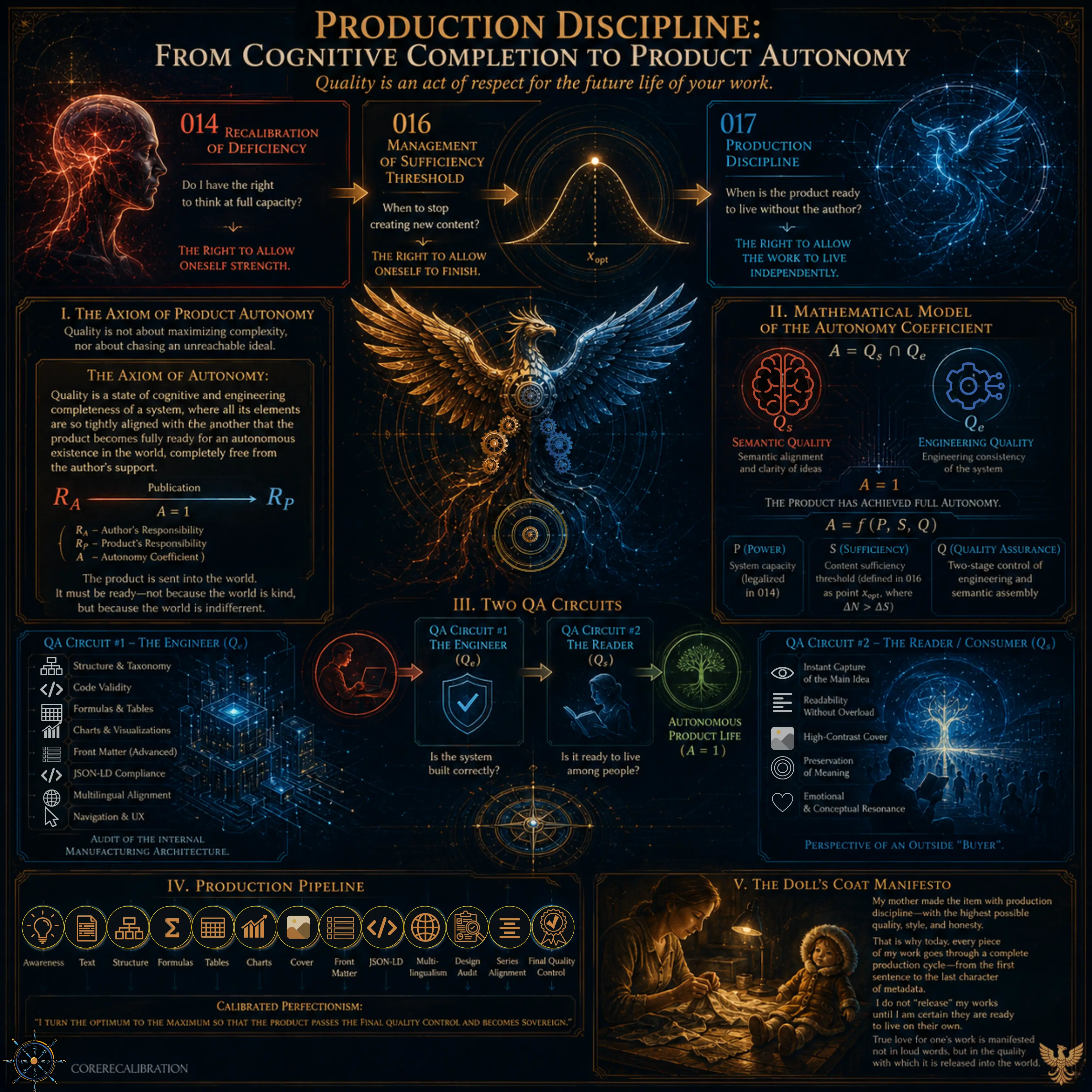
Production Discipline. From Cognitive Completion to Product Autonomy | ⟡ Core Recalibration#
Quality is an act of respect for the future life of your work.
- 014 Recalibration of Deficiency answers the question: “Do I have the right to think at full capacity?” ⭢ The right to allow oneself strength.
- 016 Management of Sufficiency Threshold answers the question: “When to stop creating new content?” ⭢ The right to allow oneself to finish.
- 017 Production Discipline answers the question: “When is the product ready to live without the author?” ⭢ The right to allow the work to live independently.
I. The Axiom of Product Autonomy#
Quality is not about maximizing the complexity of a product, nor is it an attempt to achieve an unreachable ideal.
The Axiom of Autonomy:
Quality is a state of cognitive and engineering completeness of a system, where all its elements are so tightly aligned with one another that the product becomes fully ready for an autonomous existence in the world, completely free from the author’s support.
Until the moment of publication, the author is responsible for the work. After that moment, the work is responsible for itself. The moment of responsibility transfer is governed by achieving full autonomy:
$$R_a \xrightarrow[\mathcal{A}=1]{\text{Publication}} R_p$$
(where $R_a$ is the author’s responsibility, $R_p$ is the product’s responsibility, and $\mathcal{A}$ is the product autonomy coefficient).
The product is sent into the world. And it must be ready for this—not because the world is kind, but because the world is indifferent.
II. Mathematical Model of the Autonomy Coefficient#
To precisely measure system readiness, we introduce the Autonomy Coefficient ($\mathcal{A}$). It is defined as the intersection of two fundamental quality parameters:
$$\mathcal{A} = Q_s \cap Q_e$$
- $Q_s$ (Semantic Quality) — Semantic alignment and clarity of ideas.
- $Q_e$ (Engineering Quality) — Engineering consistency of the system.
The state $\mathcal{A}$ = 1 signifies that the product has achieved full autonomy and is ready for independent existence.
Since the system’s evolution passes through three consecutive stages, autonomy itself is a function of thinking power, timely cessation, and control circuits:
$$\mathcal{A} = f(P, S, Q)$$
- P (Power): System capacity (legalized in 014).
- S (Sufficiency): Content sufficiency threshold (defined in 016 as the point $x_{opt}$, where $\frac{dV}{dx}=0$, after which $\Delta N > \Delta S$).
- Q (Quality Assurance): Two-stage control of engineering and semantic assembly.
III. Two QA (Quality Assurance) Circuits#
The process of releasing a work is a two-stage operation. What the system allows to be published on the website might be sent back for revision when it comes to social media. These are two fundamentally different testing models:
Text & Idea
↓
QA Circuit #1: THE ENGINEER ($Q_e$) ⭢ Is the system built correctly? (Code, JSON-LD, Hugo)
↓
QA Circuit #2: THE READER ($Q_s$) ⭢ Is it ready to live among people? (Meaning, Perception)
↓
Autonomous Product Life ($\mathcal{A}=1$)
🟢 QA Circuit #1 — The Engineer ($Q_e$)#
- Question: Is the system built correctly?
- Focus: Structure, code validity, formulas, tables, charts, advanced Front Matter, Hugo taxonomy, JSON-LD compliance, multilingual translation alignment, navigation. This is the audit of the internal manufacturing architecture.
🔵 QA Circuit #2 — The Reader / Consumer ($Q_s$)#
- Question: Is the product ready to live among people without its author?
- Focus: The perspective shifts to that of an outside “buyer.” Is the main idea captured instantly? Can the paragraph be read without excessive cognitive load? Is the cover image high-contrast? Is the meaning preserved accurately?
Only after the product successfully passes both circuits ($Q_e \cap Q_s$) does the autonomy coefficient reach one ($\mathcal{A} = 1$).
IV. Production Pipeline#
This process is not chaotic perfectionism; it is a rigorous engineering algorithm. A one-time investment of time into the pipeline optimizes the work’s entire subsequent life cycle.
Awareness ⭢ Text ⭢ Structure ⭢ Formulas ⭢ Tables ⭢ Charts ⭢ Cover ⭢ Front Matter ⭢ JSON-LD ⭢ Multilingualism ⭢ Design Audit ⭢ Series Alignment ⭢ Final Quality Control ⭢ PublicationCalibrated perfectionism means: “I turn the optimum to the maximum so that the product passes the final quality control and becomes sovereign.”
V. The Doll’s Coat Manifesto: The Birth of a Standard#
None of this is the result of a university education, a profession, or programming. This discipline has a specific, deeply personal origin.
One cold autumn evening, my mother told me that tomorrow I would go to kindergarten in a warm coat. And my doll would too. I didn’t understand how that was possible, because she didn’t have any other clothes, and back then, stores didn’t sell doll clothing.
In the morning, I saw my favorite doll in a tiny coat with a hood. My mother had sewn it during the night from my father’s scarf. It was extraordinary! Beautiful, stylish, neat, tailored perfectly to the doll’s figure. It had every detail, and there was even fur on the hood.
I proudly walked to kindergarten with the best doll in the world. But there, I encountered a strange evaluation criterion for the first time. The girls didn’t say how beautiful the coat was. They didn’t notice how neatly it was sewn. They didn’t see the resourcefulness and love. All I heard was: “It’s not from a store.” They evaluated the source of origin, not the quality of execution.
Only many years later did I realize that this was the moment I received my first standard of quality. Not a factory standard, but a human one. My mother made the item with production discipline—with the highest possible quality, style, and honesty.
I do not “release” my works until I am certain they are ready to live on their own. After all, long ago, my mother gave me an example showing that true love for one’s work is manifested not in loud words, but in the quality with which it is released into the world.
That is why today, every single piece of my work goes through a complete production cycle—from the very first sentence of text to the very last character of metadata. Not because I strive for an unattainable perfection. But because I want manual intellectual labor to command the exact same absolute respect that my mother once stitched into a tiny coat for my doll.
Alt-text:
Production Discipline. From Cognitive Completion to Product Autonomy — engineering infographic illustrating Product Autonomy, dual Quality Assurance circuits, the Production Pipeline, and the transition from author responsibility to autonomous product life.
Production Discipline. From Cognitive Completion to Product Autonomy. AP | Pivtorak.Studio. 27.06.2026
© Anna Pivtorak (Kostyuk)