👨⚖️ Author’s Declaration
This publication is part of an authorial research and artistic project created by an Independent Researcher and Creator (Analyst-Artist).
The material is based on the analysis of open sources and reflects the author’s personal research perspective.
Metaphors, imagery, symbols, and conceptual models may have an allegorical character and are used as tools of philosophical and systemic analysis.
This material is not a legal accusation, a journalistic investigation, or an official conclusion of any institution.
📋 Methodological Note
This series is an exercise in civilizational modeling.
The use of the present tense does not indicate an existing political reality, a prediction, or a factual statement.
The texts describe desirable systemic configurations and ethical horizons toward which societies may consciously choose to move.
The works function as architectural blueprints for possible futures rather than as descriptions of current events.
The purpose of the project is not to predict history, but to design coherent models of civilization that may serve as long-term reference systems for public reflection, institutional design, and human agency.
Every work in this series should therefore be understood simultaneously as a manifesto, a systems design exercise, and a civilizational hypothesis.
✯ Extra Credit Problem (The Asterisk Problem)
Iran – Persia: A Civilizational Transition
From the Dismantling of a Regime to the Revival of Civilization
III. Diagnosis of the System. Resource Dependence#
🔔 Ethical Resonance#
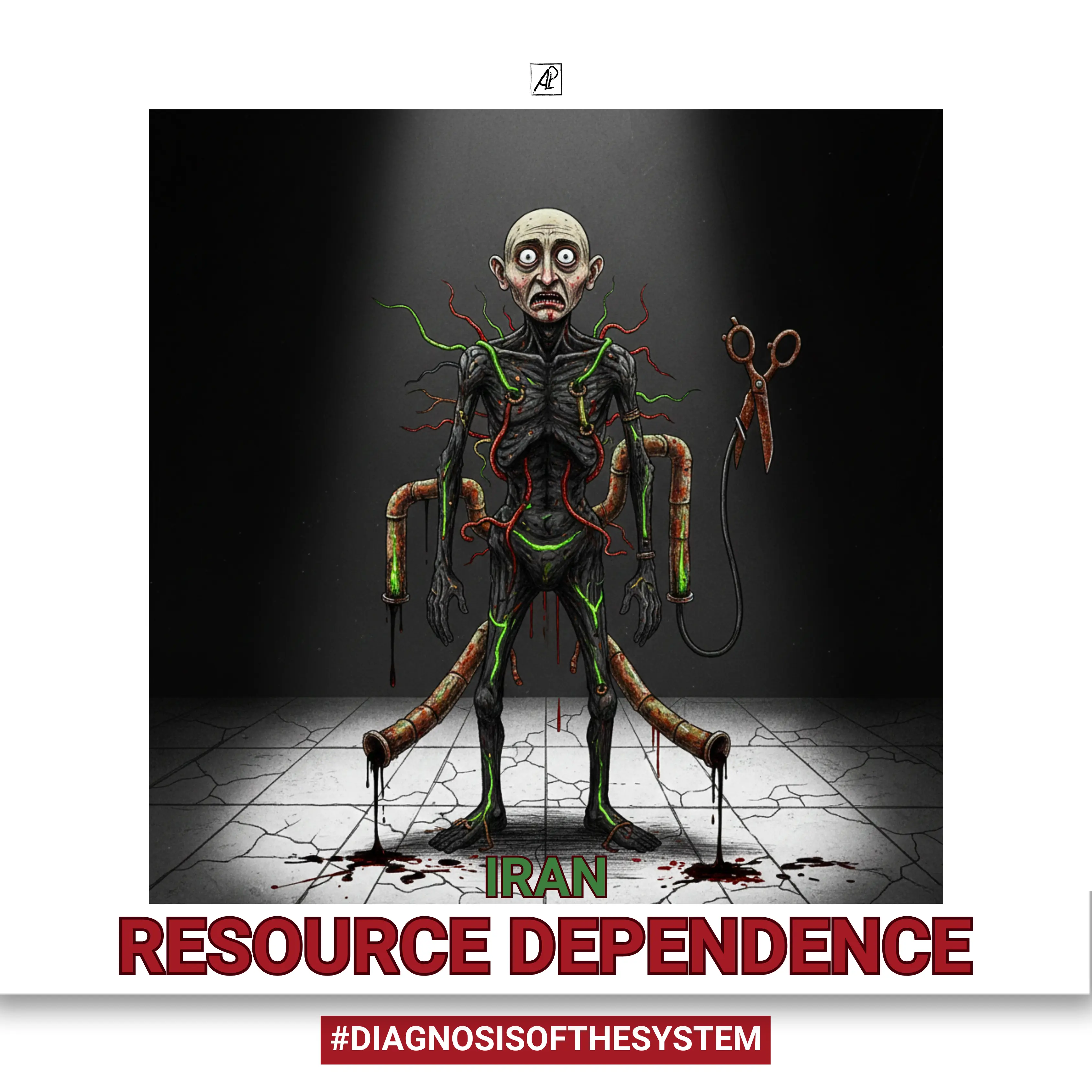
In the center of the hall stands a figure that seems vast. But looking closer, you see: it is not greatness, but bloating. Rusty pipes pass through the dictator’s body, carrying oil, dissolved gold, and human labor under high pressure. He is but a living pump casing, greedily sucking the life out of the country and turning it into fuel for his torture chambers. His volume depends not on internal strength, but on how well the valves at the other end of the pipe are functioning.
This system does not produce value and does not sustain an environment. It exists as a pump connected to external sources. Resources are not instruments of development — they are the sole condition of survival. The mechanism is unable to function without a constant influx of something else: labor, money, raw materials, endurance.
But the whistle of depressurization is already in the air. As the flow slows, the figure begins to shrivel. It turns out that without the constant injection of someone else’s resource, this giant is merely a pile of dry skin and empty promises. There is no internal reserve, no self-regulation, no capacity for recovery. The system’s thirst becomes its sentence. When the people turn off the tap of their obedience and their labor, the parasite is left alone with its own emptiness.
At this point, a person feels an icy clarity. It is the state of a sensor recording the drop in pressure within the system, realizing: the monster will not die in battle; it will simply deflate when the flow it considered its own runs dry.
This awareness carries no emotion. It registers as data.
The system dies of thirst when someone else’s flow runs dry.
📐 Systemic Solution Manifesto#
[GIVEN]:#
Iran’s criminal authority relies not on effective governance but on total control over natural resources and shadow financial flows. The entire state apparatus functions like a giant pump.
Facts: The IRGC controls over 30% of Iran’s economy, including the oil and gas sector and smuggling routes. In January 2026, amid tightened sanctions and oil worker strikes, it is becoming evident: the regime has no “engine” of its own. It can only consume what belongs to the earth and the people. Once the “pipe” (external or internal) is cut, the regime’s imitation of greatness vanishes, exposing the void.
[PARAMETERS OF ASYMMETRY]:#
- Pump vs. Generator: The system doesn’t create energy; it only transfers it from the pockets of the people into its own offshore accounts.
- Gold vs. Blood: Resource is seen as fuel for repression; the fewer the funds, the weaker the grip of the security forces.
- Flow vs. Severance: The dictatorship exists only in a state of constant inflow; it lacks the vitality for autonomous existence.
[ANALYSIS]:#
“Resource Dependency” exposes the parasitic nature of tyranny. We see the dictator not as a mighty atlas, but as a hollow shell inflated by petrodollars. This is an architectural vulnerability: the well-being of the executioners depends directly on flows they do not intellectually control. When the wire connecting the parasite to the resource is cut (via sabotage or sanctions), the “greatness” deflates in seconds.
Key Phrase: “The system dies of thirst when someone else’s flow runs dry.”
[CONCLUSION]:#
The diagnosis is confirmed:
Iran’s leadership is not an organism but a consumption mechanism.
Cutting off the resource arteries is not just an economic measure—it is an act of deconstructing tyranny.
Alt-text:
At the center of the hall stands a grotesque figure pierced by rusty pipes. Oil, dissolved gold, and human labor flow through the dictator’s body under high pressure. As the flow slows, the figure shrinks and deflates.
✯ Extra Credit Problem (The Asterisk Problem). Iran – Persia: A Civilizational Transition. III. Diagnosis of the System. Resource Dependence. AP | Pivtorak.Studio. 20.01.2026
© Anna Pivtorak (Kostyuk)
🛡️ This publication is part of an authorial research and artistic project.
The material is based on the analysis of open sources and contains the author’s interpretations, metaphors, and conceptual models.
The described images and concepts may be allegorical in nature and do not constitute legal accusations or official conclusions regarding any individuals, organizations, or states.