👨⚖️ Author’s Declaration
This publication is part of an authorial research and artistic project created by an Independent Researcher and Creator (Analyst-Artist).
The material is based on the analysis of open sources and reflects the author’s personal research perspective.
Metaphors, imagery, symbols, and conceptual models may have an allegorical character and are used as tools of philosophical and systemic analysis.
This material is not a legal accusation, a journalistic investigation, or an official conclusion of any institution.
📋 Methodological Note
This series is an exercise in civilizational modeling.
The use of the present tense does not indicate an existing political reality, a prediction, or a factual statement.
The texts describe desirable systemic configurations and ethical horizons toward which societies may consciously choose to move.
The works function as architectural blueprints for possible futures rather than as descriptions of current events.
The purpose of the project is not to predict history, but to design coherent models of civilization that may serve as long-term reference systems for public reflection, institutional design, and human agency.
Every work in this series should therefore be understood simultaneously as a manifesto, a systems design exercise, and a civilizational hypothesis.
✯ Extra Credit Problem (The Asterisk Problem)
Iran – Persia: A Civilizational Transition
From the Dismantling of a Regime to the Revival of Civilization
VII. Revival of Identity. Cultural Code of Survival (Ornament)#
🔔 Ethical Resonance#
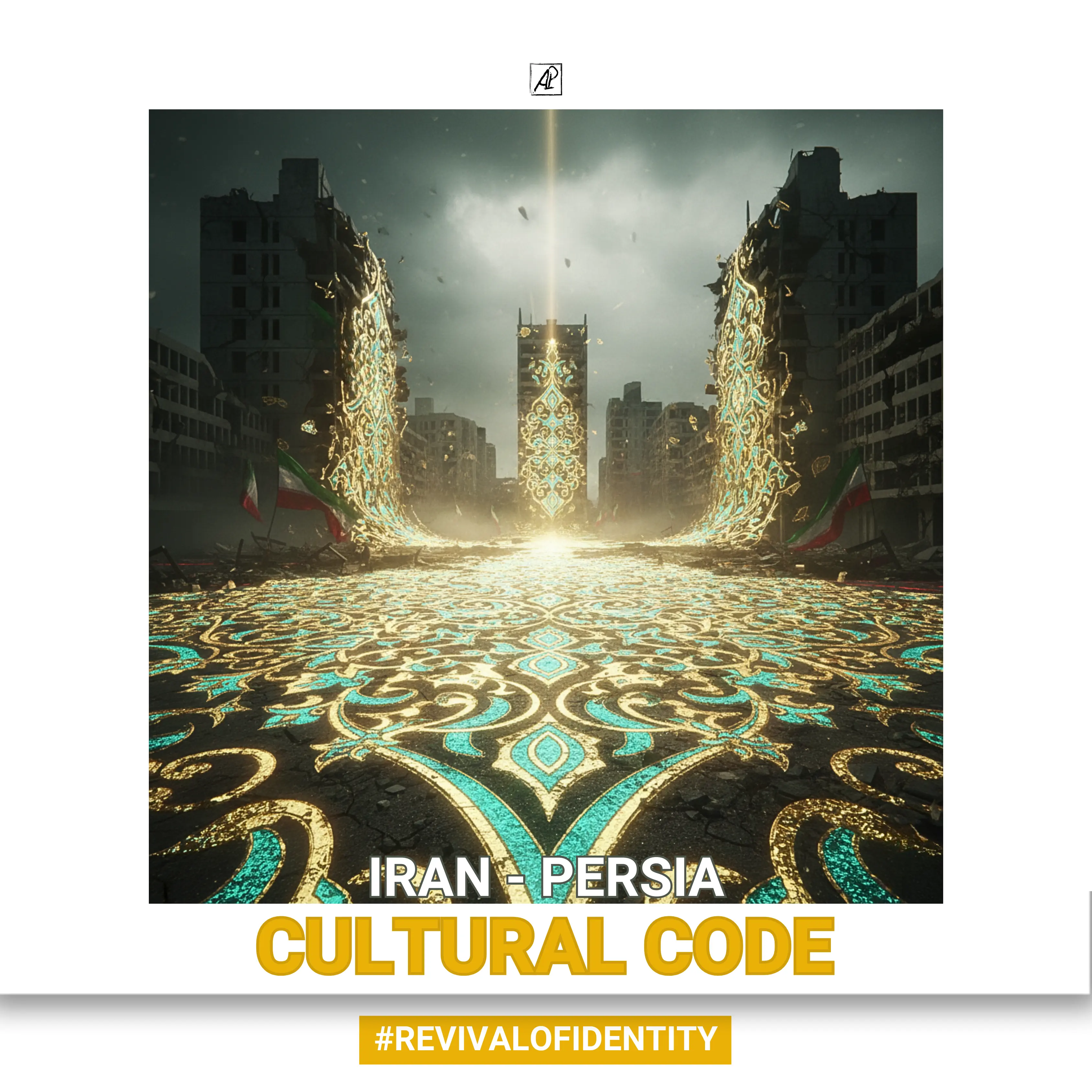
Through the grey concrete of the city walls, an intricate ornament begins to grow. Golden and turquoise lines fill the cracks, not breaking the structure, but stitching it from within.
This is our ornament. It is not just decoration—it is our secret writing, which we have preserved for centuries. In every knot of a carpet, in every pattern on ceramic, in every shape of an arch, our true selves were encoded. Tyranny tried to erase our faces, but it could not erase the pattern of our DNA.
Repressive systems operate through simplification. They erase complexity, ban everyday beauty, because it is within detail that memory survives. Ornament requires no permission — it lives in gestures, language, rhythms, in what cannot be confiscated.
When culture is recognized as structure, it stops being heritage and becomes armor. Ornament functions as a distributed system: it cannot be destroyed in one place, because it has no center. It regenerates wherever a crack appears.
In such a reality, dictatorship loses its tools. Primitive mechanisms of control cannot manage a complex fabric that continuously reproduces itself in new forms.
When you see this ornament filling the city space, you realize: we survived. We survived because our culture is more complex than their prohibitions. We are not just people living side by side; we are a single canvas where every thread holds another. We cannot be torn apart because we are interwoven by millennia of shared beauty. Feel this rhythm—it is the pulse of our freedom, written in eternity.
The human within this space feels calm. Not because danger has disappeared, but because support has emerged. Familiar lines are recognizable even among ruins — and that is enough to remain oneself.
They tried to erase us, but we were written into every pattern of our land.
📐 Systemic Solution Manifesto#
[GIVEN]:#
Ideological regimes always try to simplify the world into black-and-white slogans. Complex culture, centuries-old aesthetics, and traditions are perceived as a threat because they give individuals a sense of belonging to something greater than a party or religious dogma.
Facts: For decades, there was an attempt to “repaint” Persia in the monotonous colors of obedience. But in 2026, it became clear that the concrete walls of ideology could not stop the living flow of culture. The Persian ornament—a complex, mathematically perfect weave of lines—begins to grow through cracks in the urban landscape. This is not just decoration; it is an algorithm of survival. We capture the moment when aesthetics triumphs over dictatorship. The cultural code proves stronger than political orders because it permeates every detail of daily life—from architecture to the way of thinking.
[PARAMETERS OF ASYMMETRY]:#
- Complexity vs. Primitivity: The ornament is too complex to be controlled or censored.
- Flexibility vs. Rigidity: Concrete cracks, while the pattern finds its way, filling the voids.
- Continuity vs. Interruption: Every line of the ornament connects today with a millennia-old past, nullifying the regime’s attempts to “start history from scratch.”
[ANALYSIS]:#
“Cultural Code of Survival” is proof that the nation is not a hollow mass. It is a highly complex system of meanings. When the ornament returns to the city space, it restores the nation’s “immune system.” It is a soft power that makes the return of tyranny impossible, for a free aesthetic fosters a free perception of the world.
Key Phrase: “They tried to erase us, but we were written into every pattern of our land.”
[CONCLUSION]:#
The system restores its structure.
The cultural canvas is whole once again.
Now, on this strong foundation, new social and legal connections can be built.
Alt-text:
Persian ornament grows through concrete city walls, filling cracks with golden and turquoise lines.
✯ Extra Credit Problem (The Asterisk Problem). Iran – Persia: A Civilizational Transition.
VII. Revival of Identity. Cultural Code of Survival (Ornament). AP | Pivtorak.Studio. 27.01.2026
© Anna Pivtorak (Kostyuk)
🛡️ This publication is part of an authorial research and artistic project.
The material is based on the analysis of open sources and contains the author’s interpretations, metaphors, and conceptual models.
The described images and concepts may be allegorical in nature and do not constitute legal accusations or official conclusions regarding any individuals, organizations, or states.