⟡ Core Recalibration
The Anatomy of Rhythm. Duolingo Max as a Proving Ground for Strategic Thinking
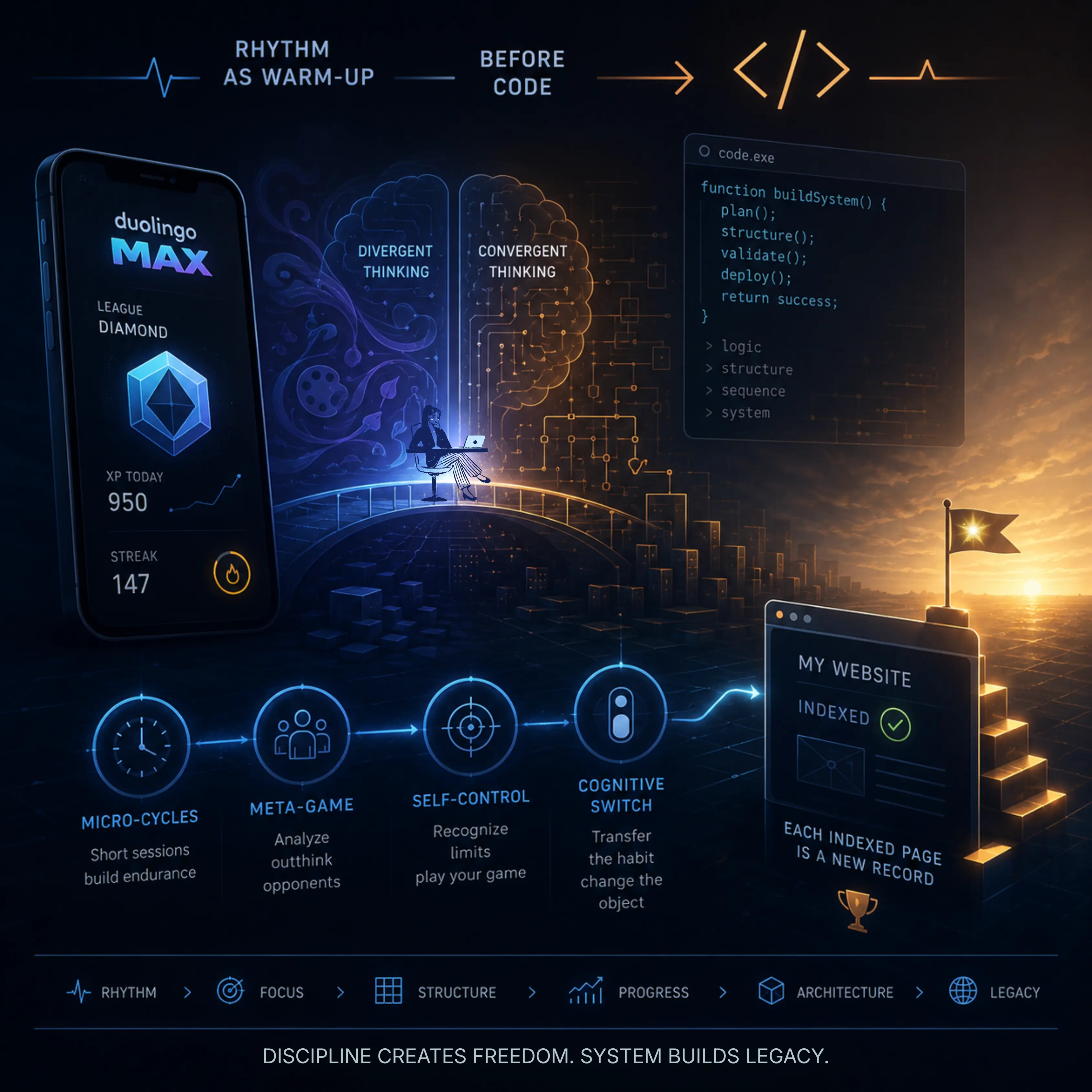
Rhythm as a warm-up before code
When we witness large-scale intellectual achievements — such as the launching of multiple digital platforms within a single week — it often appears to be the result of sudden inspiration or superhuman willpower. However, reality is structured differently. Any vertical ascent is preceded by a period of internal rhythm synchronization.
In my practice, Duolingo Max became that cognitive gym and proving ground for mental calibration. This experience proved to be significantly deeper than merely learning foreign languages; it acted as a bridge between two entirely different modes of brain operation.
Shifting Cognitive Environments: Creativity vs. Code
For a long time, while creating complex philosophical and symbolic art projects, I utilized divergent thinking (Divergent thinking). Creativity, by its very nature, operates in a regime of associations, emotional architecture, and non-linear connections. It allows for an intuitive chaos: the author can alter the structure mid-way, follow an impulse, or return to an idea months later. Art does not break from a single mistake — a mistake often becomes part of a unique style.
In contrast, launching websites and working with code demand convergent thinking (Convergent thinking). Code is an uncompromising logical engineering where strict syntactic dependencies, hierarchy, and cause-and-effect chains govern. Here, a single incorrect character is capable of paralyzing the entire system. Shifting from the pure generation of meanings to building a functional reality that must exist autonomously places a colossal load on the brain.
This is precisely where Duolingo Max performed the role of an ideal cognitive conduit.
A Language Platform as a Behavioral Simulator
For structured thinking, Duolingo Max became not a language app, but a personal cognitive simulator that trained the qualities essential for programming:
1. A Simulator for Microcycles and Game Neurochemistry.
Instead of long, exhausting sessions, the platform conditioned the brain to short, precise intervals, stable returns, and the accumulation of micro-progress. This developed a high tolerance for minor friction (tolerance for friction), which is critical during the monotonous process of debugging code.
2. Analyzing Competitors as a Meta-Game.
Competing in leagues, tracking opponents’ tactics, and optimizing reaction speed transformed the process into a testing ground for strategic planning. This enhanced the capacity to instantaneously evaluate the system’s position and scale efforts toward victory.
3. The Ecology of Self-Control.
Any gamified platform incorporates attention-retention algorithms, including nocturnal offers and bonuses. For a professional, however, this serves as an excellent practice: learning to recognize the rules of someone else’s game and exiting the system on one’s own sovereign terms, when the internal limit for the day has been reached.
The Core Cognitive Switch
Once the rhythm was honed to automation, a natural transition occurred. I simply redirected the habit of daily focus and regularity, formed within Duolingo Max, toward working with code.
I no longer needed to expend energy on building a routine or searching for motivation. The brain already knew how to enter a state of flow, how to sustain concentration, and how to derive dopamine from the pure fact of task completion. Only the object of the game changed. The routine of the application transformed into an architectural action, where each new “record” became every indexed page of my own website.
Duolingo Max provided clarity, speed, and structure. And from there, the real architecture began.
Alt-text:
A futuristic digital composition showing the transition from Duolingo Max learning rhythms into code architecture, systems thinking, and indexed websites.
The Anatomy of Rhythm. Duolingo Max as a Proving Ground for Strategic Thinking. AP | Pivtorak.Studio. 18.05.2026
© Anna Pivtorak (Kostyuk)