The Path in My Hands | Living Topography#
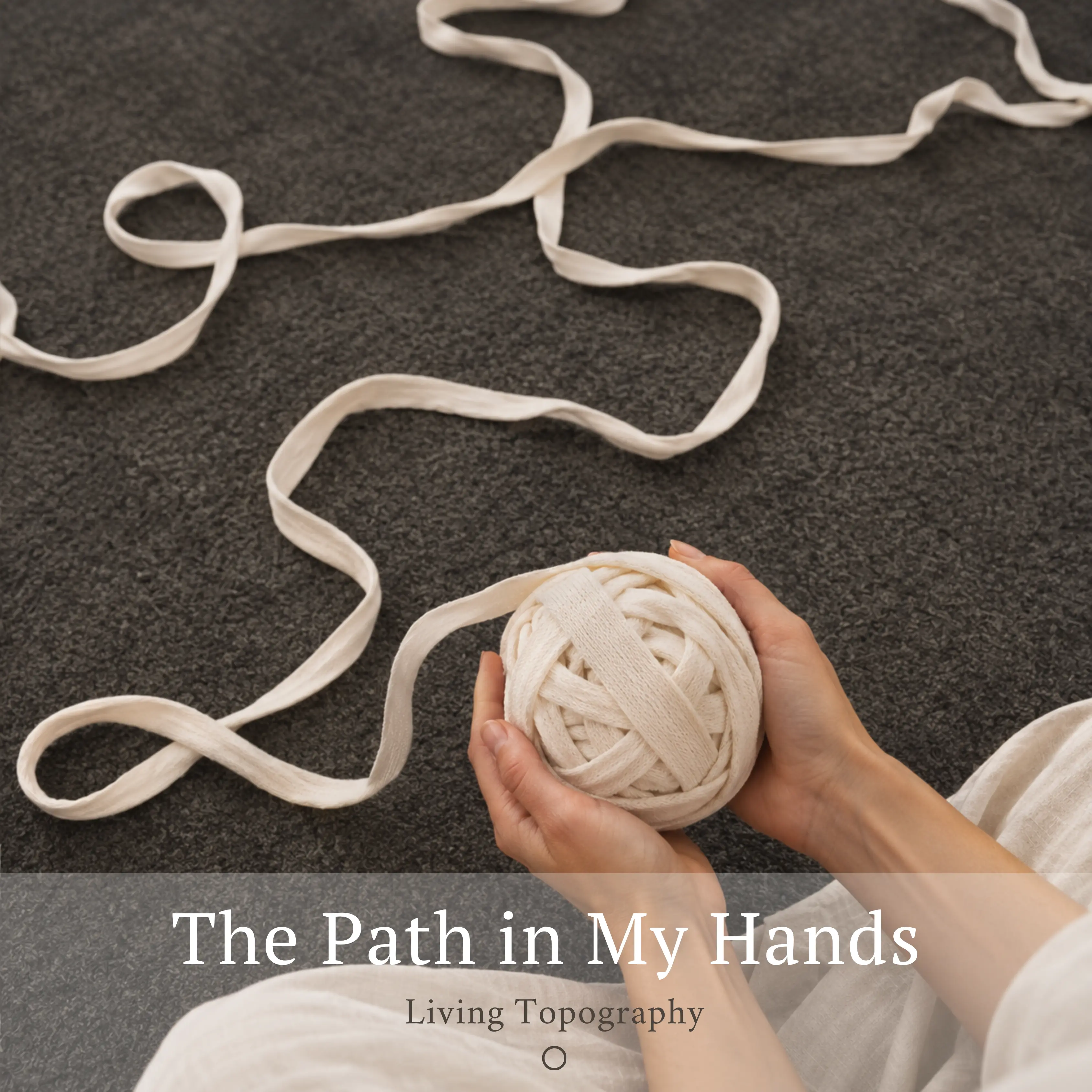
Sometimes a path is not something we simply follow. Sometimes we create it with our own hands — slowly, quickly, with loops, alongside someone else’s trajectory — until we reach a place we never even knew we were heading toward.
In this unexpected experience of a creative group, movement and spatial interaction become a gentle language of intercultural dialogue, where personal stories and shared presence quietly intertwine.
Sometimes the deepest transformative moments begin with a quiet movement, leading to an embodied experience that changes the way we perceive ourselves and the space around us.
The Invitation (I Almost Said No)#
It all began with a message. An invitation to join an intercultural theatre group organised as part of the agirE CLDS 5G project in Esposende — an initiative aimed at fostering intercultural dialogue, integration, and stronger community connections.
My first reaction was to step back. I’m not a theatre person. Playing a role on stage, performing in front of an audience — all of it felt unfamiliar and uncomfortable.
Instead of declining, I sent a short message to ask:
“A participação implica necessariamente atuar em palco, ou haverá também outras formas de participação?”
(Does participation necessarily involve performing on stage, or will there also be other ways to participate?)
The answer came quickly and warmly:
“Sim, há várias formas de participar. Será muito bem vinda para estar presente…”
(Yes, there are several ways to participate. You will be very welcome to join us…)
That simple reassurance changed everything. No pressure to perform. Just an open door to explore.
The Room, the Grey Carpet, and the White Strip#
The venue for our first meeting was the Centro de Informação Turística. When I walked in, the atmosphere felt surprisingly warm and grounding.
The facilitator explained the main rules of our shared space:
- Participate only in what feels comfortable.
- No one judges anyone; everyone’s personal boundaries are respected.
- Every decision — to take part or to step back — is completely voluntary.
There was a large grey carpet on the floor. We were invited to take off our shoes if we wished, so that we could feel at home. At first, I kept mine on. But five minutes later, I took them off. Sitting barefoot on the carpet simply felt more comfortable.
Each of us was given a ball of white knitted fabric — soft, pleasant to the touch, and flexible. And in the centre was an equally large grey ball of fabric.
Creating the Path#
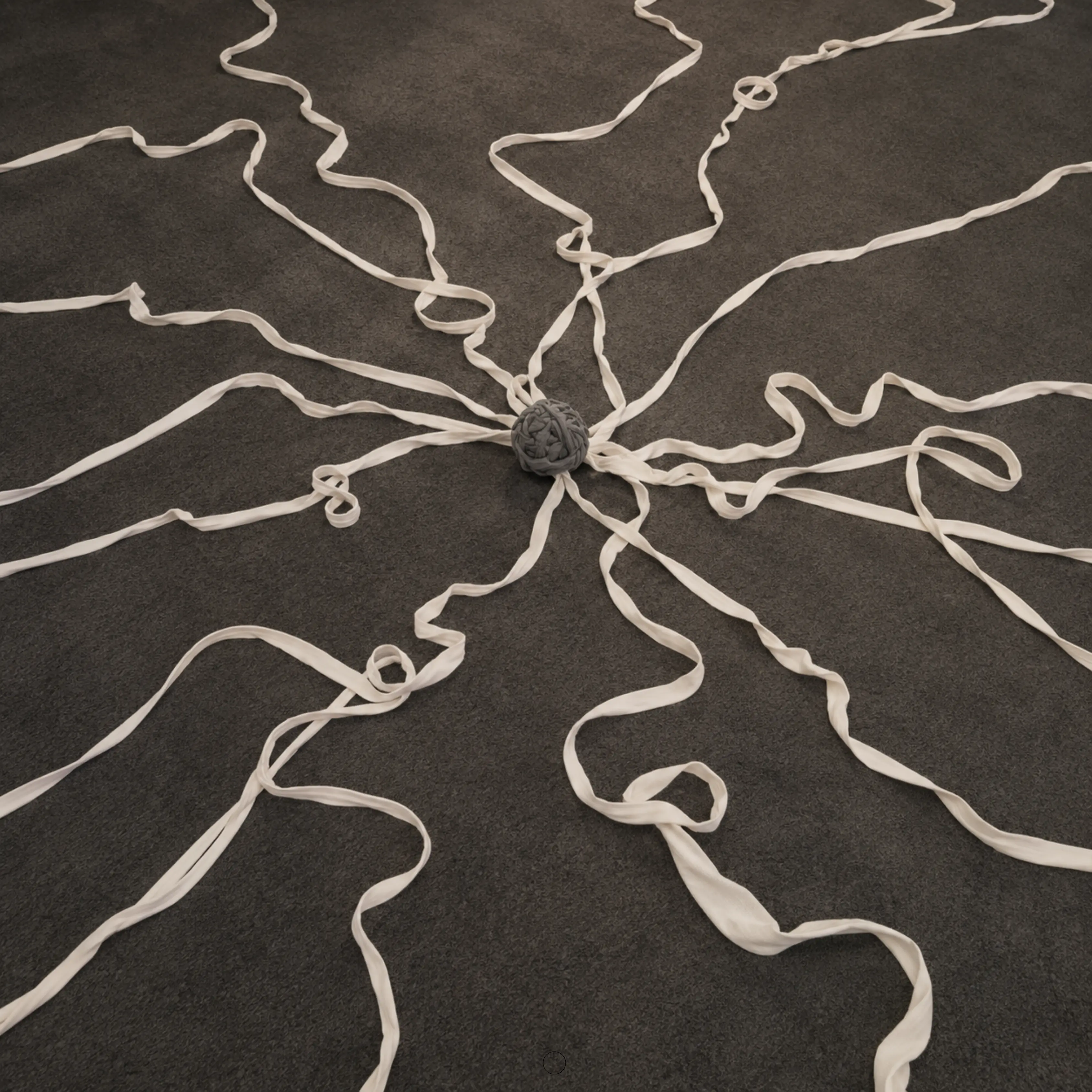
The music began, and with it came the first task: to unwind our white strips across the floor, creating our own paths from where we were sitting towards the central grey ball.
The children who were in the room with their parents naturally joined the game from the very beginning.
The rhythm of this creation was very alive:
- We began slowly, carefully laying the fabric across the grey surface.
- Then, feeling the impulse, the pace accelerated.
- The music continued without stopping, inviting us to explore direction rather than speed.
Curves began to appear. Sideways movements, unexpected deviations, and gentle loops started to shape the pattern. Our white lines wound their way across the floor, creating different trajectories — some almost independent and restrained, others marked by loops, crossings, and unexpected incursions into another path’s territory. Each person was creating their own topography.
We changed the pace again as the music approached its end, and eventually we all reached the central grey ball at the same time, becoming still in a quiet pause as the final notes faded away.
Walking the Path and When Paths Meet#
Creating the topography was only the beginning; next, we had to physically experience it with our feet.
At the facilitator’s direction, we began walking along our paths. First, along our own white line. Then, on a signal, we moved onto another person’s caminho, entering their spatial logic, before returning to our own path and then stepping onto someone else’s again.
This movement-based interaction transformed individual routes into a shared field.
As we moved freely around the room, simple gestures began to bridge the distance between strangers:
- A warm handshake on a particular count.
- Spontaneous hugs.
- Waving to one another.
- A joyful reaction as if we had just met an old friend after twenty years apart.
Then came an exercise in personal introduction.
Each person said their name while making a particular movement — for example, a blooming flower, a turn, or a wave.
When my turn came, I introduced myself with a light, deliberate curtsy (reverence).
A moment later, in a remarkable act of collective mirroring, the whole group repeated my movement at the same time, recreating the curtsy in unison. Being seen, mirrored, and supported by a group of strangers turned out to be an unexpectedly moving experience.
The Stories We Share#
We gathered on the carpet again. The facilitator opened the circle to anyone who wanted to share something about their journey.
Participants shared fragments of their real-life journeys. Someone spoke about arriving from Venezuela; someone else shared the story of leaving Syria por causa da guerra.
Someone chose not to speak. And that silence was completely accepted and supported.
Speaking was an option; remaining silent was an equally valid choice. In an intercultural encounter, listening and presence are themselves a form of storytelling.
The Body Becomes a Group#
As the session continued, individual movement grew into a collective choreography.
We paired up, moving around the room as a single synchronised organism. Soon, two pairs merged into a group of four; then four expanded into six, until the entire group was moving together in complete coordination.
The Path in My Hands#
For the final exercise, we sat down on the carpet again. The music was just as gentle.
We were invited to wind our white strips back up, retracing our paths from the central ball towards ourselves.
As I wound the soft material into a compact ball, I was overcome by a remarkable feeling. The path was no longer spread across the floor. It was no longer a line leading into the unknown. It was complete, whole, and resting quietly in my palms.
Holding this physical symbol of the journey I had made felt like a moment of deep integration.
You carry your story with you; it does not scatter or disappear.
What I Didn’t Expect#
An hour and a half passed like a single breath.
I had arrived with some apprehension, expecting traditional theatre rules. Instead, I discovered a space for movement, observation, subtle play, and an organic connection between people.
At the end of the evening, as we sat together on the carpet, everyone expressed the same thought: we want to come back again.
Our next meeting will take place at Escola Henrique Medina, continuing this travelling journey through different corners of Esposende.
And honestly, feeling such a genuine level of involvement, I wouldn’t be surprised if one day we actually started performing on stage together.
Closing Thought#
Perhaps this is what living topography really is: not a static map of the places where we have lived, but a living record of human encounters.
In any genuine intercultural community, we arrive with our own path. We walk alongside someone, change our pace, adjust our direction, and meet one another without losing ourselves.
And when the music fades, we realise that we do not leave our path behind — we simply hold it in our own hands, ready for the next encounter.
P.S.#
I am sitting barefoot on the carpet. In my hands is a rolled-up white strip — my trail. Just a moment ago, it stretched across the room, creating a trajectory and changing its pace with the music.
Now it is back in my hands.
And the most remarkable feeling is not where this path was leading, but the fact that I can hold it, touch it, and carry it with me wherever I go.
Alt-text:
Hands holding a white fabric path over a dark grey carpet.
Living Topography. The Path in My Hands. AP | Pivtorak.Studio. 01.10.2026
© Anna Pivtorak (Kostyuk)