Knowledge Base#
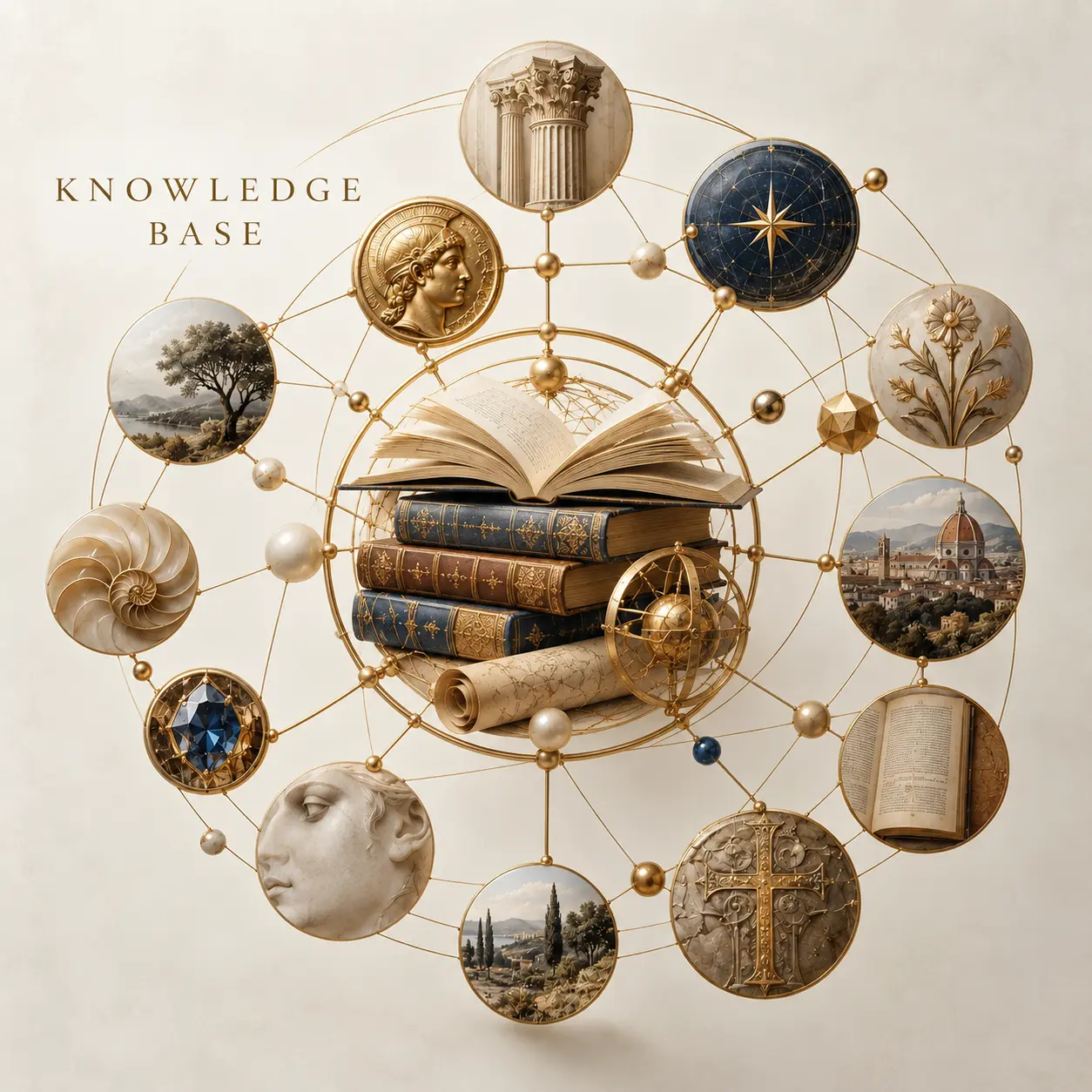
The Knowledge Base is a structured collection of knowledge developed within Pivtorak.Studio.
It brings together observations, research, essays, concepts, objects, documents, references, and other materials that contribute to the development of the Studio’s knowledge system.
The Knowledge Base is not intended to be a simple archive.
Its purpose is to make knowledge accessible, understandable, reusable, and connected.
How the Knowledge Base Develops#
Knowledge may begin with an observation, a question, a discovered object, a document, a historical fact, or an unexpected connection.
Some materials may develop into essays.
Others may become references, definitions, research notes, visual materials, or entries within a larger conceptual structure.
Over time, these materials form a growing body of knowledge.
The Knowledge Base therefore develops continuously rather than being completed as a fixed catalogue.
Structure#
The Knowledge Base may contain different types of information:
- concepts and definitions;
- research notes;
- essays and analytical texts;
- historical information;
- objects and artefacts;
- people and places;
- materials and techniques;
- symbols and cultural references;
- documents and sources;
- collections;
- visual materials;
- methodological observations;
- market and cultural context.
Different types of material may coexist within the same system because knowledge rarely belongs to only one category.
From Information to Knowledge#
Information becomes more useful when it is placed into context.
A historical fact may explain an object.
An object may provide evidence for a broader cultural practice.
A technique may reveal something about a period, a region, or a community.
A document may change the interpretation of an existing observation.
The Knowledge Base records these elements so that they can be examined again, compared with other materials, and connected to new research.
Knowledge and Relationships#
The Knowledge Base and the Knowledge Graph are closely related, but they serve different purposes.
The Knowledge Base contains the materials and knowledge developed through research.
The Knowledge Graph makes relationships between these elements visible.
A single essay may therefore become a node within a larger network of ideas.
A document may provide evidence for several subjects.
An object may connect historical, material, symbolic, cultural, and economic contexts.
The two structures develop together.
A Living System#
The Knowledge Base is designed as a living system.
Existing materials may be revised when new information becomes available.
Earlier observations may acquire new meaning when connected with other research.
New discoveries may lead to new questions rather than immediate conclusions.
This allows the Knowledge Base to preserve not only established knowledge, but also the process through which knowledge develops.
Purpose#
The purpose of the Pivtorak.Studio Knowledge Base is to create a durable environment for collecting, developing, organizing, and connecting knowledge.
It provides a foundation for research while allowing individual observations, objects, documents, and ideas to become part of a larger intellectual structure.
Knowledge is not only collected.
It is developed, connected, revisited, and transformed through research.
Alt-text:
Knowledge Base — structured and interconnected system of knowledge.
Knowledge Base. AP | Pivtorak.Studio. 06.10.2026
© Anna Pivtorak (Kostyuk)