👨⚖️ Author’s Declaration
This publication is part of an authorial research and artistic project created by an Independent Researcher and Creator (Analyst-Artist).
The material is based on the analysis of open sources and reflects the author’s personal research perspective.
Metaphors, imagery, symbols, and conceptual models may have an allegorical character and are used as tools of philosophical and systemic analysis.
This material is not a legal accusation, a journalistic investigation, or an official conclusion of any institution.
📋 Methodological Note
This series is an exercise in civilizational modeling.
The use of the present tense does not indicate an existing political reality, a prediction, or a factual statement.
The texts describe desirable systemic configurations and ethical horizons toward which societies may consciously choose to move.
The works function as architectural blueprints for possible futures rather than as descriptions of current events.
The purpose of the project is not to predict history, but to design coherent models of civilization that may serve as long-term reference systems for public reflection, institutional design, and human agency.
Every work in this series should therefore be understood simultaneously as a manifesto, a systems design exercise, and a civilizational hypothesis.
✯ Extra Credit Problem (The Asterisk Problem)
Iran – Persia: A Civilizational Transition
From the Dismantling of a Regime to the Revival of Civilization
IV. Vulnerability Point. Informational Fragility#
🔔 Ethical Resonance#
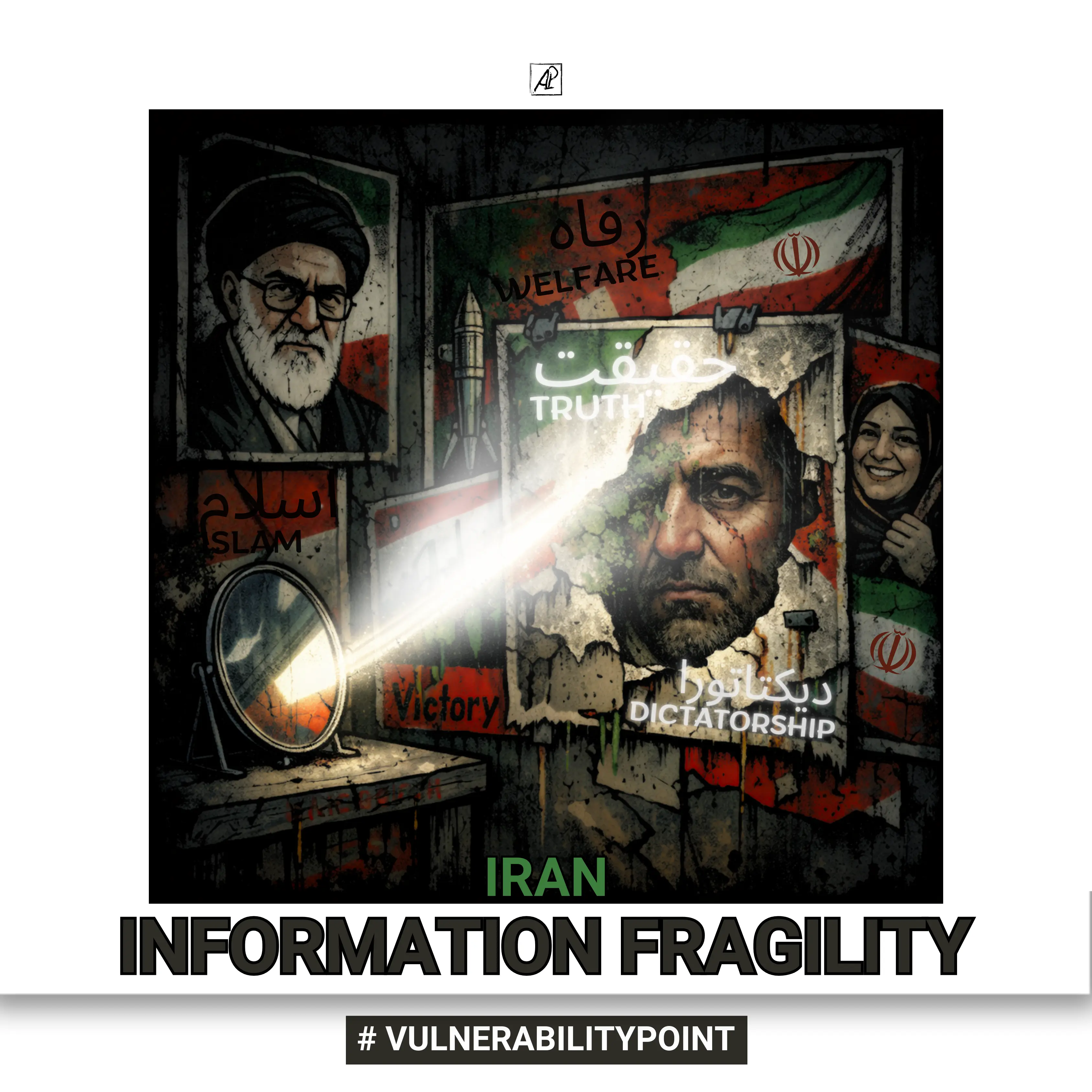
A dark room is completely covered with ideological posters. The surface is smooth, the paint is fresh, the faces are smiling and identical. In one corner, a small mirror accidentally catches a ray of sunlight and reflects it onto the wall.
The light spot moves slowly. Where it touches the poster, the paint fades. Mold appears beneath the paper, rusty nails become visible, the edges begin to peel. The mask of joy slips away, revealing the tired face of a neighbor — the one that was replaced by a perfect image.
The regime’s information system is built as a closed loop. It does not require truth — only repetition. Vast resources are spent not on persuasion, but on eliminating comparison. Any external light is dangerous because it does not argue with the narrative; it measures its deviation from the norm.
When even a small mirror of reality appears — a satellite signal, a banned video, a foreign experience — the system does not collapse instantly. It begins to lose coherence. Control over perception weakens because the norm can no longer remain singular.
The human inside this room makes no choice. They simply see. Inside, a brief silence appears — a pause where fear gives way to clarity.
At this point comes the understanding of the norm. Truth requires no effort to be the truth; effort is only required to hide it. When thousands of people pull out their mirrors simultaneously, the dark hall ceases to be a prison. It becomes just a room that needs cleaning.
Truth does not persuade; it simply illuminates reality.
📐 Systemic Solution Manifesto#
[GIVEN]:#
The criminal regime spends billions creating an alternative reality through state media and censorship. The entire public square is covered with ideological dogma posters.
Facts: In January 2026, we see that Iran’s informational veil has become too thin. When a citizen sees “prosperity” on TV, but in the mirror sees their exhausted face and an empty refrigerator, propaganda stops working. The monopoly on information lasts only as long as there is nothing to compare it to. Today, every private video, every honest post, is a small mirror reflecting a ray of real light onto the regime’s fake scenery.
[PARAMETERS OF ASYMMETRY]:#
- Searchlight vs. Sunbeam: The regime uses giant propaganda searchlights, but they are blinded by one small mirror of truth.
- Complexity vs. Simplicity: Lies require complex constructs and constant maintenance; truth simply exists.
- Mass vs. Quality: Millions of bots cannot outweigh a single fact confirmed by thousands of witnesses.
[АНАЛІЗ]:#
“Informational Fragility” is the diagnosis of a system whose architecture fears comparison. Dictatorship demands not just faith, but the rejection of one’s own eyes. But the light of truth has a way of penetrating the smallest cracks. When the mirror illuminates the shabby corners of “greatness,” fear turns into disgust, and obedience into solidarity.
Key Phrase: “Truth does not persuade; it simply illuminates reality.”
[CONCLUSION]:#
The informational monopoly is dead.
We are recording the moment when the sum of small mirrors in the hands of the people creates a flood of light that the ideological facade cannot withstand.
The light reveals cracks that can no longer be covered with posters.
Alt-text:
A dark room with walls fully covered in ideological posters. A small mirror reflects a ray of sunlight onto a poster. Where the light hits, the paint fades, revealing mold, rusty nails, and a tired human face beneath the paper.
✯ Extra Credit Problem (The Asterisk Problem). Iran – Persia: A Civilizational Transition.
IV. Vulnerability Point. Informational Fragility. AP | Pivtorak.Studio. 22.01.2026
© Anna Pivtorak (Kostyuk)
🛡️ This publication is part of an authorial research and artistic project.
The material is based on the analysis of open sources and contains the author’s interpretations, metaphors, and conceptual models.
The described images and concepts may be allegorical in nature and do not constitute legal accusations or official conclusions regarding any individuals, organizations, or states.