Kovtyukh “Continuity Under Renunciation”#
Some figures do not form a system. They preserve the possibility of its existence.
This section is dedicated to Epifan Kovtyukh — a figure whose actions became decisive for the survival of a lineage.
Historical figure#
Epifan Kovtyukh (1890–1938)
A corps commander, participant of World War I and the Russian Civil War.
He rose from staff-captain of the Imperial Army to a respected commander in the Red Army.
He was known as:
- a skilled strategist
- a fair commander
- a person devoted to duty
In 1938, during the Great Terror, he was arrested and executed on false charges.
In 1956, he was posthumously rehabilitated.
Family dimension#
Within the family, his meaning is defined differently:
he remains the one
who saved the lineage but could not save himself.
His name is passed from generation to generation
as a form of preserving this event.
Literary reflection#
In 1924, Alexander Serafimovich wrote “The Iron Flood”.
The main character — commander Kozhukh — was based on a real person.
That person was Epifan Kovtyukh.
Thus, his figure exists both in history
and in literary form.
Meaning#
This is not only memory.
It is a point where the continuity of existence is preserved.
This section is part of the process of restoring the name
and fixing its place in both family and broader history.
Alt-text:
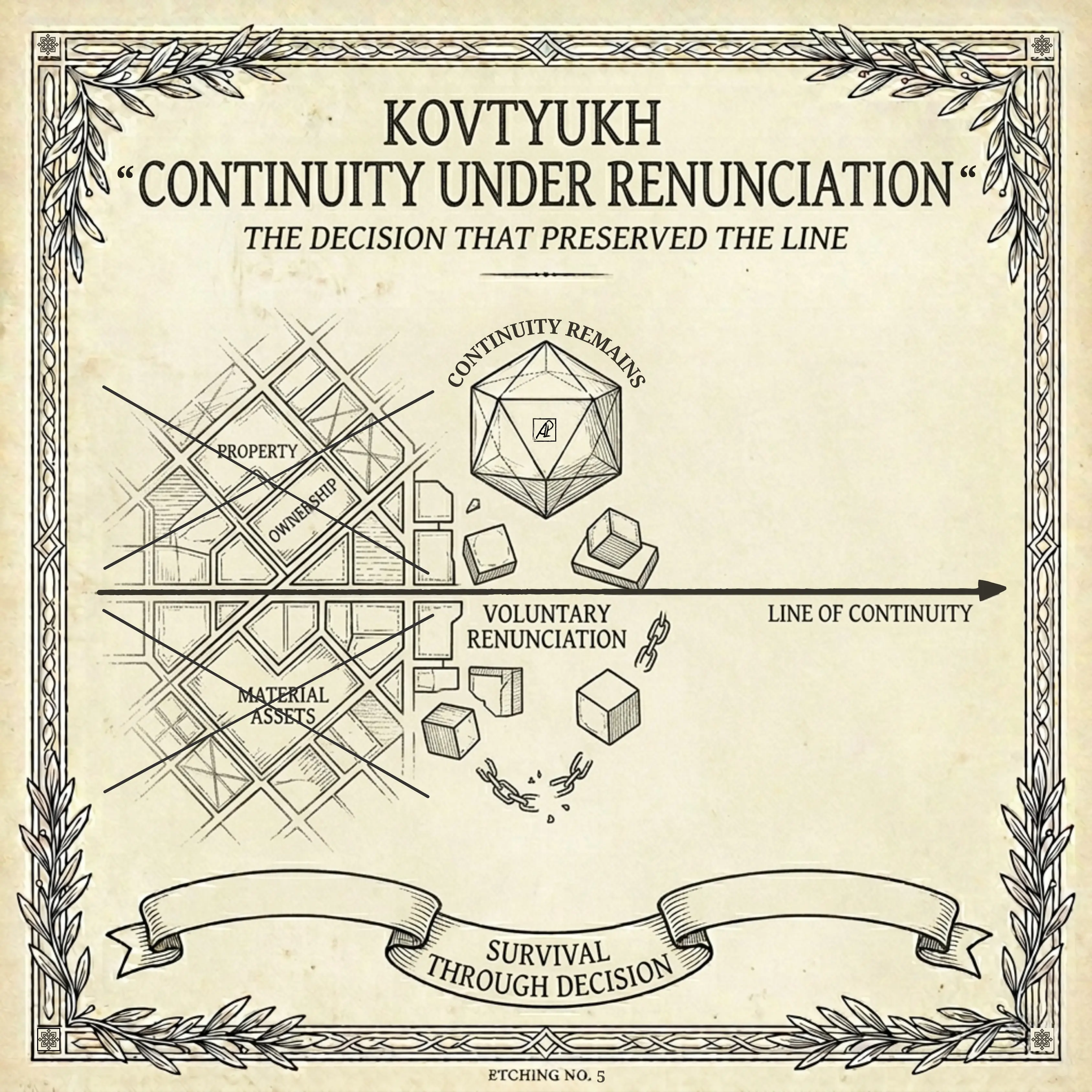
To visualize Kovtyukh’s role, an abstract composition is used to represent a critical decision that preserved the continuity of a lineage.
At the center is a map or structural layout of resources, where parts are crossed out, removed, or erased. This symbolizes the voluntary renunciation of property as a condition for survival.
A thin but continuous line runs through the composition, representing lineage continuity. It remains unbroken despite the loss of material foundation.
The image does not focus on a person, but on the decision itself — an action that altered the trajectory and prevented the system from disappearing.
It marks a point where renunciation became the condition for existence.