Knowledge Graph#
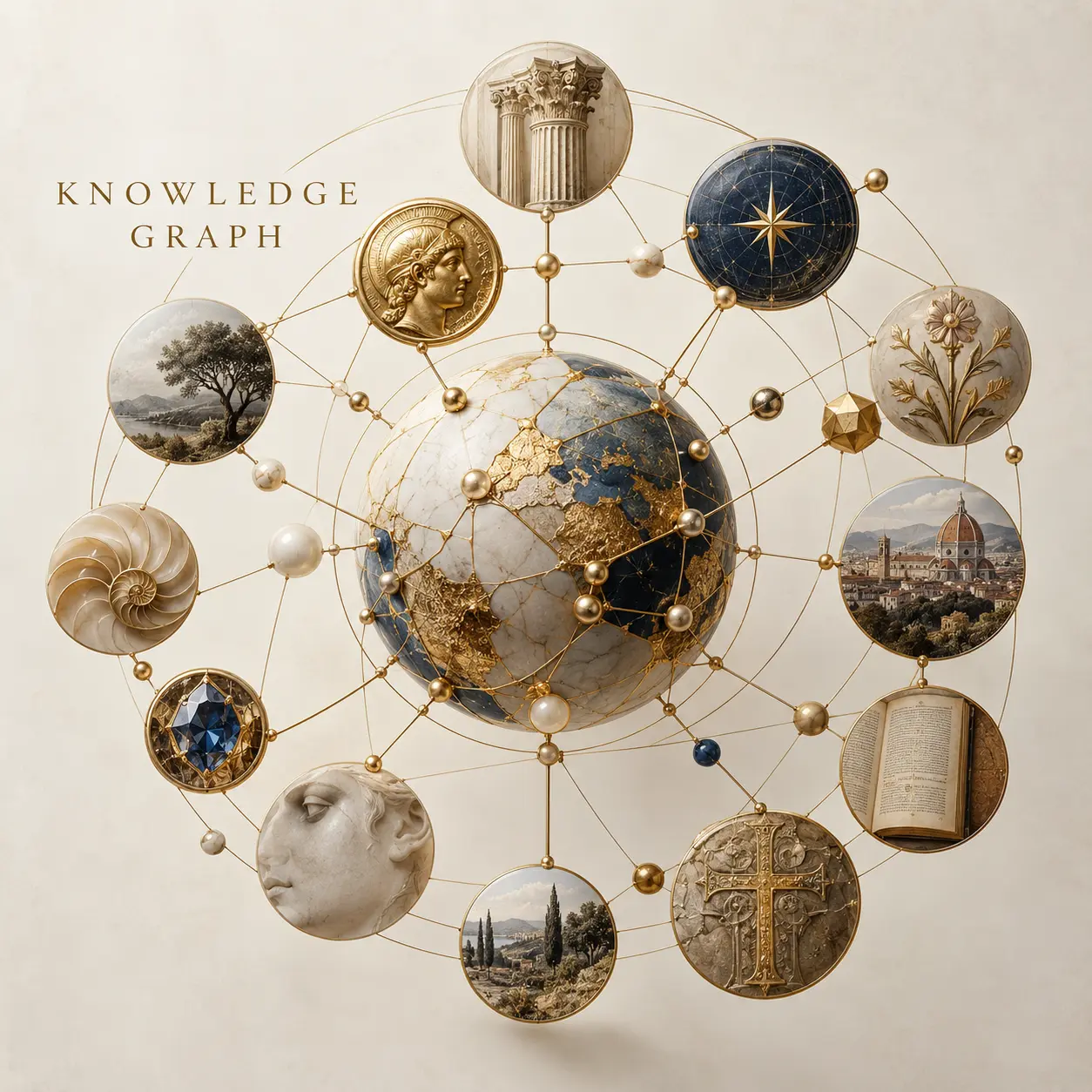
A Knowledge Graph is a system for representing relationships between ideas, objects, concepts, fields of knowledge, people, events, symbols, and contexts.
Within Pivtorak.Studio, the Knowledge Graph is not conceived as a static catalogue. It is an evolving structure of connections.
An individual idea rarely exists in isolation. Its meaning becomes clearer through its relationships with other ideas, disciplines, objects, historical contexts, cultural practices, and forms of value.
How the Graph Forms#
The Knowledge Graph begins with a question, observation, concept, or unexpected connection.
A thought may lead to an object.
An object may lead to a historical context.
A historical context may reveal a symbolic system.
A symbol may connect different disciplines.
A connection may reveal a new interpretation.
The resulting relationship becomes part of the graph.
In this sense, the graph is formed not only by collecting information, but by identifying meaningful relationships between elements that might otherwise be considered separately.
Nodes and Connections#
Each significant element may function as a node:
- an object;
- a person;
- a concept;
- a material;
- a technique;
- a symbol;
- a historical period;
- a place;
- an event;
- a discipline;
- a document;
- a collection;
- a form of cultural or market value.
The connections between these nodes may be equally important.
A relationship may be historical, material, symbolic, cultural, intellectual, methodological, economic, or contextual.
The purpose is not to create connections for their own sake, but to reveal relationships that contribute to understanding.
From Observation to Interpretation#
A Knowledge Graph allows an observation to develop into a broader structure of meaning.
For example, a piece of jewelry may initially be considered a material object. Further examination may connect it with craftsmanship, identity, symbolism, religion, social status, provenance, memory, art, and market value.
The object remains the same.
The context surrounding it becomes richer.
This expansion of context can change how an object is understood, documented, attributed, interpreted, and valued.
Cross-Disciplinary Connections#
The Knowledge Graph does not require knowledge to remain within disciplinary boundaries.
Jewelry may connect with numismatics.
Numismatics may connect with political power, iconography, history, and economics.
Iconography may connect with theology.
Fine art may connect with materials, techniques, patronage, provenance, and cultural memory.
These intersections are not secondary to the research. They may reveal relationships that are invisible when each field is examined separately.
The Role of Essays#
A Knowledge Graph can be expressed through essays.
An essay may begin with a single question or observation and develop a chain of related concepts.
The essay does not have to provide a final answer to every question. Its role may be to clarify a relationship, formulate an interpretation, document an observation, or establish a new conceptual connection.
Each meaningful connection can become another point in the larger structure.
Knowledge as a Network#
The Knowledge Graph therefore treats knowledge as a network rather than a linear collection of facts.
A page may lead to another page not because both belong to the same category, but because they illuminate one another.
The resulting structure is cumulative.
Each new relationship can increase the interpretive density of the existing system.
Purpose#
The purpose of the Pivtorak.Studio Knowledge Graph is to make meaningful relationships visible.
It provides a space where objects, ideas, disciplines, symbols, contexts, and forms of value can be examined not only individually, but through the relationships that connect them.
Knowledge is not only what is known.
It is also the structure of relationships through which meaning becomes visible.
Alt-text:
Knowledge Graph — interconnected structure of ideas, objects, disciplines, symbols, and contexts.
Knowledge Graph. AP | Pivtorak.Studio. 05.10.2026
© Anna Pivtorak (Kostyuk)