👨⚖️ Author’s Declaration
This publication is part of an authorial research and artistic project created by an Independent Researcher and Creator (Analyst-Artist).
The material is based on the analysis of open sources and reflects the author’s personal research perspective.
Metaphors, imagery, symbols, and conceptual models may have an allegorical character and are used as tools of philosophical and systemic analysis.
This material is not a legal accusation, a journalistic investigation, or an official conclusion of any institution.
📋 Methodological Note
This series is an exercise in civilizational modeling.
The use of the present tense does not indicate an existing political reality, a prediction, or a factual statement.
The texts describe desirable systemic configurations and ethical horizons toward which societies may consciously choose to move.
The works function as architectural blueprints for possible futures rather than as descriptions of current events.
The purpose of the project is not to predict history, but to design coherent models of civilization that may serve as long-term reference systems for public reflection, institutional design, and human agency.
Every work in this series should therefore be understood simultaneously as a manifesto, a systems design exercise, and a civilizational hypothesis.
✯ Extra Credit Problem (The Asterisk Problem)
Iran – Persia: A Civilizational Transition
From the Dismantling of a Regime to the Revival of Civilization
II. AfterTragedy. The Illusion of a Game#
🔔 Ethical Resonance#
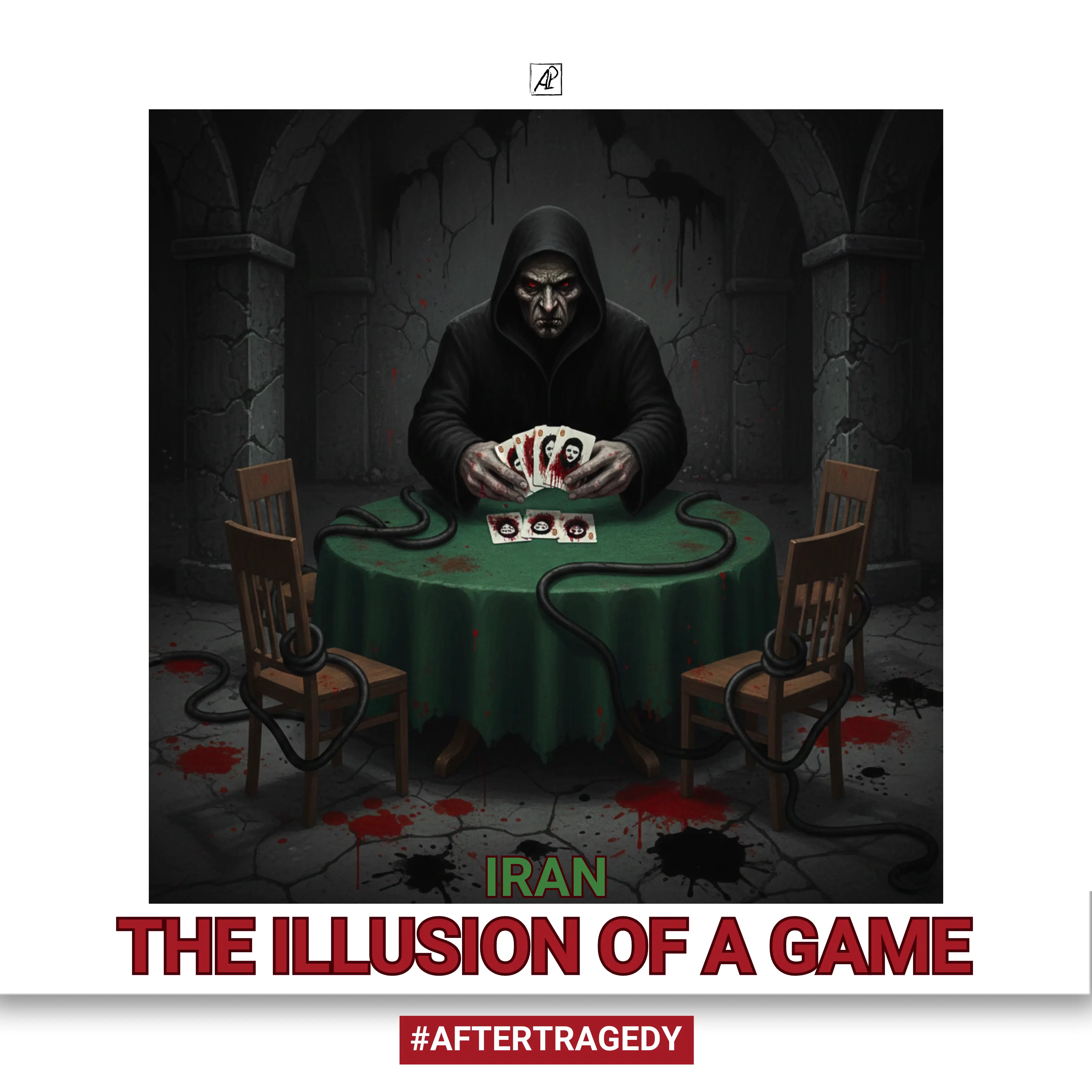
At a table covered in green cloth, a carefully devised imitation unfolds. Cards are dealt on time, protocols are followed, and the silence in the hall mimics respect. There are no suits — only red fingerprints and the faces of those who are gone. A black microphone cable coils around the table and chairs, tightening into a noose.
The system demands that people believe this is a game that can be won by following the rules. But the rules are ornamental. The outcome is determined by force, not law. The cards are never shuffled — they are arranged in advance, and every round ends the same. The table is not a place of negotiation but an instrument of execution: to sit is to accept a script with no exit.
This is not a competition of ideas; it is a ritual of legitimizing murder. Every “procedure” is just a step in a script written long before it began. The true tragedy is not that the cards are marked, but that the table itself is an instrument of execution.
Inside this illusion, a person feels a paralyzing pause. It is the state of a sensor that sees not the movement of cards, but the mechanism of a trap slowly closing around everyone who dared to sit at the table.
A human recognizes it too late. Silence becomes transparent, fear precise, clarity cold: when rules do not restrain power, the game is only a mask for crime.
This is not a game; it is a script for execution.
📐 Systemic Solution Manifesto#
[GIVEN]:#
Iran’s criminal regime requires the illusion of a “process.” It is vital for them that the world sees elections, parliamentary sessions, and legal debates. This creates a smoke screen behind which torture and executions are hidden.
Facts: Every “player” in Iran’s political field undergoes IRGC censorship. The executioner deals the cards, the murderer writes the rules, and any attempt to play fairly ends in a noose. This is not political competition — it is a spectacle to legitimize violence.
[PARAMETERS OF ASYMMETRY]:#
- Rules vs. Force: Citizens and observers are expected to follow procedures, while the regime reserves the right to override any outcome through coercion.
- Participation vs. Control: Society enters the process believing participation influences results; the regime enters knowing the results are predetermined.
- Transparency vs. Script: Democratic systems rely on uncertainty and open competition; the regime relies on scripted outcomes disguised as public choice.
- Consent vs. Submission: The public is invited to interpret obedience as participation, transforming compliance into a substitute for legitimacy.
[ANALYSIS]:#
“The Illusion of a Game” is the moment we peek behind the scenes. We see that the table is a scaffold, and the cards are lists of the condemned. The regime does not seek dialogue; it seeks submission masked as consent. When we call this “politics,” we become part of their lie. The exposure lies in calling things by their true names: this is not a negotiation table, but a machine for processing lives into power.
Key Phrase: “This is not a game; it is a script for execution.”
[CONCLUSION]:#
Documenting systemic fraud is the first step toward destroying its power.
When the world stops perceiving tyranny as a “partner in the game,” tyranny loses its primary defense — its diplomatic mask.
The next step is to admit that they are not negotiating with the cheater, they are isolating him.
Alt-text:
Grotesque scene: the hands of a dictator/executioner deal cards bearing red fingerprints and faces of murdered opponents. A black microphone cable wraps the table and forms a noose around the chairs.
✯ Extra Credit Problem (The Asterisk Problem). Iran – Persia: A Civilizational Transition. II. AfterTragedy. The Illusion of a Game. AP | Pivtorak.Studio. 19.01.2026
© Anna Pivtorak (Kostyuk)
🛡️ This publication is part of an authorial research and artistic project.
The material is based on the analysis of open sources and contains the author’s interpretations, metaphors, and conceptual models.
The described images and concepts may be allegorical in nature and do not constitute legal accusations or official conclusions regarding any individuals, organizations, or states.