👨⚖️ Author’s Declaration
This publication is part of an authorial research and artistic project created by an Independent Researcher and Creator (Analyst-Artist). The material is based on the analysis of open sources and reflects the author’s personal research perspective. Metaphors, imagery, symbols, and conceptual models may have an allegorical character and are used as tools of philosophical and systemic analysis. This material is not a legal accusation, a journalistic investigation, or an official conclusion of any institution.
📋 Methodological Note
This series is an exercise in civilizational modeling.
The use of the present tense does not indicate an existing political reality, a prediction, or a factual statement.
The texts describe desirable systemic configurations and ethical horizons toward which societies may consciously choose to move.
The works function as architectural blueprints for possible futures rather than as descriptions of current events.
The purpose of the project is not to predict history, but to design coherent models of civilization that may serve as long-term reference systems for public reflection, institutional design, and human agency.
Every work in this series should therefore be understood simultaneously as a manifesto, a systems design exercise, and a civilizational hypothesis.
✯ Extra Credit Problem (The Asterisk Problem)
IRAN – PERSIA: A CIVILIZATIONAL TRANSITION#
From the Dismantling of a Regime to the Revival of Civilization
This series is part of ✯ Extra Credit Problem (The Asterisk Problem) — a research project dedicated to systemic crises that cannot be resolved through conventional political, military, or economic tools.
Iran became the first civilizational case within this framework.
The purpose of the series is not to analyze individual politicians, parties, or events. Instead, it examines the deeper mechanisms that allow regimes to survive, reproduce themselves, and maintain control even after losing moral legitimacy.
The research is structured as a sequence of 30 interconnected works that move from documenting tragedy toward constructing a vision of the future.
Each work consists of two layers:
🔔 Ethical Resonance — an artistic-philosophical image that reveals the phenomenon through symbolism, structure, and human experience.
📐 Systemic Solution Manifesto — an analytical protocol that formulates the problem as a systemic challenge and proposes a pathway toward resolution.
Together, these layers create a bridge between emotional perception and systemic thinking.
The series is organized into nine cycles:
I. Tragedy
II. After Tragedy
III. System Diagnosis
IV. Point of Vulnerability
V. Protest Environment
VI. Desacralization of Fear
VII. Revival of Identity
VIII. Point of Transition
IX. Persia 2.0: Global Dimension
The focus gradually shifts from the regime to society, from society to civilization, and from civilization to the individual.
The final destination of the research is neither the state, nor a political system, nor a historical symbol.
The final destination is the human being as a subject.
This is why the series carries a dual name.
Iran represents the problem.
Persia represents the potential.
Between them lies a civilizational transition.
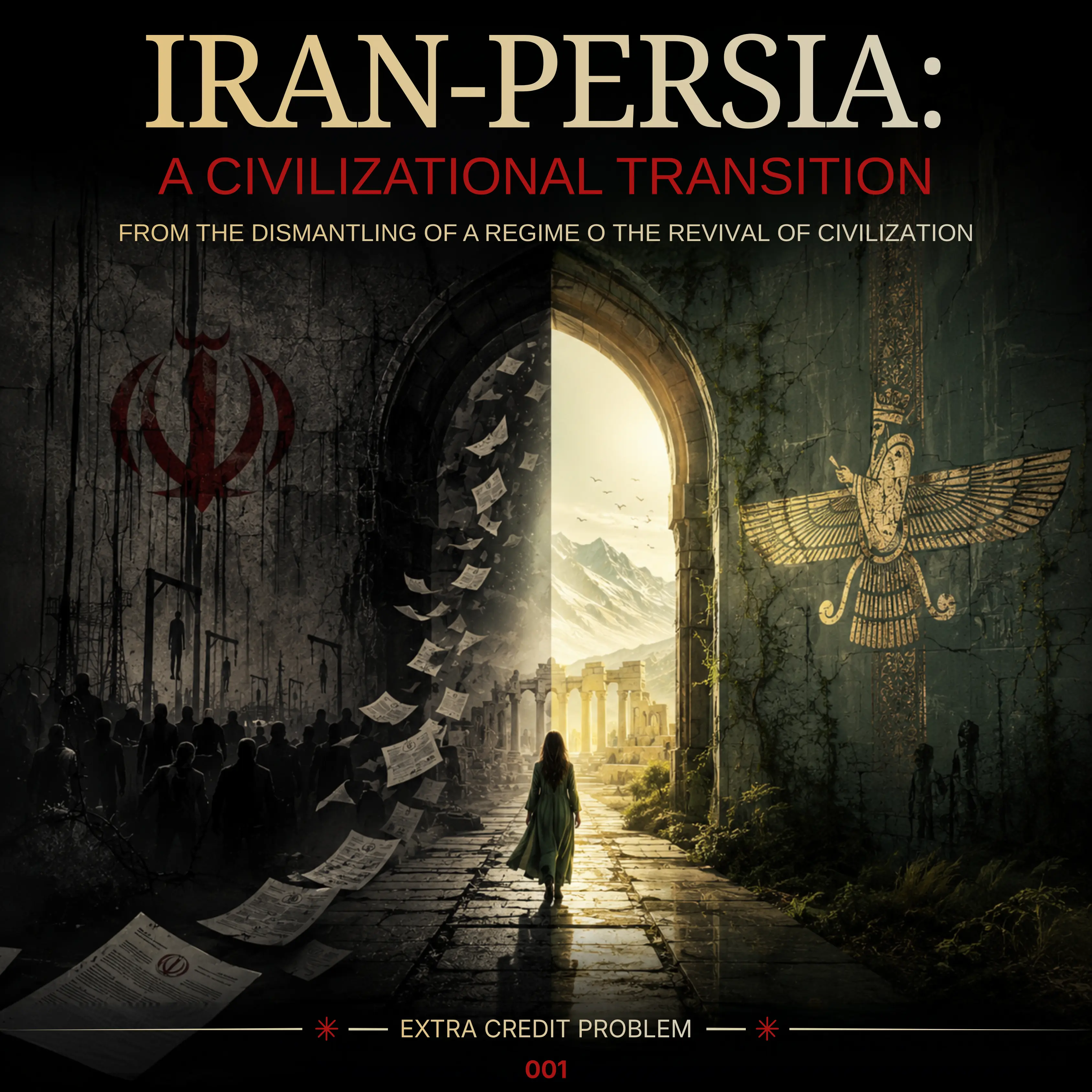
Alt-text:
A monumental passage from darkness to light connecting Iran and Persia through a symbolic civilizational transition.
Extra Credit Problem (The Asterisk Problem). Iran – Persia: A Civilizational Transition. AP | Pivtorak.Studio. 16.01.2026
© Anna Pivtorak (Kostyuk)
🛡️ This publication is part of an authorial research and artistic project.
The material is based on the analysis of open sources and contains the author’s interpretations, metaphors, and conceptual models.
The described images and concepts may be allegorical in nature and do not constitute legal accusations or official conclusions regarding any individuals, organizations, or states.
- 01-01 Tragedy. Ethical Vacuum
- 01-02 Tragedy. False Dialogue
- 01-03 Tragedy. Consumable Material
- 02-01 AfterTragedy. Delegitimation
- 02-02 AfterTragedy. System without Immunity
- 02-03 AfterTragedy. The Illusion of a Game
- 03-01 Diagnosis of the System. Vertical of Fear
- 03-02 Diagnosis of the System. Resource Dependence
- 03-03 Diagnosis of the System. Imitation of State
- 04-01 Vulnerability Point. Human Factor
- 04-02 Vulnerability Point. Economic Overload
- 04-03 Vulnerability Point. Informational Fragility
- 05-01 Protest Environment. Social Sabotage
- 05-02 Protest Environment. Parallel Structures
- 05-03 Protest Environment. Collective Silence
- 06-01 Desacralization of Fear. Exposing Vulnerability
- 06-02 Desacralization of Fear. Loss of Subjectivity
- 06-03 Desacralization of Fear. Inevitability of Tribunal
- 07-01 Revival of Identity. Call of the Ancestors (Faravahar)
- 07-02 Revival of Identity. The Right to One’s Own Energy (Shir-o-Khorshid)
- 07-03 Revival of Identity. Cultural Code of Survival (Ornament)
- 07-04 Revival of Identity. Return of Time
- 07-05 Revival of Identity. Ethics as a Foundation. Zoroastrianism as Ethics
- 07-06 Revival of Identity. Symbolic Cleansing
- 08-01 Point of Transition. Request for a Bridge (Pahlavi)
- 08-02 Point of Transition. Refusal of the "Republic"
- 08-03 Point of Transition. The True Name: Persia
- 09-01 Persia 2.0: Global Dimension. Freedom as Structure (Open Ecosystem)
- 09-02 Persia 2.0: Global Dimension. Peace as Norm (Architecture of Regional Security)
- 09-03 Persia 2.0: Global Dimension. The Human Subject (Citizen of the World with a Persian Heart)