👨⚖️ Author’s Declaration
This publication is part of an authorial research and artistic project created by an Independent Researcher and Creator (Analyst-Artist).
The material is based on the analysis of open sources and reflects the author’s personal research perspective.
Metaphors, imagery, symbols, and conceptual models may have an allegorical character and are used as tools of philosophical and systemic analysis.
This material is not a legal accusation, a journalistic investigation, or an official conclusion of any institution.
📋 Methodological Note
This series is an exercise in civilizational modeling.
The use of the present tense does not indicate an existing political reality, a prediction, or a factual statement.
The texts describe desirable systemic configurations and ethical horizons toward which societies may consciously choose to move.
The works function as architectural blueprints for possible futures rather than as descriptions of current events.
The purpose of the project is not to predict history, but to design coherent models of civilization that may serve as long-term reference systems for public reflection, institutional design, and human agency.
Every work in this series should therefore be understood simultaneously as a manifesto, a systems design exercise, and a civilizational hypothesis.
✯ Extra Credit Problem (The Asterisk Problem)
Iran – Persia: A Civilizational Transition
From the Dismantling of a Regime to the Revival of Civilization
VI. Desacralization of Fear. Inevitability of Tribunal#
🔔 Ethical Resonance#
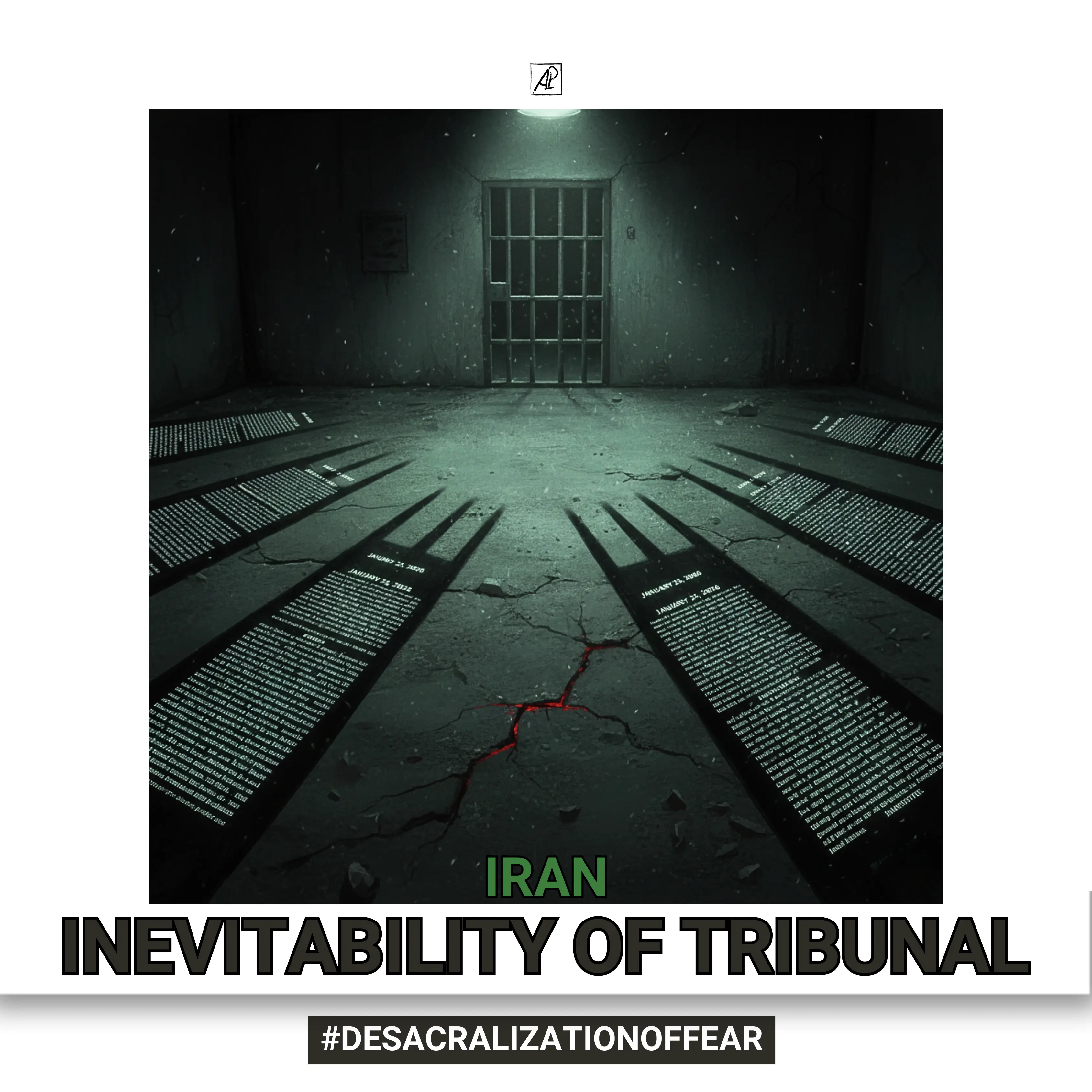
A dark prison cell. Light above the door falls onto the floor, and the shadows of the bars spread in different directions. They align with precision, forming distinct lines.
Once, these shadows from the bars seemed like eternal lines crossing out a life. But now every minute of bondage is recorded in an invisible but indestructible protocol of history.
The space no longer conceals violence. What once functioned as an instrument of intimidation begins to register itself. Prison architecture shifts its role: it stops erasing traces and becomes a surface of record. The system no longer absorbs crimes — it stores them.
The shadows remain still, yet time is embedded within them. Each line is an event, each direction a testimony. Repression loses anonymity because it no longer dissolves into fear. It is translated into the language of protocol.
The floor is cracked. The deepest central fracture glows red from within — not as a threat, but as accumulated evidence. This is not an explosion. It is exposure.
This is the great transformation: what was created to break you now becomes evidence. The prison no longer belongs to the executioners. It belongs to Time, which has begun to testify against them. Every guard’s step, every movement of a hand with an instrument of torture—all of it is already recorded in the shadows that have become text.
The human presence here feels no panic. There is silence and counting. Fear no longer immobilizes — it changes ownership.
We are no longer victims; we are the authors of the future indictment. Justice does not come from the outside; it grows through the very walls of the dictatorship the moment you stop seeing only bondage in the bars. Now, you see the lines in which the truth will be written.
When fear vanishes, the countdown to justice begins.
📐 Systemic Solution Manifesto#
[GIVEN]:#
The instruments of repression—bars, walls, corridors—usually work to conceal the truth. Dictatorships believe that behind closed prison doors, they are omnipotent.
Facts: In Iran 2026, a fundamental transformation of perception occurred: prison architecture ceased to be a symbol of fear and became a symbol of future retribution. We capture the moment when the shadow of the bars—which previously symbolized bondage—transforms into clear, printed lines of a court protocol. A system accustomed to operating in darkness suddenly finds that every action is recorded. Now, every night in a cell is not just a wait for torture, but a countdown to the moment the walls begin to testify.
[PARAMETERS OF ASYMMETRY]:#
- Shadow vs. Text: The uncertainty of fear is replaced by the precision of a legal document.
- Prisoner vs. Protocol: The victim becomes a witness, and the instrument of detention becomes the evidence base.
- Past vs. Future: The prison no longer holds one in the past; it lays the groundwork for future justice.
[ANALYSIS]:#
“Inevitability of Tribunal” is an ethical turning point. We demonstrate that the era of dictatorship ended not when the walls fell, but when violence began to be documented by history itself. When the shadow of the bars becomes a protocol, justice becomes a physical law that cannot be overturned by an order.
Key Phrase: “When fear vanishes, the countdown to justice begins.”
[CONCLUSION]:#
We conclude the desacralization of fear.
Now the punishers fear the light of justice more than the people feared their dark basements.
The great reckoning begins.
Alt-text:
A dark prison cell. A light source above the door casts shadows of prison bars across the floor in multiple directions, resembling lines of a legal protocol. The floor is cracked, with a central crack glowing red from within.
✯ Extra Credit Problem (The Asterisk Problem). Iran – Persia: A Civilizational Transition.
VI. Desacralization of Fear. Inevitability of Tribunal. AP | Pivtorak.Studio. 25.01.2026
© Anna Pivtorak (Kostyuk)
🛡️ This publication is part of an authorial research and artistic project.
The material is based on the analysis of open sources and contains the author’s interpretations, metaphors, and conceptual models.
The described images and concepts may be allegorical in nature and do not constitute legal accusations or official conclusions regarding any individuals, organizations, or states.