The Gesture That Stayed | Living Topography#
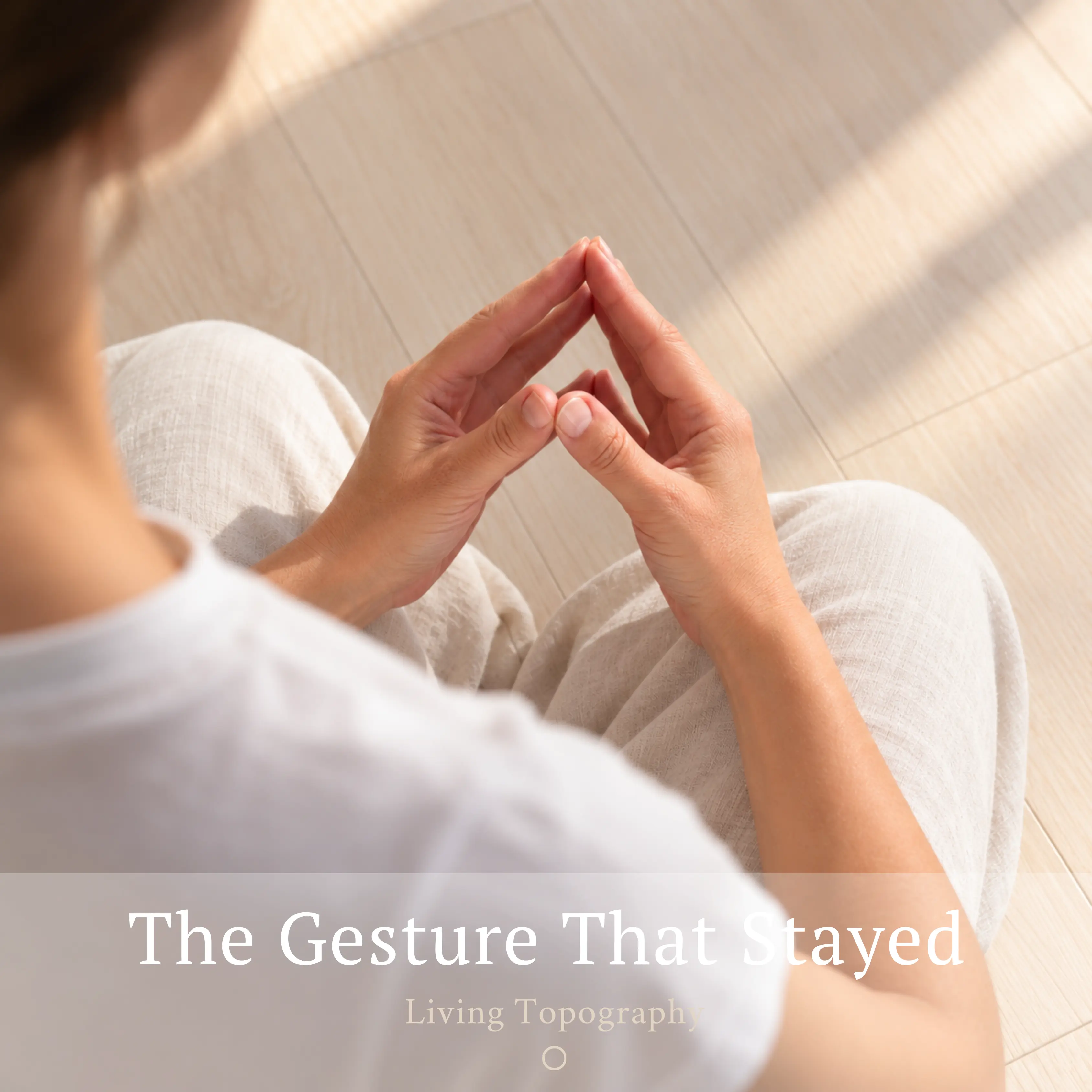
As we explored movement and our own interpretations this evening, I unexpectedly returned to a familiar gesture.
I brought the fingers of both hands together and, in that moment, felt a familiar calm — my own centre.
The gesture came from the past — from the time when I practised kung fu.
Only later did I realise that I had made this gesture before. More than once or twice.
I had simply never thought about it.
Behind the Scenes#
That evening, our meeting, organised by agirE CLDS 5G in Esposende, took place backstage, in a bright room beside the stage.
There was a mirror and a ballet barre, a glass wall overlooking the street, changing lockers, low benches, and an exit onto the stage. Outside, evening was falling, while artificial light illuminated the room.
This time, we explored interaction through movement.
Invisible Strings#
We split into pairs. With music playing, one partner lay on the floor while the other imagined pulling them by invisible strings: by the forehead, nose, ear, leg, back…
As though those strings could help the person rise and come to their feet.
Then we switched roles. The person who had just been guiding someone else’s movements now followed the imaginary strings themselves.
I felt no discomfort when I was the one whose movements were being guided. We were all careful with one another, without sudden movements or excessive force.
And when it was my turn to be the puppeteer, I chose to be careful too.
I didn’t want to cause my partner any physical discomfort. I didn’t want to see someone being made to submit, even if it was only a game. And I wanted us to remain friends afterwards, without unpleasant memories of that interaction.
I don’t like manipulating people.
That is why I can allow myself to be manipulated, but only in a game.
When the music faded, we sat in a circle and began sharing our impressions. Which was better: being the puppeteer or being the puppet?
For me, it wasn’t a question of which role was better. I could accept either one. But when guiding another person, I wanted to leave them as comfortable as possible.
Four Words#
Then came another exercise.
Centro. Fronteira. Abrigo. Passagem.
Centre. Boundary. Shelter. Passage.
We were asked to create our own movements for each word. First, we moved individually to the music, then together. Afterwards, we sat in a circle again so that everyone could show their movements and explain what they meant.
And that was when I became confused.
We had all heard the same words, yet the movements were different. For some, abrigo meant a roof over their heads. For others, it meant wrapping their arms around themselves.
I saw that gesture and copied it. Yet I didn’t immediately understand why an embrace was connected to shelter.
Fronteira was not much easier. I guessed it meant a border, but I didn’t understand whose border it was or how it was supposed to be expressed through movement.
Some imagined an enclosed or partially restricted space. Someone else represented a long strip, lunging sideways or forwards.
And passagem remained a mystery to me.
At one point, I simply stopped and began watching the others. I couldn’t come up with my own movements, and copying someone else’s felt confusing and awkward.
I couldn’t find time to think. I couldn’t formulate my own response.
When it was my turn to explain my movements, I simply said that I had nothing to say. And that was acceptable.
As the others described their associations, I gradually began to understand what the exercise was about. But I still couldn’t formulate my own interpretation.
Later, I wrote this down on my phone:
Parece que estávamos a construir aqui as nossas próprias fronteiras.
Cada um fazia o que entendia. (It seemed that we were building our own boundaries here.
Everyone did what they understood in their own way.)
Centro#
But among all those movements, there was one I hadn’t invented.
For the word centro, I brought the fingers of both hands together.
When I was a student, I used to practise kung fu. At the end of our training sessions, we would sit in the seiza position, close our eyes, and hold our hands in front of us with our fingers joined. In those moments, we felt a flow of energy.
This time, music was playing around us, the other participants were moving, and everyone was doing their own exercise. I didn’t feel what I had once felt during training. There was no silence, no closed eyes, no familiar end to a session.
But the gesture was familiar.
I hadn’t deliberately searched for it. It was simply that, when I needed to show centro, my fingers came together in that same way.
It was a familiar state of calm for me.
Perhaps I felt confused among all those movements I didn’t understand. Perhaps that was precisely why the gesture came so naturally.
I only remember being surprised when it returned from the past.
And later, I realised something else: I had made that gesture before. More than once or twice. I had simply never thought about it.
What Stayed#
I came to the meeting and took part in the exercises without knowing what I would carry away from them.
At first, I thought that evening had been about manipulation. About how one person can guide another person’s movements, how we accept someone else’s influence, and how we behave when we ourselves are given the opportunity to lead.
Now, I remember something else above all.
The joined fingers of both hands.
I don’t know whether the word centro held that same meaning for the meeting’s organisers. My gesture is not an explanation of the word for other people. It only tells the story of what it meant to me in that moment.
And perhaps that is precisely what I took away with me.
I can allow another person to guide my movements. I can guide someone else’s movements myself. I can find myself among people who understand an exercise better than I do, without knowing what to do next.
And somewhere within that experience, something familiar may emerge. Not necessarily something I was looking for. Sometimes, something whose existence I had never even considered.
P.S.#
That evening, the meeting stayed with me not as an experience about manipulation.
It stayed with me as an experience about centro.
About a gesture that returned from the past.
About a gesture that, as it turned out, had never truly disappeared.
Alt-text:
A woman seated in seiza, viewed from behind, gently touching the fingers of both hands above her lap on a light wooden floor.
Living Topography. The Gesture That Stayed. AP | Pivtorak.Studio. 15.10.2026
© Anna Pivtorak (Kostyuk)