🕊️🧠⚖️📚 Common Sense Is the Foundation of Peace | Peaceful Life#
Every politician was once a child sitting at a school desk, learning the simplest lessons about living with others.
Peace depends not only on borders, agreements, and institutions, but also on the ability of those who hold power to see reality clearly and understand the consequences of their decisions. The distance between a lesson of peace in childhood and political violence in adult life can begin with one very simple failure: common sense is no longer allowed to guide power.
What We See#
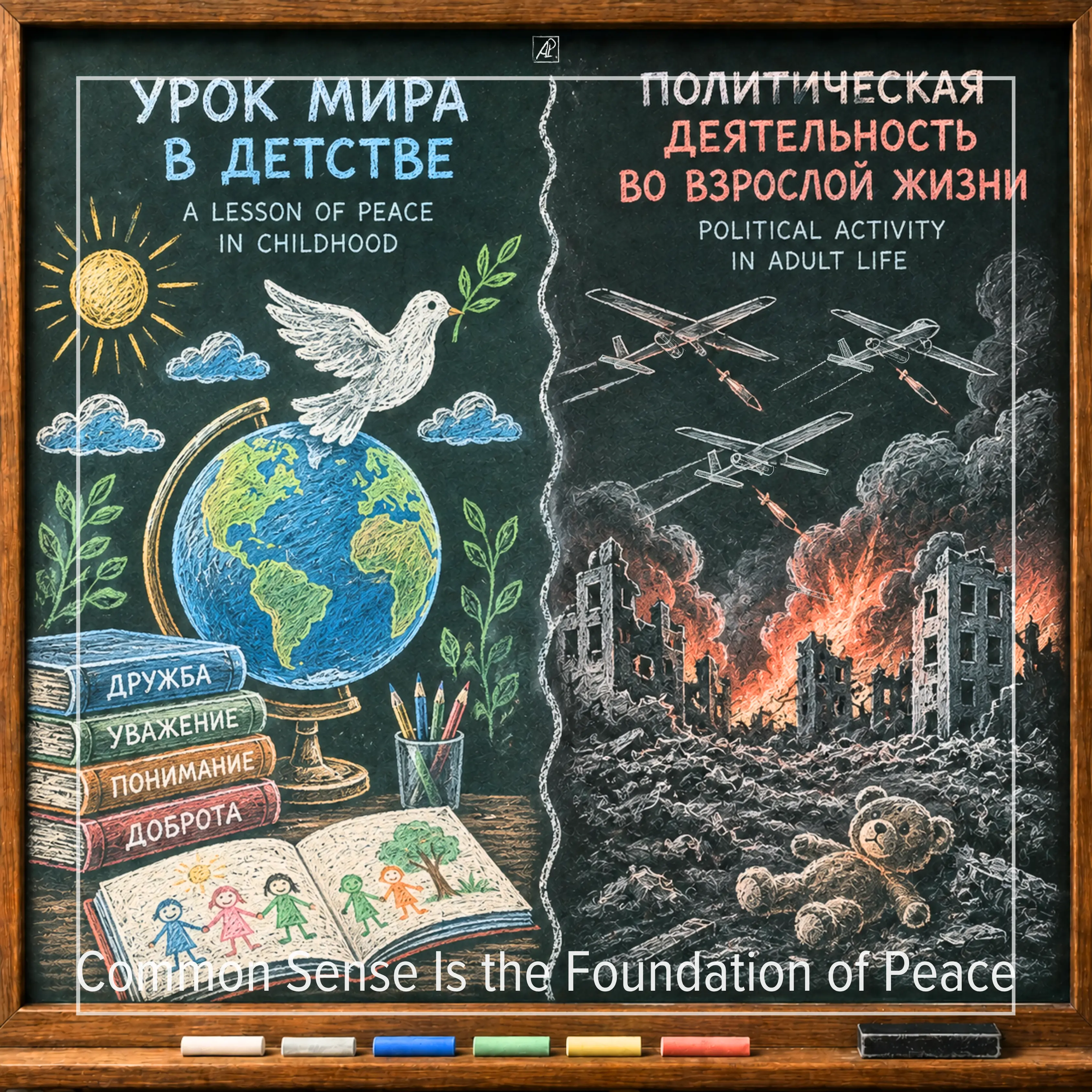
The same school blackboard can show two very different stages of life.
On one side, there is a childhood lesson of peace: a globe, a dove with an olive branch, books about friendship, respect, understanding, and kindness. The message is simple enough for a child: the world is shared, and other people are not our enemies simply because they are different.
On the other side, the picture changes completely. Drones fill the sky, explosions tear through cities, buildings burn, and destruction replaces the quiet language of coexistence.
No person is drawn between these two worlds.
Only the question remains: what happened between the lesson and the decision?
What It Reveals#
Every person who eventually receives political power once had a childhood. They once learned that hurting another person was wrong, that taking what belonged to someone else was unfair, and that conflicts could be resolved without destroying the people involved.
Growing up does not make these principles obsolete.
In fact, power makes them more important.
A private mistake may harm one person. A political decision can affect millions. A distorted perception of reality, a refusal to recognize consequences, or the belief that another country’s territory and lives are available for someone else’s ambitions can turn a failure of judgment into a human catastrophe.
This is why peace is not only a matter of treaties. It is also a matter of responsible thinking at the point where decisions become actions.
What We Choose#
Healthy political power should begin with the same basic principles that children can understand: reality matters, other people matter, boundaries matter, and actions have consequences.
Common sense does not mean political simplicity. It means being able to distinguish reality from fantasy, a neighbour from an enemy, and a legitimate interest from an appetite for domination.
Common sense in power is the safety of millions.
The fundamental question is simple:
What happens when the person making decisions for millions stops applying to political life the basic rules they once learned as a child?
responsible leadership · mental clarity · cause and effect · political responsibility · peaceful coexistence
Peace does not depend on perfect people. It depends on systems, institutions, and leaders capable of limiting destructive decisions and preserving contact with reality. A child can understand that another person has a right to their own space. An adult entrusted with power should understand that principle even more clearly — because the consequences of forgetting it are no longer measured in a classroom.
The lesson of peace is simple. The responsibility to remember it is enormous.
The next question is no longer whether the lesson was understood. It is whether a system is strong enough to stop one person’s distorted reality from becoming everyone else’s reality.
Alt-text:
A detailed chalk drawing on a school blackboard divided into two contrasting scenes: childhood’s lesson of peace with a globe, a dove carrying an olive branch, and books about friendship, respect, understanding, and kindness; and adult political activity with drones, explosions, burning buildings, and destruction.
Peaceful Life. Common Sense Is the Foundation of Peace. AP | Pivtorak.Studio. 04.09.2026
© Anna Pivtorak (Kostyuk)