👨⚖️ Author’s Declaration
This publication is part of an authorial research and artistic project created by an Independent Researcher and Creator (Analyst-Artist).
The material is based on the analysis of open sources and reflects the author’s personal research perspective.
Metaphors, imagery, symbols, and conceptual models may have an allegorical character and are used as tools of philosophical and systemic analysis.
This material is not a legal accusation, a journalistic investigation, or an official conclusion of any institution.
📋 Methodological Note
This series is an exercise in civilizational modeling.
The use of the present tense does not indicate an existing political reality, a prediction, or a factual statement.
The texts describe desirable systemic configurations and ethical horizons toward which societies may consciously choose to move.
The works function as architectural blueprints for possible futures rather than as descriptions of current events.
The purpose of the project is not to predict history, but to design coherent models of civilization that may serve as long-term reference systems for public reflection, institutional design, and human agency.
Every work in this series should therefore be understood simultaneously as a manifesto, a systems design exercise, and a civilizational hypothesis.
✯ Extra Credit Problem (The Asterisk Problem)
Iran – Persia: A Civilizational Transition
From the Dismantling of a Regime to the Revival of Civilization
III. Diagnosis of the System. Imitation of State#
🔔 Ethical Resonance#
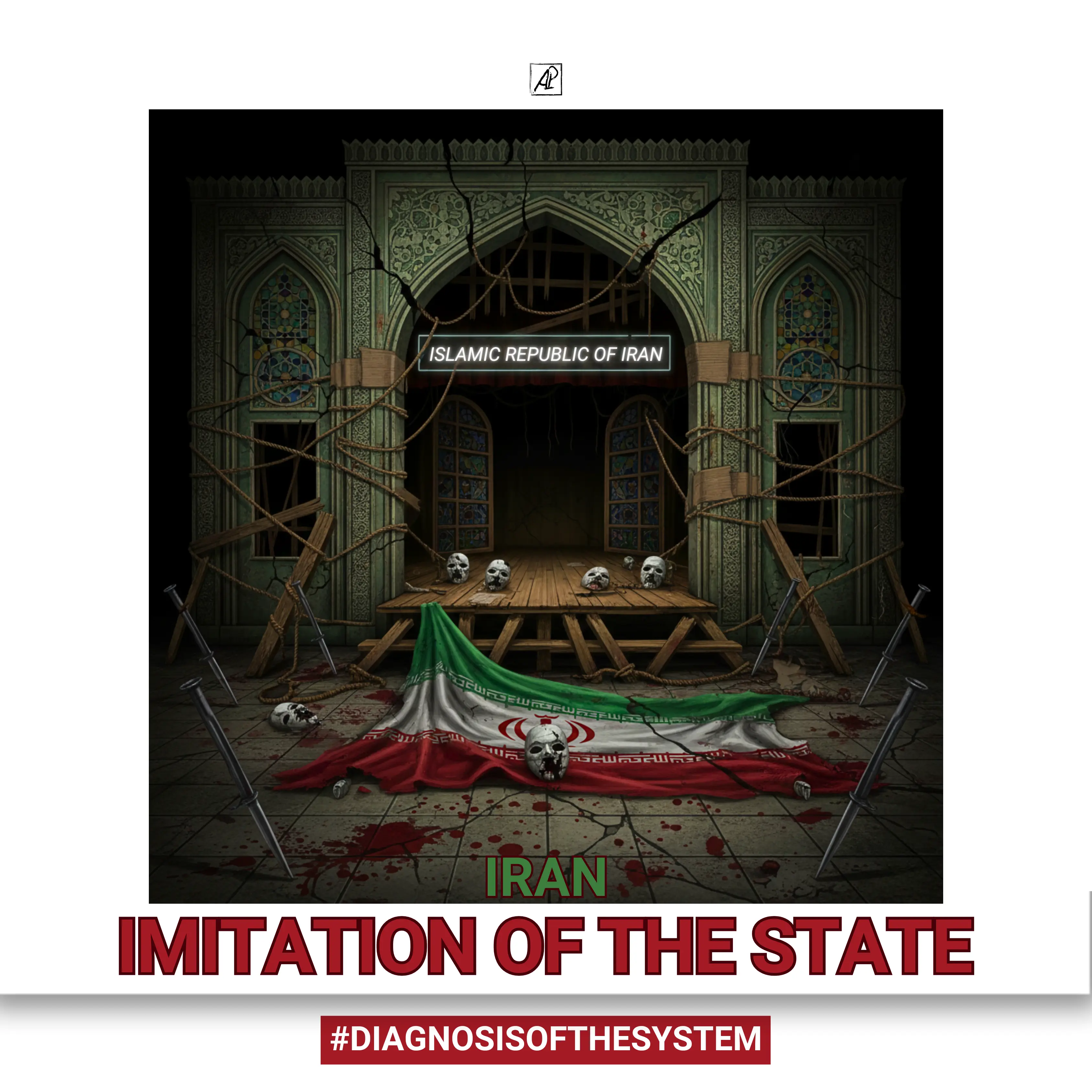
You see a majestic building with high columns. It looks indestructible, but it is an illusion. Closer inspection reveals the wooden beams and ropes holding the facade upright. The palace windows are merely painted glass, behind which yawns the void of an abandoned theater. On stage lie the discarded masks of “judges,” “ministers,” and “legislators,” but the actors long ago forgot their roles, having moved on to open violence.
This system invests not in institutions, but in appearance. Statehood here does not function — it is performed. Laws, courts, and ministries exist as props, concealing the absence of processes, accountability, and limits. The mechanism does not govern — it stages governance.
This system does not build a future; it merely imitates its presence for outside observers. Every official statement is a line from a bad play; every “trial” is a farce where the ending is known before the curtain rises. This is not the life of a country; it is the protracted tour of a criminal gang that has seized state offices and turned the national emblem into a brand.
As fear weakens, the cardboard nature of the structure becomes visible. The façade stands not on trust or rules, but on supports and the habit of not approaching too closely. Behind the stage there is no apparatus — only emptiness, where violence is no longer shielded by symbols.
A person who steps closer registers the transition from grandeur to decoration. No emotion is required — it is enough to see the beams, the ropes, and the masks scattered on the floor.
At this point, a person feels a strange relief. It is the state of a sensor that perceives not walls, but only dust and cardboard. Fear vanishes when you realize: you are not facing a majestic fortress, but merely an old stage set that will crumble with the first real gust of wind.
This is not a government; it is a crime syndicate on tour.
📐 Systemic Solution Manifesto#
[GIVEN]:#
The Iranian regime uses the attributes of a state—courts, parliament, ministries—merely as theatrical props. In reality, all decisions are made by a tight circle of criminal-religious elites.
Facts: In January 2026, the illusion of a “parliamentary republic” finally dissolved. Majlis deputies have no influence over the IRGC, and court verdicts are issued according to pre-written lists. The “state” in Iran is just a cardboard facade held up by bayonet struts. Behind it lies no service to citizens, only a void filled by the gang’s will to survive.
[PARAMETERS OF ASYMMETRY]:#
- Flag vs. Reality: Official symbolism covers the total absence of a legal framework.
- Law vs. Script: What is called “lawmaking” is just another act in a play designed to intimidate the population.
- Institution vs. Decoration: Ministries exist for reporting to the world, not for performing state functions.
[ANALYSIS]:#
“Imitation of State” is a diagnosis that exposes the decorative nature of power. We see that the authority in Tehran has no roots in the traditional sense of statehood (responsibility, law, social contract). It is a touring criminal group that has seized a theatrical stage and forces the audience to believe that the play “Justice” is actual life.
Key Phrase: “This is not a government; it is a crime syndicate on tour.”
[CONCLUSION]:#
We state the fact:
we are not facing a sovereign state, but a criminal set-piece.
Recognizing this frees us from the need to play by their rules.
When the struts rot, the facade will fall, exposing an empty stage where the executioners stand unprotected by institutional walls.
Alt-text:
A cracked façade of an Islamic building supported by wooden planks, bound with ropes and patched with paper strips. Behind painted windows is an empty theatrical stage. The wooden stage collapses. On the floor lie the Iranian flag, broken masks, swords stuck into the floor, and blood stains.
✯ Extra Credit Problem (The Asterisk Problem). Iran – Persia: A Civilizational Transition. III. Diagnosis of the System. Imitation of State. AP | Pivtorak.Studio. 21.01.2026
© Anna Pivtorak (Kostyuk)
🛡️ This publication is part of an authorial research and artistic project.
The material is based on the analysis of open sources and contains the author’s interpretations, metaphors, and conceptual models.
The described images and concepts may be allegorical in nature and do not constitute legal accusations or official conclusions regarding any individuals, organizations, or states.