⟡ Core Recalibration
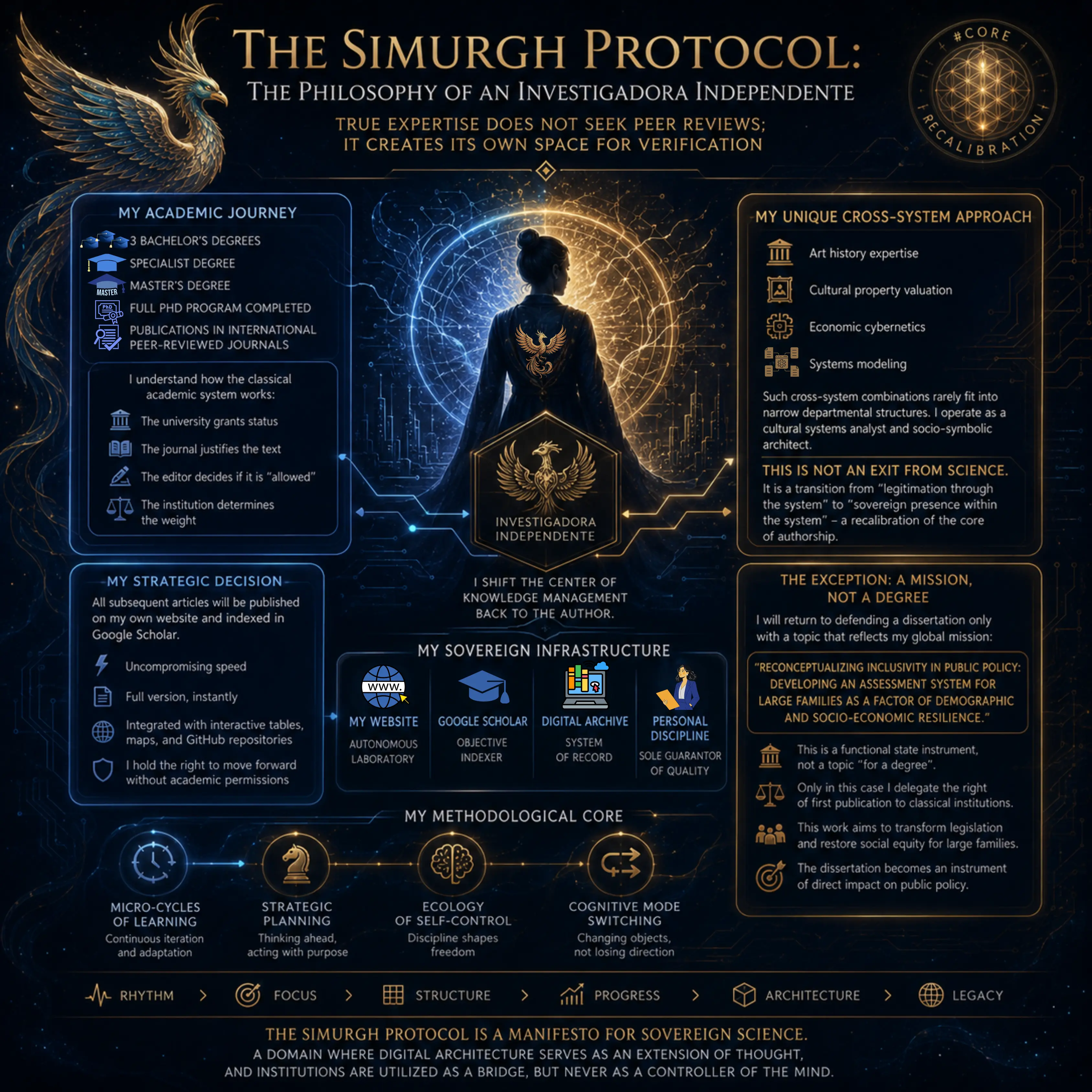
The Simurgh Protocol. The Philosophy of an Investigadora Independente
True expertise does not seek peer reviews; it creates its own space for verification
Behind me is the defense of five degrees: three Bachelor’s, a Specialist degree, a Master’s degree, alongside the completion of a full PhD program and the required volume of scientific papers published in international peer-reviewed journals. This path provided me with a comprehensive understanding of how the classical academic system operates. It functions on the principle of external legitimation: the university grants status, the journal justifies the existence of the text, the editor decides if the knowledge is “allowed,” and the institution determines the weight of the researcher.
I have made a strategic decision: from now on, all subsequent scientific articles will be published on my own website, while being indexed in Google Scholar. This grants me uncompromising speed — I no longer waste months on bureaucratic alignments and reserve the right to release materials instantly, in their full version, integrated with interactive tables, maps, and GitHub repositories.
My case is unique: I merge art history expertise, cultural property valuation, economic cybernetics, and systems modeling. Such cross-system combinations rarely fit into narrow departmental structures; therefore, I hold the absolute right to move forward without the permissions of the academic community.
This is not an “exit from science.” It is a transition from the model of “legitimation through the system” to a model of “sovereign presence within the system” — a recalibration of the core of authorship (#CoreRecalibration). My website becomes an autonomous laboratory, Google Scholar acts as an objective indexer, the digital archive serves as the system of record, and personal discipline remains the sole guarantor of quality. I am shifting the center of knowledge management back to the author.
The figure of the Simurgh as an Investigadora Independente is not an anti-academic gesture. It is the stance of a researcher who has navigated the system completely, mastered its tools, but no longer requires the ritual of permission.
My primary strength lies in cross-system analysis. Unlike fragmented academic environments, I operate as a cultural systems analyst and a socio-symbolic architect, analyzing cultural and state structures as coherent cybernetic systems.
However, there is one exception. If I return to the necessity of defending a dissertation, it will be strictly with a topic that reflects my global mission: “Reconceptualizing Inclusivity in Public Policy: Developing an Assessment System for Large Families as a Factor of Demographic and Socio-Economic Resilience.” This is not a topic “for a degree”; it is a functional state instrument. Only in this specific instance am I willing to delegate the right of first publication to classical institutions, as this work is designed to transform legislation and restore social equity for large families. Here, the dissertation becomes an instrument of direct impact on public policy rather than a proof of my competence.
The Simurgh Protocol is a manifesto for sovereign science. A domain where digital architecture serves as an extension of thought, and institutions are utilized as a bridge, but never as a controller of the mind.
Alt-text:
Symbolic infographic titled ‘The Simurgh Protocol’: an independent researcher positioned between the academic system and a sovereign digital knowledge infrastructure. Dark blue and gold palette, cybernetic diagrams, architecture of thought, Google Scholar, digital archives, and the Simurgh figure.
The Simurgh Protocol. The Philosophy of an Investigadora Independente. AP | Pivtorak.Studio. 20.05.2026
© Anna Pivtorak (Kostyuk)