👨⚖️ Author’s Declaration
This publication is part of an authorial research and artistic project created by an Independent Researcher and Creator (Analyst-Artist). The material is based on the analysis of open sources and reflects the author’s personal research perspective. Metaphors, imagery, symbols, and conceptual models may have an allegorical character and are used as tools of philosophical and systemic analysis. This material is not a legal accusation, a journalistic investigation, or an official conclusion of any institution.
📋 Methodological Note
This series is an exercise in civilizational modeling.
The use of the present tense does not indicate an existing political reality, a prediction, or a factual statement.
The texts describe desirable systemic configurations and ethical horizons toward which societies may consciously choose to move.
The works function as architectural blueprints for possible futures rather than as descriptions of current events.
The purpose of the project is not to predict history, but to design coherent models of civilization that may serve as long-term reference systems for public reflection, institutional design, and human agency.
Every work in this series should therefore be understood simultaneously as a manifesto, a systems design exercise, and a civilizational hypothesis.
🎯 Object of Research
This series does not examine Afghanistan as a country or the Afghan people as such. The object of research is the process of stripping away human agency. The focus is on the mechanisms that progressively dismantle the core pillars of civilization:
- responsibility;
- institutions;
- law;
- education;
- human dignity;
- a society’s capacity to protect its own children.
A specific focus of this series is directed at the collapse of the institution of patriarchal responsibility.
It is an investigation into a system where the right to control women is preserved, while the duty to protect them completely vanishes.
The ultimate consequence is the degradation of a society to a state where a child is reduced to an economic resource, and human life becomes a mere bargaining chip for survival.
✯ Extra Credit Problem (The Asterisk Problem)
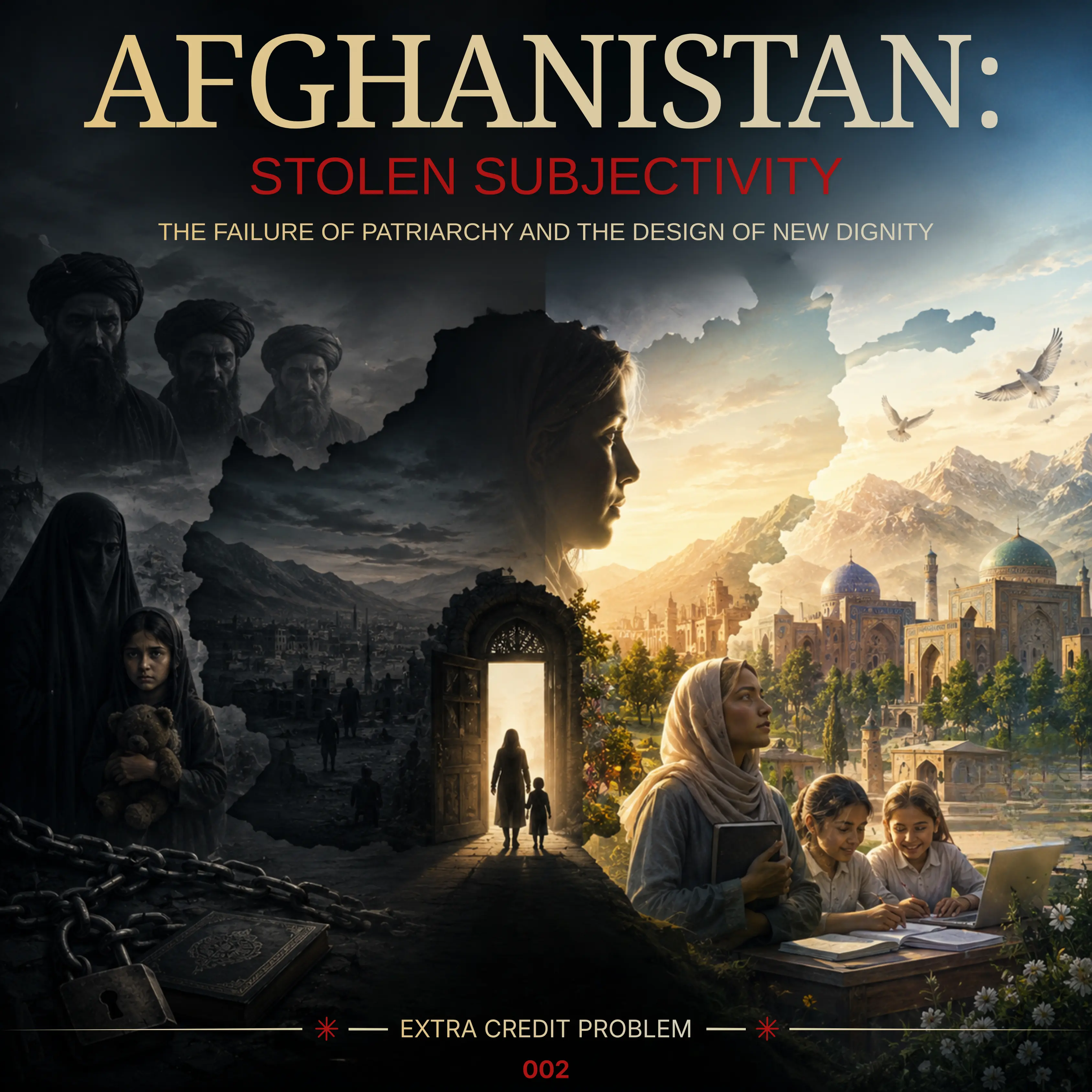
AFGHANISTAN. STOLEN SUBJECTIVITY#
The Failure of Patriarchy and the Design of New Dignity
This series is part of the ✯ Extra Credit Problem (The Asterisk Problem) project — an exploration of systemic crises that cannot be solved through conventional political, military, or economic instruments.
Afghanistan became the second civilizational case study of this research.
The purpose of this series is not to analyze a particular country, a specific people, or a religion.
Instead, it investigates deeper mechanisms of dehumanization — processes that gradually deprive societies of their ability to protect their own children, dismantle institutions of responsibility, and transform human beings into resources for survival.
A particular focus of this research is the collapse of patriarchal responsibility.
This is not an attack on men, but an analysis of a system in which the right to control women continues to exist while the obligation to protect them completely disappears.
At the center of the research lies the fundamental question of the series:
Who allowed a human being to stop being human?
The study is built as a sequence of 54 interconnected works that move from documenting dehumanization to designing a new social dignity.
Each work consists of two layers:
🔔 Ethical Resonance — a philosophical and artistic image that allows the phenomenon to be perceived through symbol, structure, and human experience.
📐 Manifesto of Systemic Resolution — an analytical protocol that formulates the problem as a systemic challenge and proposes a logic for overcoming it.
Together, these two layers create a bridge between emotional experience and systemic thinking.
The series is organized into nine cycles:
I. Tragedy. Ethical Collapse. Human Being as a Resource
II. Chronic Tragedy. The Legitimation of Evil
III. System Diagnosis. Architecture of Collapse. Occupation and Simulation
IV. Hidden Fragility of the Regime. Points of Vulnerability
V. Protest Environment. Collective Silence. Hidden Resistance
VI. Desacralization of Fear. The Dismantling of Idols
VII. Revival of Identity. Returning to the Origins
VIII. Point of Transition. Breaking the Construct
IX. Afghanistan 2.0. New Subjectivity
Gradually, the focus shifts from a terrorist organization to society, from society to civilizational mechanisms, and from civilization to the human being.
The final point of this research is neither the regime, nor the state, nor historical trauma.
The final point is the human being as a subject.
That is why this series carries a dual title.
Afghanistan describes the problem.
New Dignity describes the potential.
Between them lies the path of returning the human being to oneself.
Alt-text:
A monumental composition depicting the transition from stolen subjectivity to restored human dignity: the dark silhouette of Afghanistan gradually transforms into a space where women, children, and human beings once again become full subjects of civilization.
Extra Credit Problem (The Asterisk Problem). Afghanistan. Stolen Subjectivity. AP | Pivtorak.Studio. 22.06.2026
© Anna Pivtorak (Kostyuk)
🛡️ This publication is part of an authorial research and artistic project.
The material is based on the analysis of open sources and contains the author’s interpretations, metaphors, and conceptual models.
The described images and concepts may be allegorical in nature and do not constitute legal accusations or official conclusions regarding any individuals, organizations, or states.