👨⚖️ Author’s Declaration
This publication is part of an authorial research and artistic project created by an Independent Researcher and Creator (Analyst-Artist).
The material is based on the analysis of open sources and reflects the author’s personal research perspective.
Metaphors, imagery, symbols, and conceptual models may have an allegorical character and are used as tools of philosophical and systemic analysis.
This material is not a legal accusation, a journalistic investigation, or an official conclusion of any institution.
📋 Methodological Note
This series is an exercise in civilizational modeling.
The use of the present tense does not indicate an existing political reality, a prediction, or a factual statement.
The texts describe desirable systemic configurations and ethical horizons toward which societies may consciously choose to move.
The works function as architectural blueprints for possible futures rather than as descriptions of current events.
The purpose of the project is not to predict history, but to design coherent models of civilization that may serve as long-term reference systems for public reflection, institutional design, and human agency.
Every work in this series should therefore be understood simultaneously as a manifesto, a systems design exercise, and a civilizational hypothesis.
✯ Extra Credit Problem (The Asterisk Problem)
Iran – Persia: A Civilizational Transition
From the Dismantling of a Regime to the Revival of Civilization
III. Diagnosis of the System. Vertical of Fear#
🔔 Ethical Resonance#
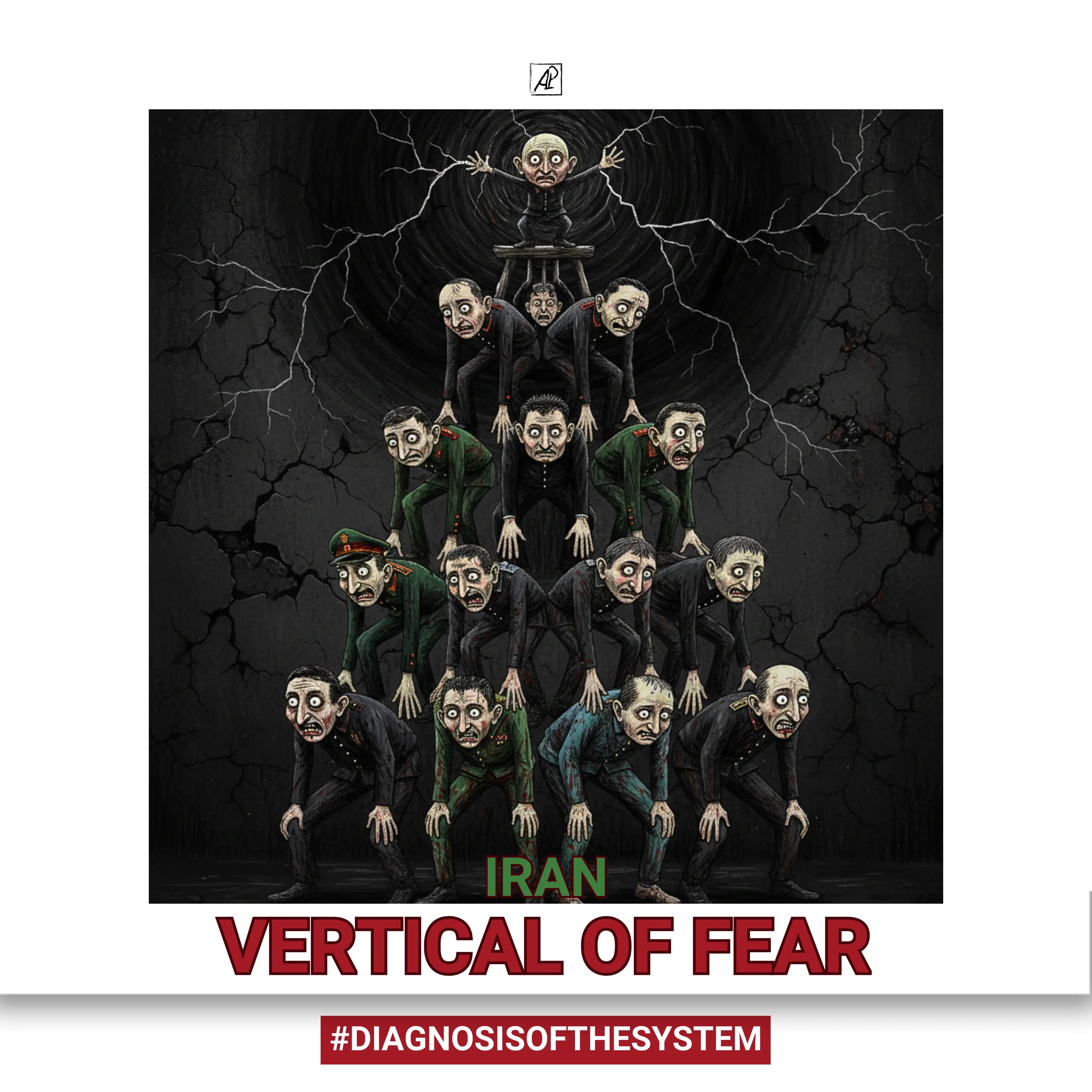
The tower is built not of stone, but of people pressed down by the weight of those above. It is a construction of pure pressure: each successive level is heavier than the last, for it carries within it the fear of the leadership’s wrath. The lower links tremble — not out of weakness, but from the impossibility of endlessly holding this bloody burden on their shoulders. At the very top, where there should be meaning and a future, emptiness reigns, feverishly trying to maintain balance.
This system is held together not by trust or rules, but by the vertical transmission of fear. Pressure moves downward, responsibility is pushed upward, and no level possesses autonomy. Fear replaces law, orders replace process, loyalty replaces competence. The mechanism does not produce stability; it merely postpones collapse.
Each link functions as a temporary support, fully aware of its disposability. The system does not protect its components — it consumes them. Control requires ever-increasing effort, because fear does not bind; it dries the connections and makes the structure brittle.
When a person at the base of this tower straightens their shoulders or takes a step aside, the entire hierarchy begins to crumble. It turns out that the monolith of the regime is an optical illusion that holds only as long as each element agrees to be a support for its executioner.
At this point, a person feels a loud silence of realization. It is the state of a sensor recording that the weight from above is no longer inevitable, and one’s own step is the end of the tower itself. The human here is not a subject, but a sensor of impending failure.
Fear is a glue that dries out in the light.
📐 Systemic Solution Manifesto#
[GIVEN]:#
Power in Iran is built on the principle of unconditional hierarchy of coercion. Every link in the system—from the rank-and-file security officer to the minister—acts not out of conviction, but through pressure from above.
Facts: The IRGC (Pasdaran) and Basij structures are maintained through internal espionage and a system of “collective blood guilt.” Everyone who suppresses protesters is themselves under the sights of internal security. In January 2026, we witness this tower beginning to vibrate: as the lower links (rank-and-file executors) lose their footing due to the sheer scale of the protests, the top finds itself in a state of weightlessness over the abyss.
[PARAMETERS OF ASYMMETRY]:#
- Weight vs. Support: The higher the link, the more pressure it exerts, yet the less it controls the stability of the foundation.
- Tension vs. Loyalty: Fear mimics unity, but in reality, it creates maximum tension that leads to the snapping of the chain.
- Center vs. Periphery: An order from the center loses its force when the executor on the ground sees the tower beneath them swaying.
[ANALYSIS]:#
The “Vertical of Fear” is a diagnosis of a system that lacks internal integrity. It is not a monolith; it is a stack of bodies where everyone is afraid to fall while simultaneously fearing the person above. We visualize this fragility: the dictatorship appears mighty only until the bottom link takes a step aside. As soon as fear ceases to be the “glue,” the tower turns into a heap of random elements.
Key Phrase: “Fear is a glue that dries out in the light.”
[CONCLUSION]:#
A system built on fear is destined for collapse the moment the tension exceeds the endurance limit of the lower links. We are recording this vibration. A vertical that has no roots in the people’s will is merely a matter of time and the light that reveals the cracks.
Alt-text: A grotesque tower of people in uniforms and official suits standing on each other’s shoulders. The bottom figures tremble under the strain, their faces expressing terror. At the very top, a tiny figure of a tyrant balances over a black void. Grotesque.
✯ Extra Credit Problem (The Asterisk Problem). Iran – Persia: A Civilizational Transition. III. Diagnosis of the System. Vertical of Fear. AP | Pivtorak.Studio. 20.01.2026
© Anna Pivtorak (Kostyuk)
🛡️ This publication is part of an authorial research and artistic project.
The material is based on the analysis of open sources and contains the author’s interpretations, metaphors, and conceptual models.
The described images and concepts may be allegorical in nature and do not constitute legal accusations or official conclusions regarding any individuals, organizations, or states.