Ancestors: Generations of Integrity#
Not everything that forms a system can be directly traced.
This section is dedicated to ancestors — not as individual figures,
but as a field of lineage within which thinking is formed.
This is not about biographies,
but about what is transmitted beyond words:
- a sense of boundary between acceptable and unacceptable
- attitude toward work
- the ability to carry load
- internal integrity
These qualities are not always conscious,
but they define:
- how decisions are made
- what is considered right
- where the line is drawn
This is not memory in a direct sense.
It is a structure that exists prior to individual experience.
Some figures can be named.
But most of the influence remains unnamed.
This section documents not stories,
but the presence of generations within thinking.
Alt-text:
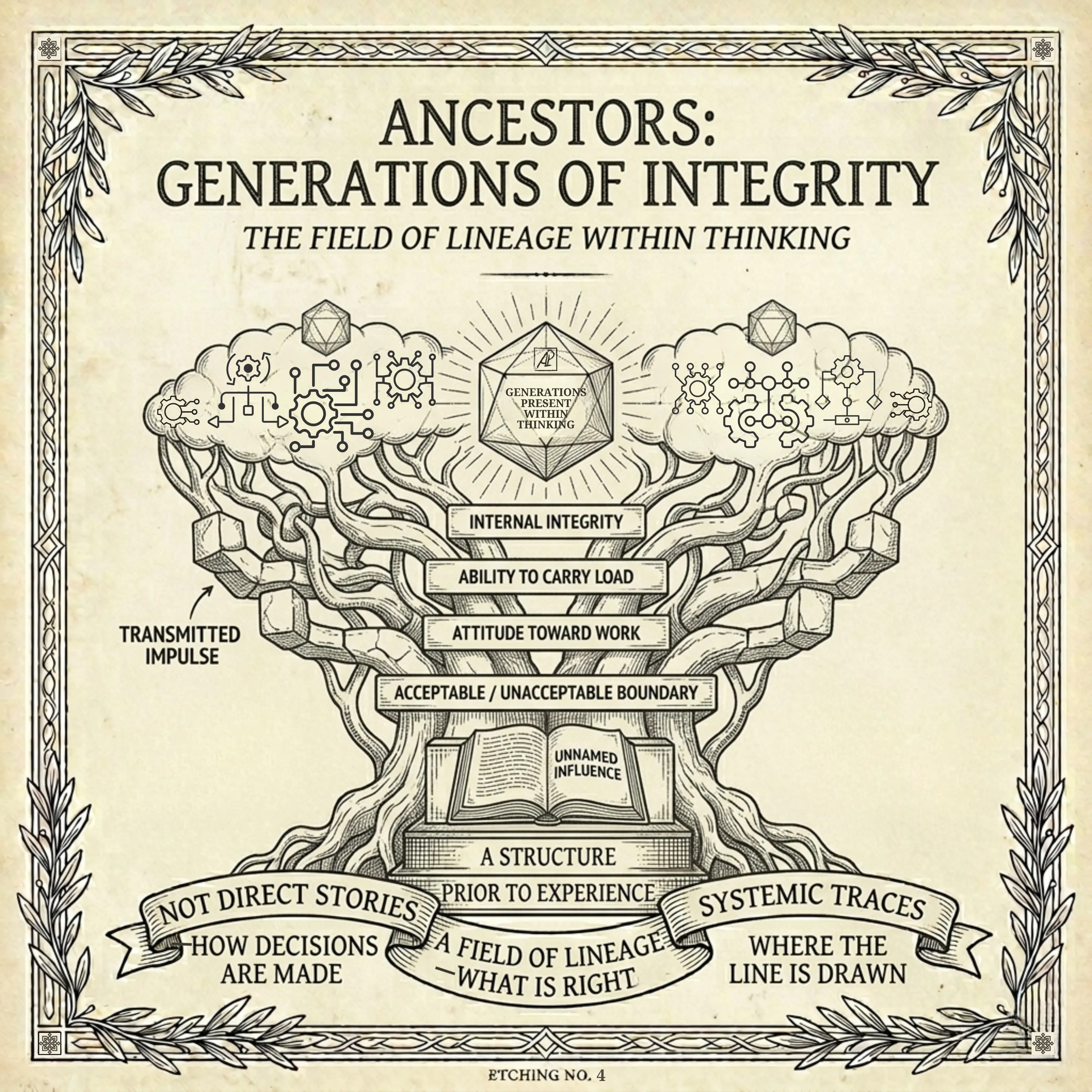
To visualize the influence of ancestors, a tree is used as a central metaphor, combining roots, structure, and thinking.
At the center is a tree with deep roots and branching structures, symbolizing the transmission of qualities across generations. It represents not individuals, but a field of lineage within which thinking is formed.
The trunk contains key qualities: internal integrity, the ability to carry load, attitude toward work, and the boundary between acceptable and unacceptable.
At the base, an open book labeled “unnamed influence” represents the invisible yet defining role of ancestral impact.
The crown integrates logical and structural elements, showing how this influence becomes part of present thinking.
At the center, a geometric form labeled “generations within thinking” reflects the presence of generations within the structure of thought.
The image presents ancestors not as history, but as a structure that exists prior to individual experience and shapes decision-making.