👨⚖️ Author’s Declaration
This publication is part of an authorial research and artistic project created by an Independent Researcher and Creator (Analyst-Artist).
The material is based on the analysis of open sources and reflects the author’s personal research perspective.
Metaphors, imagery, symbols, and conceptual models may have an allegorical character and are used as tools of philosophical and systemic analysis.
This material is not a legal accusation, a journalistic investigation, or an official conclusion of any institution.
📋 Methodological Note
This series is an exercise in civilizational modeling.
The use of the present tense does not indicate an existing political reality, a prediction, or a factual statement.
The texts describe desirable systemic configurations and ethical horizons toward which societies may consciously choose to move.
The works function as architectural blueprints for possible futures rather than as descriptions of current events.
The purpose of the project is not to predict history, but to design coherent models of civilization that may serve as long-term reference systems for public reflection, institutional design, and human agency.
Every work in this series should therefore be understood simultaneously as a manifesto, a systems design exercise, and a civilizational hypothesis.
✯ Extra Credit Problem (The Asterisk Problem)
Iran – Persia: A Civilizational Transition
From the Dismantling of a Regime to the Revival of Civilization
I. Tragedy. Consumable Material#
🔔 Ethical Resonance#
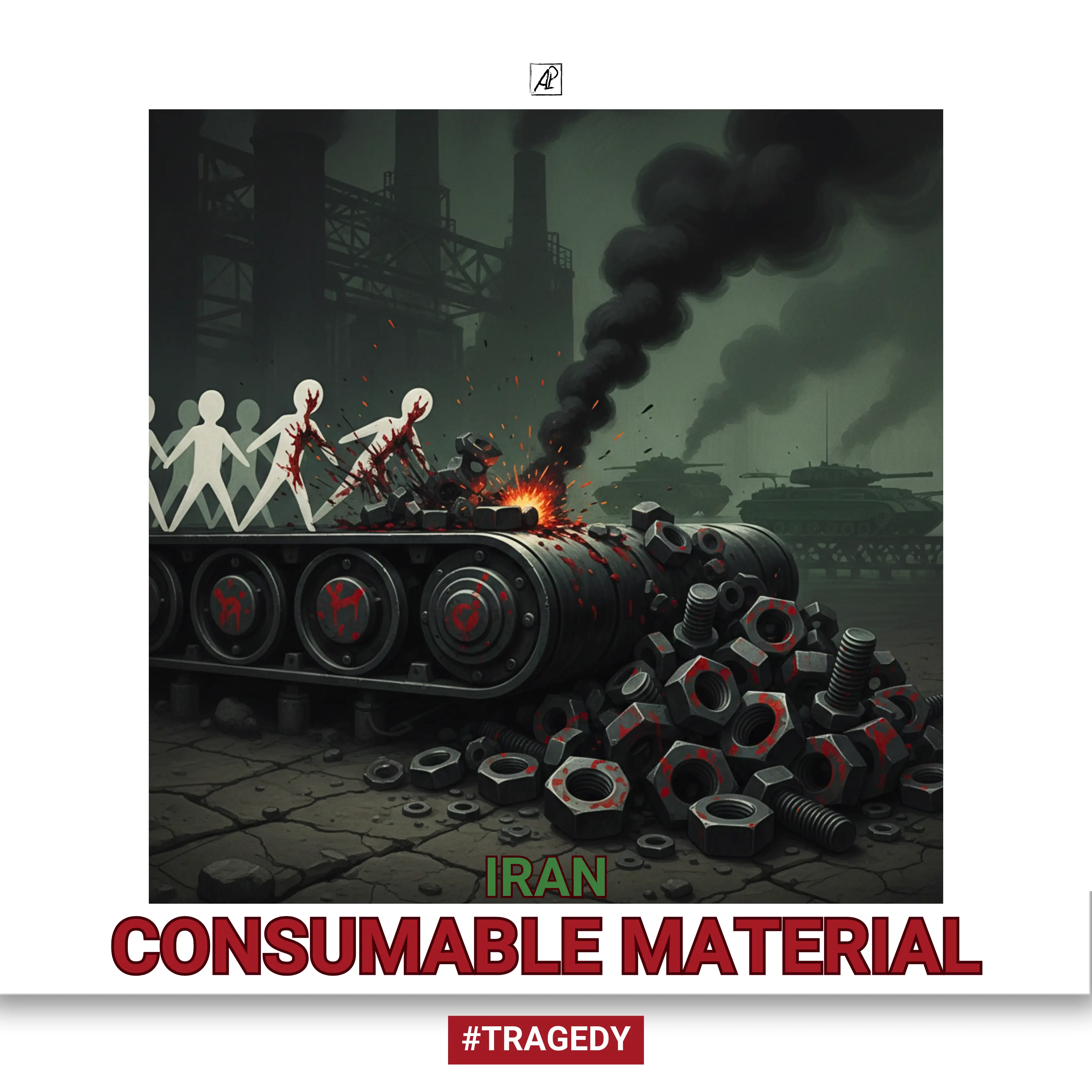
The conveyor moves steadily, without interruption. White human figures enter from one side and exit the other as iron screws — dark, heavy, marked with red indicators of purpose.
The system does not register the transition. It does not record the moment when a body ceases to be a body. In its logic, a person is a unit of resource with caloric value, time capacity, and an acceptable rate of wear. The conveyor follows plan: fear lowers resistance, silence increases throughput, isolation simplifies accounting. When the connection to the outside world is cut, error margins disappear, and losses become unverifiable. This week, the number of those killed is spoken of in the thousands, yet no exact figure exists — the system does not require precision when accounting does not affect output.
Inside this mechanism, a human experiences a halt. Not as resistance, but as clarity. When the surrounding space becomes too quiet, it becomes evident that there is no one left to continue protesting — not because there was no protest, but because the sensors were turned off along with the light.
The system does not see faces; it sees calories and hours.
📐 Systemic Solution Manifesto#
[GIVEN]:#
The Iranian regime has transformed human life into a resource that can be utilized and disposed of. Every protester, every dissident, every citizen who refuses to comply, is not viewed as an individual but as a unit of “expendable material” subject to processing.
Facts: Since the start of protests in September 2022, estimates suggest between 500 and over 20,000 protesters have been killed, thousands imprisoned, and hundreds sentenced to death. Recent weeks have been marked by particularly brutal “purges,” as the regime, exploiting a complete internet blackout (Digital Blackout), crushes the remaining resistance. Silence has engulfed cities—a silence resulting from mass extermination and intimidation.
[PARAMETERS OF ASYMMETRY]:#
- Human vs. Function: The regime sees people not as citizens with rights, but as functional units that either serve or are disposed of.
- Dignity vs. Conveyor Belt: Individual dignity is shattered by the mechanism of mass processing of human destinies.
- Silence vs. Truth: Communication blackouts and the silence following purges do not signify reconciliation, but merely the concealment of the tragedy’s scale.
[ANALYSIS]:#
“Expendable Material” is a concept where society transforms into a death factory. Human figures (symbolically white, like blank sheets of life) are fed onto an invisible conveyor belt. At the output, they are no longer people but iron screws, gears, or even fuel for a war machine (black and red). The system does not process thoughts or feelings; it processes mass, its energetic potential, transforming it into means of supporting its own repressive infrastructure and aggression abroad. This is complete dehumanization, elevated to the status of state strategy.
Key Phrase: “The system does not see faces; it sees calories and hours.”
[CONCLUSION]:#
The silence in Iran is not the end of the struggle but proof that the regime has crossed a line beyond which human life holds no value.
We must realize that by allowing this system to turn people into expendable material, we become complicit in dehumanization.
The next step is to recognize that the only way to stop this conveyor belt is to dismantle the system itself.
Alt-text:
A conveyor belt where white human figures gradually transform into black metal screws with red accents, intended for military machinery. Industrial background, no text.
Extra Credit Problem (The Asterisk Problem). Iran – Persia: A Civilizational Transition. I. Tragedy. Consumable Material. AP | Pivtorak.Studio. 17.01.2026
© Anna Pivtorak (Kostyuk)
🛡️ This publication is part of an authorial research and artistic project.
The material is based on the analysis of open sources and contains the author’s interpretations, metaphors, and conceptual models.
The described images and concepts may be allegorical in nature and do not constitute legal accusations or official conclusions regarding any individuals, organizations, or states.