👨⚖️ Author’s Declaration
This publication is part of an authorial research and artistic project created by an Independent Researcher and Creator (Analyst-Artist).
The material is based on the analysis of open sources and reflects the author’s personal research perspective.
Metaphors, imagery, symbols, and conceptual models may have an allegorical character and are used as tools of philosophical and systemic analysis.
This material is not a legal accusation, a journalistic investigation, or an official conclusion of any institution.
📋 Methodological Note
This series is an exercise in civilizational modeling.
The use of the present tense does not indicate an existing political reality, a prediction, or a factual statement.
The texts describe desirable systemic configurations and ethical horizons toward which societies may consciously choose to move.
The works function as architectural blueprints for possible futures rather than as descriptions of current events.
The purpose of the project is not to predict history, but to design coherent models of civilization that may serve as long-term reference systems for public reflection, institutional design, and human agency.
Every work in this series should therefore be understood simultaneously as a manifesto, a systems design exercise, and a civilizational hypothesis.
✯ Extra Credit Problem (The Asterisk Problem)
Iran – Persia: A Civilizational Transition
From the Dismantling of a Regime to the Revival of Civilization
VIII. Point of Transition. Request for a Bridge (Pahlavi)#
🔔 Ethical Resonance#
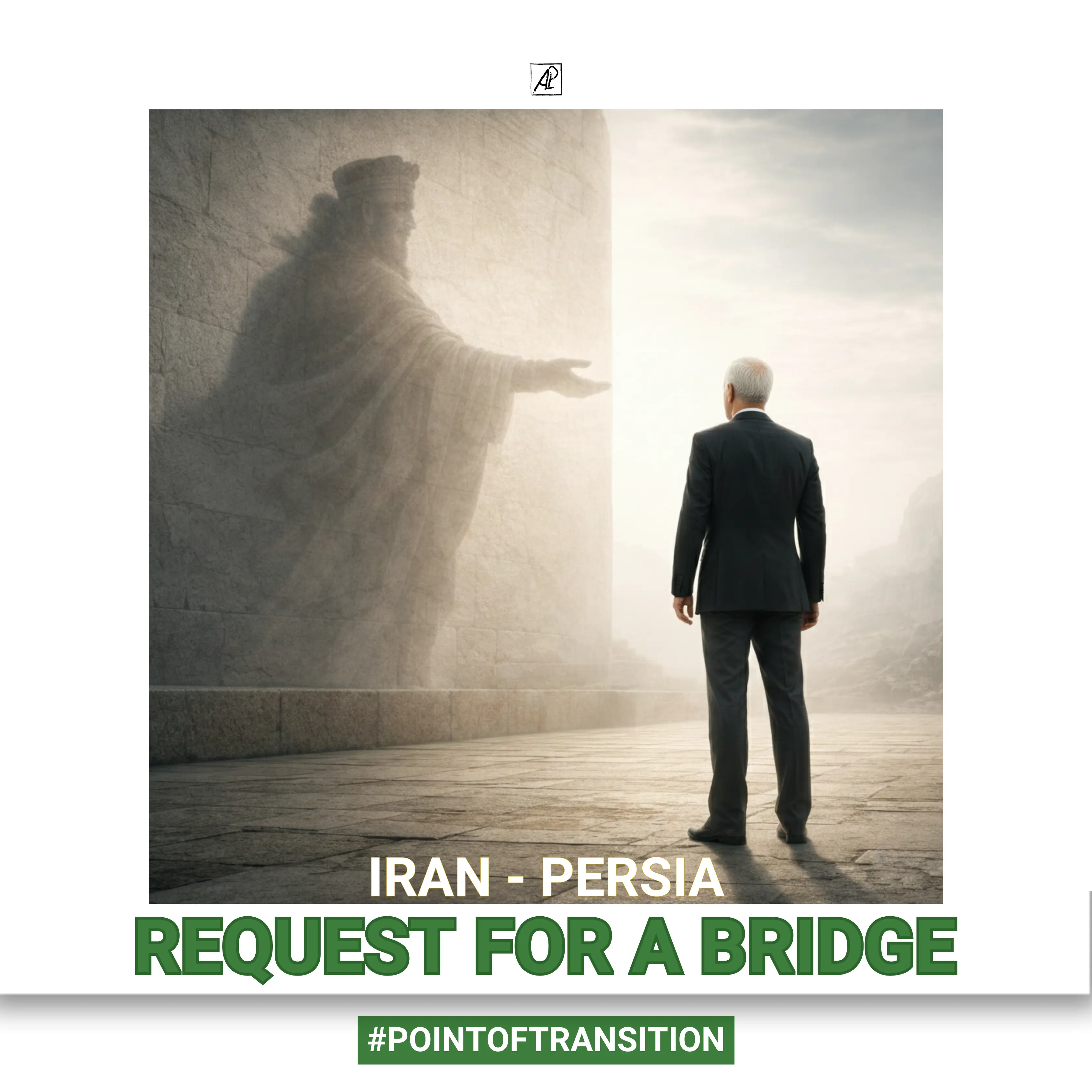
A shadow of a great figure from the past appears in the space. It does not dominate or command — it simply extends a hand forward, toward a living contemporary figure standing at the threshold of transition.
When an old prison collapses, the greatest danger is the confusion faced before an infinite open space. We stand on the edge of an abyss: behind us is the darkness we have finally left; before us is the freedom we have yet to build. In such a moment, a nation needs not a new overseer, but a sturdy bridge.
This bridge is our continuity. It is a hand reaching out to us across the centuries. When we recall the name Pahlavi, we are not calling for a monarchy; we are calling for dignity. We are turning to a symbol that reminds the world and ourselves: we are a great nation with deep roots.
The shadow of Cyrus the Great stands beside those who take responsibility for tomorrow. This gesture is neither a return to monarchy nor a political slogan. It functions as a mechanism of continuity: a system that has lost legitimacy requires a connection to its own civilizational memory in order not to collapse during transformation.
In this construction, Pahlavi operates as a bridge — not as power, but as an anchor. His presence closes the rupture between historical depth and new rules of the game, allowing the transition from tyranny to democracy to occur without structural failure.
This is not a return to the past. It is the use of our past’s strength to stand firm today. A bridge is necessary to cross over to true democracy without losing the state in the process. We are not choosing an idol; we are choosing a path. We are choosing to stand on the shoulders of giants to see the horizon where Persia is once again free, modern, and grand.
A bridge between the greatness of the past and the freedom of the future.
📐 Systemic Solution Manifesto#
[GIVEN]:#
After the desacralization of fear and the restoration of identity, a dangerous void emerges—a power vacuum. Revolutions often perish in chaos because they lack a mechanism of continuity. Society needs an anchor that is not part of the old regime but is part of the national code.
Facts: In 2026 Persia, a “Request for a Bridge” is formed. The name Pahlavi arises not as a return to absolutism, but as a symbol of legitimacy and civilizational continuity. It is a request for a leader-arbiter, a leader-guarantor who connects the greatness of the ancient world (symbolized by the shadow of Cyrus the Great) with modern democratic institutions. We capture the moment when a nation seeks not a new dictator, but a hand to help cross the abyss between “how it was” and “how it must be.” This is a functional solution to preserve the integrity of the state at its moment of highest vulnerability.
[PARAMETERS OF ASYMMETRY]:#
- Person vs. Function: Pahlavi is a marker of stability, not an end in himself.
- Shadow of Cyrus vs. The Present: The past extends a hand to the future to confirm the right to agency.
- Continuity vs. Chaos: A legitimate name becomes a shield against external and internal destructive forces.
[ANALYSIS]:#
“Request for a Bridge” is a strategic step. We assert that true democracy in Persia needs roots. Utilizing Pahlavi symbolism allows the nation to feel confident: we are not building something random on sand; we are restoring a home on a foundation of millennia. This is the transition from chaotic protest to systemic state-building.
Key Phrase: “A bridge between the greatness of the past and the freedom of the future.”
[CONCLUSION]:#
The point of transition is defined.
The bridge is established.
The nation gains a foothold to perform the final political maneuver.
Alt-text:
The shadow silhouette of an ancient Persian ruler extends a hand toward a modern human figure standing at a symbolic threshold, in a neutral space without signs of power or violence.
✯ Extra Credit Problem (The Asterisk Problem). Iran – Persia: A Civilizational Transition.
VIII. Point of Transition. Request for a Bridge (Pahlavi). AP | Pivtorak.Studio. 29.01.2026
© Anna Pivtorak (Kostyuk)
🛡️ This publication is part of an authorial research and artistic project.
The material is based on the analysis of open sources and contains the author’s interpretations, metaphors, and conceptual models.
The described images and concepts may be allegorical in nature and do not constitute legal accusations or official conclusions regarding any individuals, organizations, or states.