⟡ Core Recalibration
The Architecture of Meaning Environments. The Vitruvian Triad of Sovereign Thinking
Construction creates objects.
Architecture designs the environments in which those objects become possible.
Historically, the concept of “architecture” was firmly anchored to the physical world—the design of structures, cities, or landscapes. However, within contemporary informational and cybernetic realities, we witness not an expansion of this word’s meaning, but a return to its foundational essence. Architecture is the art and practice of creating resilient environments wherein people, ideas, processes, or systems can sustainably exist, interact, and evolve. A physical building is merely one of countless possible vessels for this discipline.
The more complex the systems became, the more evident it was that isolated objects could no longer be understood separately from the environments that generated them. Today, we design the architecture of decisions, interaction, knowledge, political design, and human presence.
The final stage of core recalibration (#CoreRecalibration) marks a fundamental shift in my internal optics: moving from the logic of constructing individual objects to the architecture of integrated environments. This transition from the role of an author to the role of an Architect obeys the three classical principles of Vitruvius, reinterpreted through the prism of sovereign systems thinking:
-
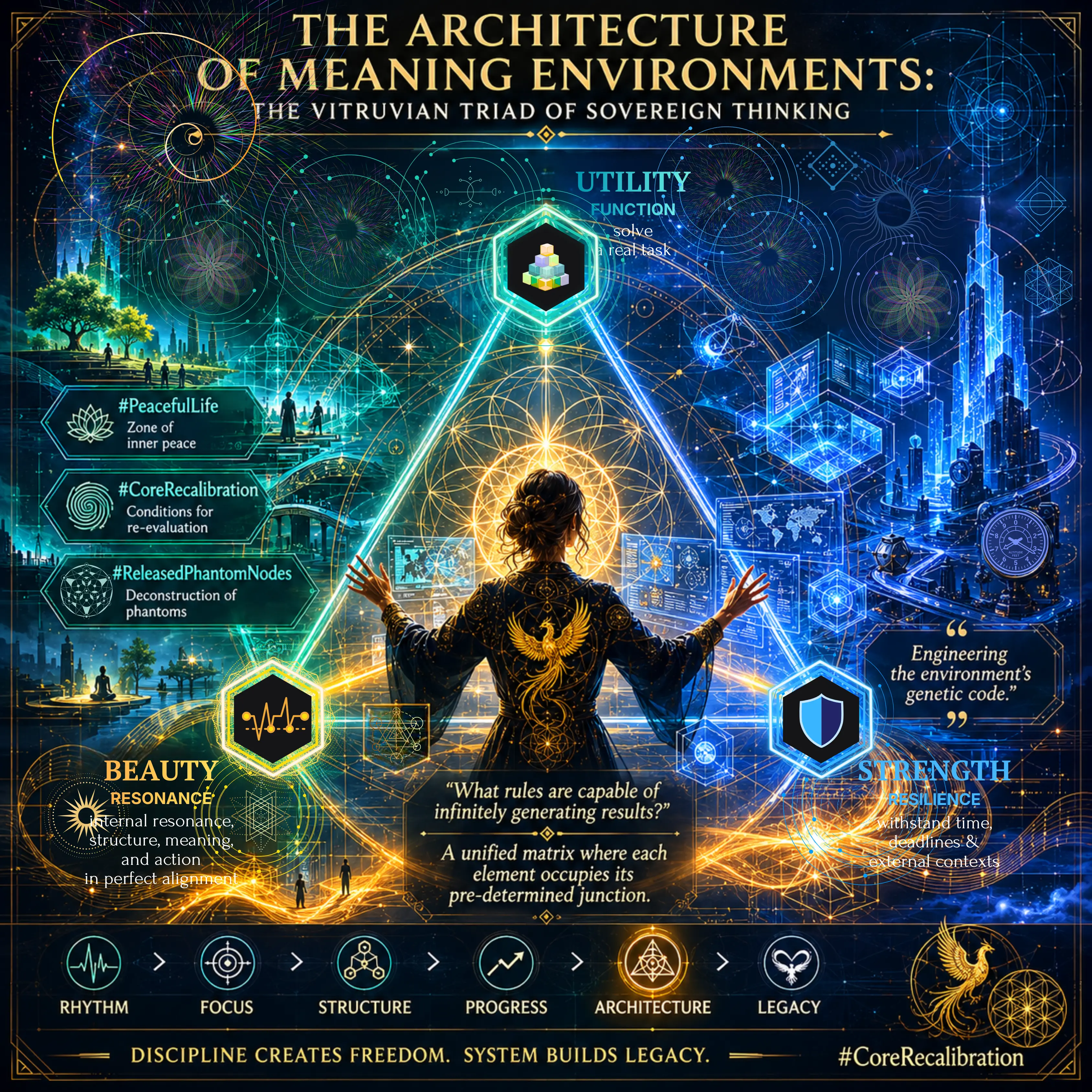
Utility (Function): Any system of meaning must solve a real, utilitarian task, rather than existing for its own sake. Thus, the space of #PeacefulLife architecturally establishes a zone of inner peace; #CoreRecalibration models the conditions for re-evaluation; and the structure of #ReleasedPhantomNodes serves as an instrument for the deconstruction of historical and geopolitical phantoms.
-
Strength (Resilience): A structure of meanings must be resilient enough to withstand to withstand the challenges of time, linear deadlines, and shifting external contexts. The resilience of the structure becomes far more vital than the speed of achieving a temporary result.
-
Beauty (Resonance): Within immaterial systems, aesthetics are stripped of false facades. It manifests through a flawless internal resonance, when structure, meaning, and action align so precisely that a fundamental sensation emerges: “Yes. This is exactly how it was meant to be.”
For the Architect, thinking ceases to be a process of content creation. It transforms into the process of engineering the environment’s genetic code. Instead of the anxious question, “What exactly do I want to create today?”, a sovereign one arises: “What rules and conditions are capable of infinitely generating the required results?”. Working on maps, cybernetic structures, and conceptual series is no longer a collection of random, isolated actions. It is the unfolding of a unified matrix where each element gradually finds its appropriate architectural position. We no longer build houses — we design the space where life generates itself.
Alt-text:
An architect standing within a luminous Vitruvian-inspired geometric structure representing Utility, Strength, and Beauty as pillars of sovereign systems thinking.
The Architecture of Meaning Environments. The Vitruvian Triad of Sovereign Thinking. AP | Pivtorak.Studio. 31.05.2026
© Anna Pivtorak (Kostyuk)