When Our Stories Intertwine | Living Topography#
Note
This text is my personal account of the second meeting organised by agirE CLDS 5G in Esposende, Portugal.
My knowledge of Portuguese is not perfect. I understood the instructions, words and participants’ reactions through context, my own understanding and personal impressions.
This is a story about what I observed, how I understood what was happening, and the reflections that arose in me during the meeting.
Returning to a Shared Space#
At the second meeting, we began by revisiting the introductions from our previous gathering.
Participants recalled how they had introduced themselves and repeated the movements that had accompanied their names. Newcomers invented their own movements as they introduced themselves to the group. Each movement was repeated twice.
In this way, we returned to our previous meeting, bringing back familiar gestures and adding new ones.
Then seven chairs were placed in a circle in the centre of the room. There were twelve of us.
We moved around the chairs to music. When the music stopped, some tried to take a seat while others ended up in the space inside the circle. The last person had to name a word in a language associated with one of the continents.
When no word came to mind, others joined in to help. We tried to recall real words or imitate sounds that we associated with particular languages.
It was a game involving movement, quick reactions and linguistic uncertainty. There was not always a ready answer. Sometimes we had to improvise; at other times, we relied on the group for help.
When a Line Becomes an Image#
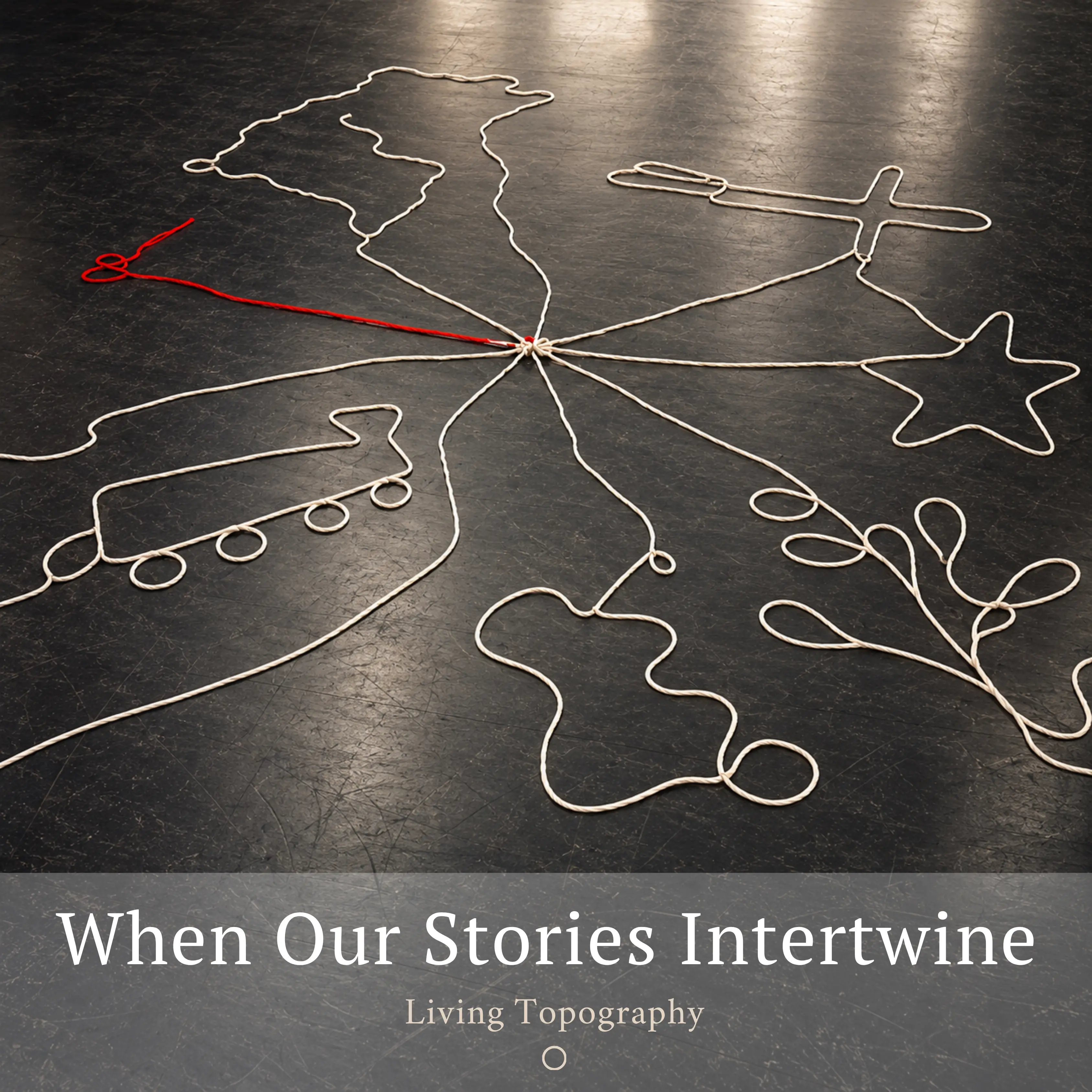
Once again, our material was a white strip wound into a ball.
There were fewer balls than participants, so we worked in pairs. Some pairs shared one ball, while others had two.
This time, the task was to use the strip to create an image that could tell our story.
As the music played, different shapes appeared on the floor.
A locomotive. A tree. A person holding a heart. A basket of fruit. A five-pointed star. Abstract compositions that could not necessarily be named or explained at first glance.
The same simple line could become countless different images.
The strip had no predetermined meaning. Its shape emerged from our decisions: where to turn, where to leave a curve, how to connect the parts, and what we wanted to depict.
Each image became an opportunity to tell something about ourselves.
But first, we were invited to approach the images created by other participants.
Someone Else’s Image, Our Own Story#
We found ourselves standing beside compositions we had not created.
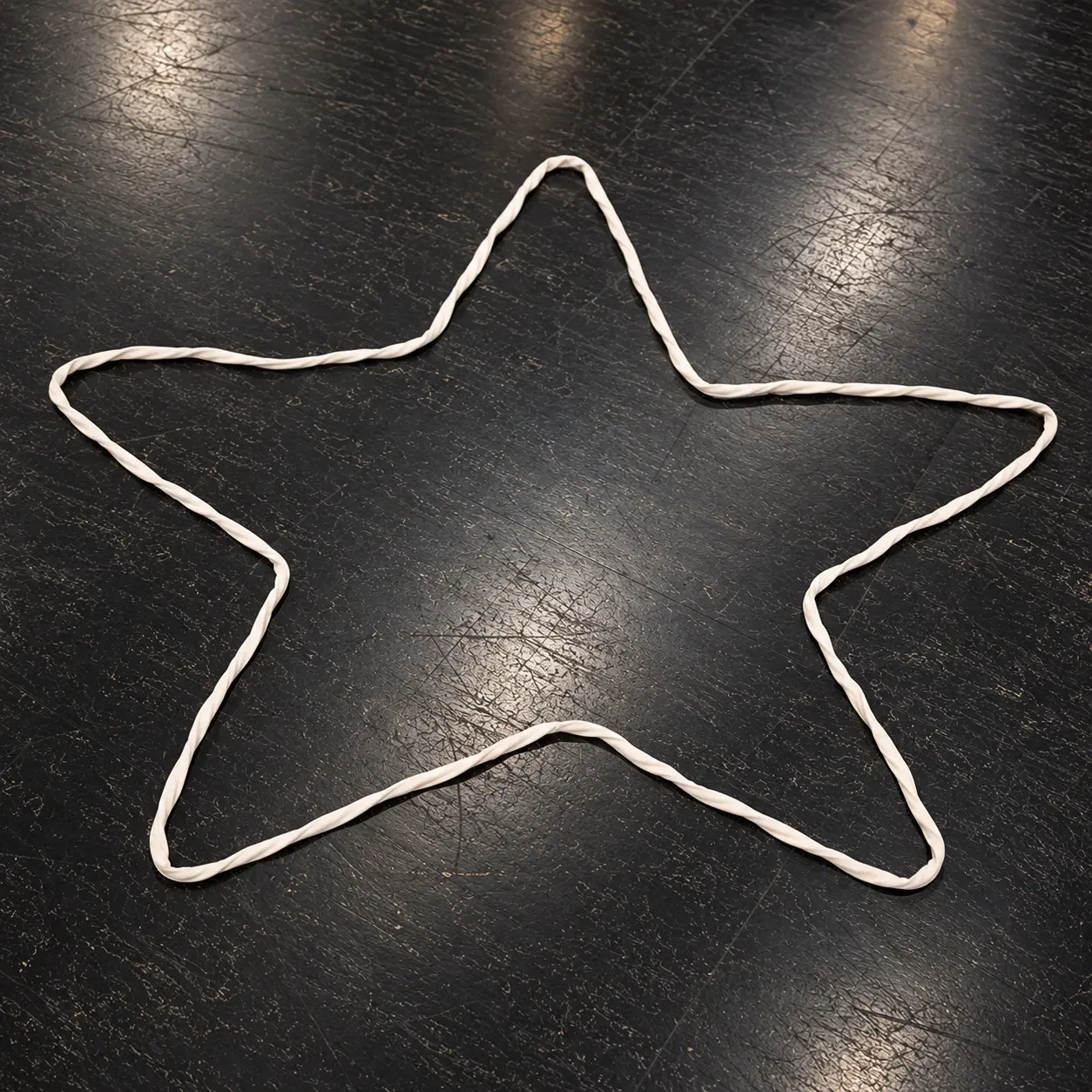
I stopped in front of a five-pointed star.
To me, its five points became a symbol of my five children. Each point represented one of them: Oleksandr, Daryna, Volodymyr, Zlata and Karolina.
That was how I interpreted the image.
I did not know what its creator had intended. Nor did I try to guess. I simply told the story that came to mind when I saw the star.
Other participants also began interpreting what they saw, drawing on their own associations and experiences.
Then the task changed again. We formed groups of four and had to create a story by combining two images.
For example, a star and a tree could become the beginning of a story about a family tree, resting in its shade and sharing the fruit it bears.
Two separate images gave rise to a third story — one that had not existed before.
The participants created it together, finding connections, negotiating ideas and bringing different elements into a shared narrative.
A Locomotive and the Journey from Ukraine to Portugal#
Finally, we returned to our own images and could tell their stories.
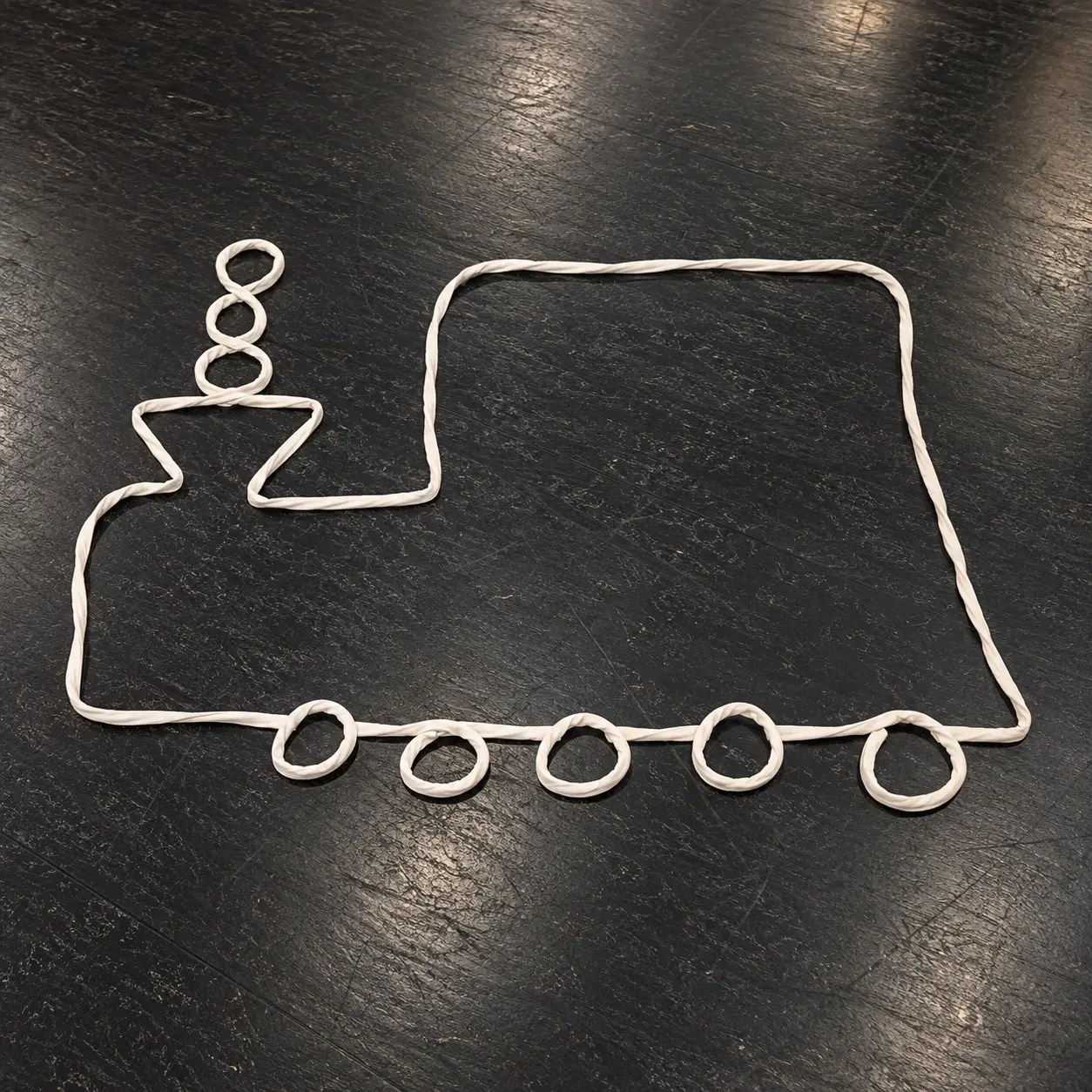
My locomotive represented our journey from Ukraine to Portugal. We travelled on different trains for six days, escaping the war with our children.
For me, the composition represented a concrete experience — a real journey that had become part of our family history.
Another participant, a schoolboy, spoke about wars and the people who die every day as a result of violence. He had a special red strip. He spoke in French, and someone helped with the translation.
I cannot claim to have understood every word. However, as far as I could understand, his story concerned the human losses and violence that continue to take place around the world.
Different scales of human experience stood side by side: the personal story of a journey between two countries and a reflection on tragedies affecting people in different parts of the world.
Each image had its own story. Each participant brought into the shared space something that mattered to them.
The Point of Intersection#
At the end, we each took one end of our image and moved it towards the centre of the room.
There, the ends of all the compositions came together.
This is the image that stayed with me: different lines, created by different people, converging in one place.
And I thought about intersection.
In mathematics, the intersection of two sets does not mean that they become identical. It means that they have something in common — a point or a part that belongs to both.
It seems to me that this image can serve as a metaphor for human encounters.
We arrive with different stories, experiences, languages and ways of seeing the world. Sometimes we understand one another. Sometimes we see different things in the same image. And sometimes we create a shared story that belongs entirely to none of us.
We Do Not Always Need to Decipher Others#
This meeting also reminded me of changes that have taken place in my own life.
I used to analyse other people’s actions extensively, trying to understand their decisions and often giving advice, including to my children, even when they had not asked for it.
Eventually, I felt a sense of relief when I stopped taking that kind of responsibility upon myself.
I realised that the same problem can have several solutions. Shoelaces, for example, can be tied in different ways. If they are tied and serve their purpose, does it really matter whether they have been tied exactly as I would have tied them?
Perhaps this simple thought also matters in how we perceive other people.
Not every action needs to be analysed. Not every story needs to be deciphered. Not every image needs to be interpreted according to its creator’s intention — especially when that intention is unknown to us.
We can allow another person to see the world in their own way, while allowing ourselves to respond to it in ours.
This does not mean that understanding others is unimportant. It means that understanding does not always begin with analysis, and respect does not necessarily require us to explain every action.
Sometimes it is enough to be present, to listen and to leave room for what we do not know.
When Our Stories Intertwine#
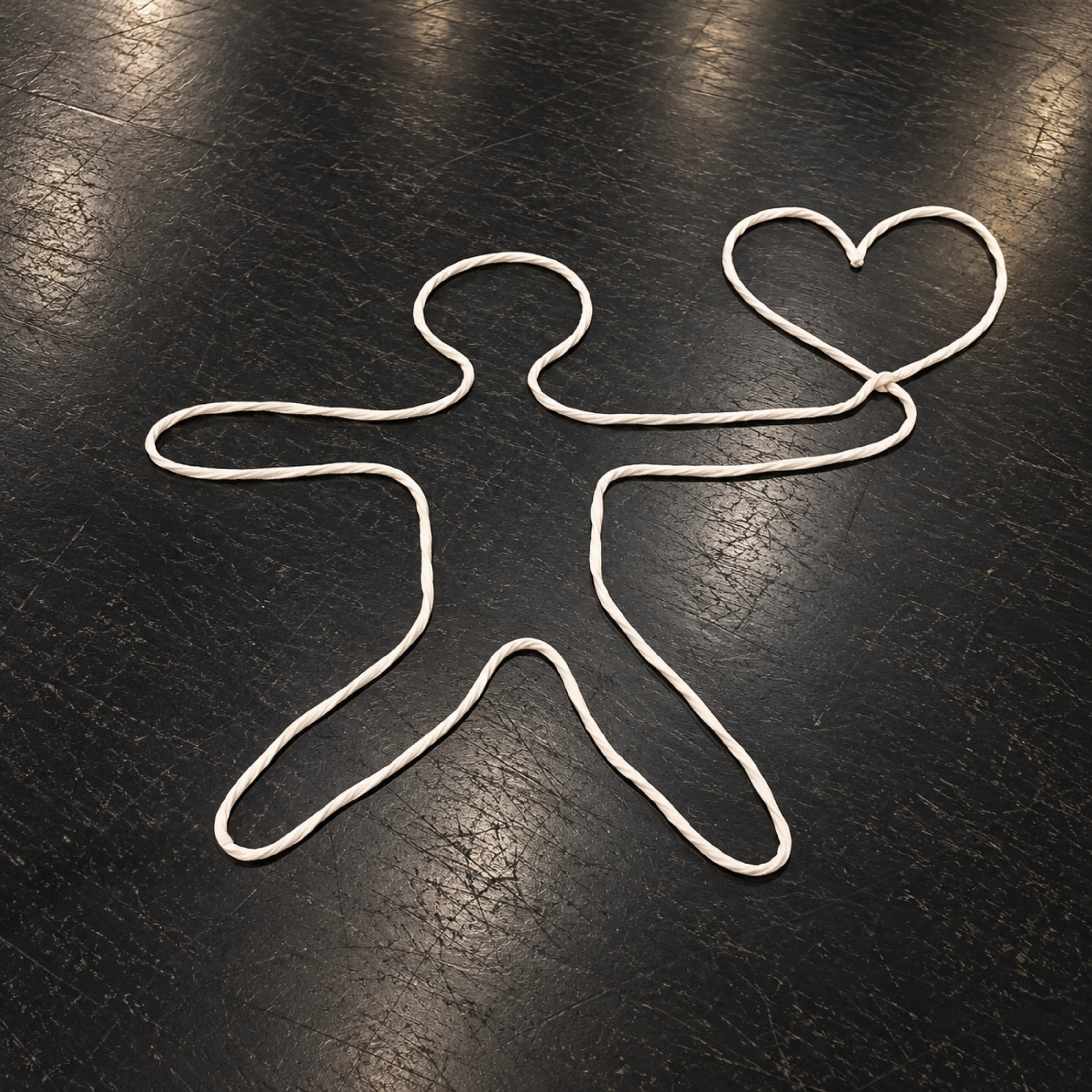
For me, this meeting became an experience of different stories interacting.
A white strip became an image. The image evoked associations. Two images became a shared story. And eventually, separate compositions met at a common centre.
I see something important in this process: a shared space does not necessarily emerge when everyone thinks alike or interprets what they see in the same way.
It can emerge when different people allow their stories to meet.
Not to make them identical.
But to discover that a connection can exist between them.
P.S.#
When our stories intertwine, each remains its own. But the space between them is no longer what it was before the encounter.
Alt-text:
White fabric strips forming a locomotive, a five-pointed star, a person offering a heart, and other abstract shapes on a dark charcoal floor, with their lines converging at a shared centre.
Living Topography. When Our Stories Intertwine. AP | Pivtorak.Studio. 08.10.2026
© Anna Pivtorak (Kostyuk)