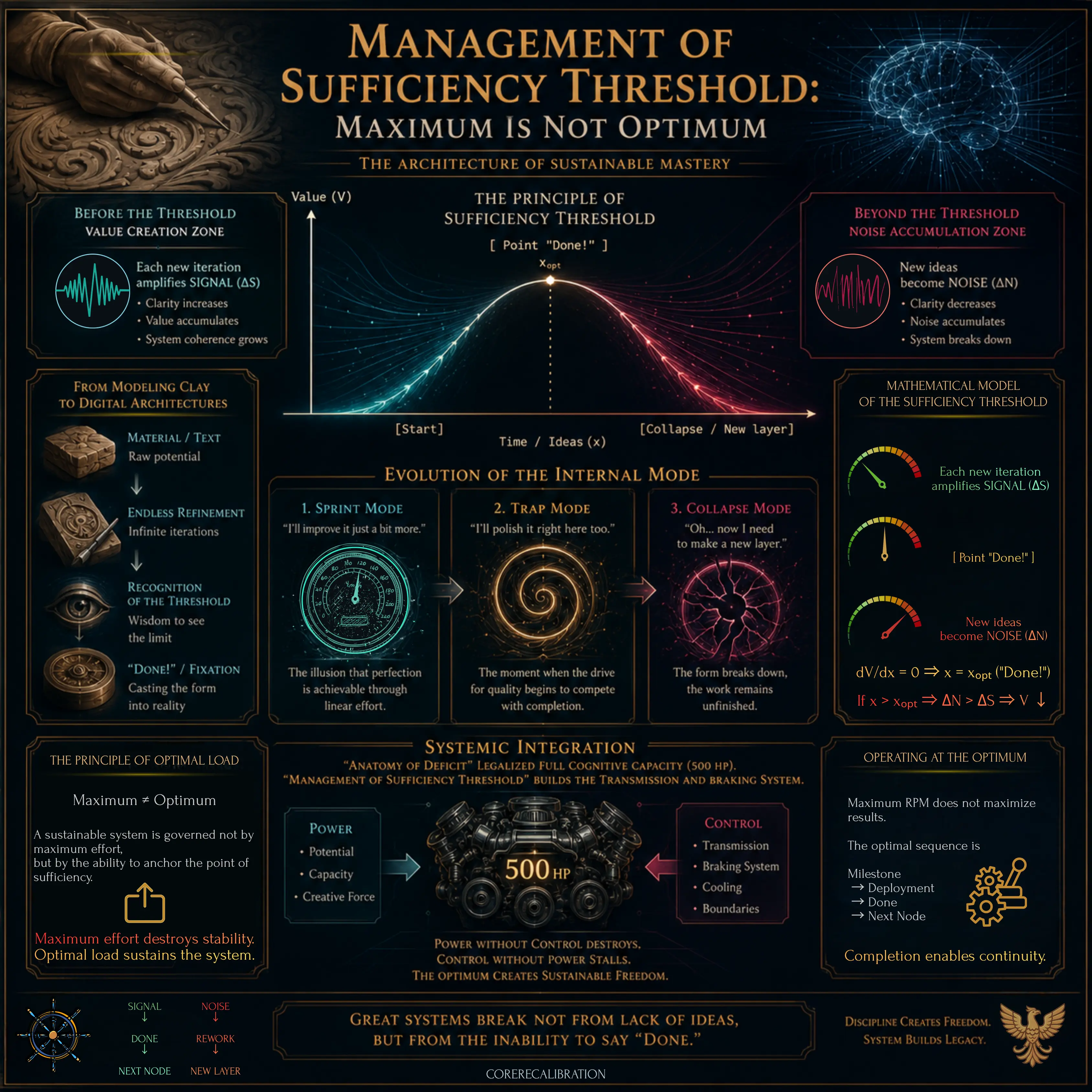
Management of Sufficiency Threshold. Maximum is not Optimum | ⟡ Core Recalibration#
“Done” is also a form of mastery.
In what mode must the system itself operate to avoid collapse?
I. Cognitive Trajectory: From Modeling Clay to Digital Architectures#
Long before working with digital systems, I studied in a private icon-painting workshop, mastering the full cycle of creating icons and decorative bas-relief covers (oklads): gesso (levkas), underdrawing (proris), gilding, egg tempera painting, as well as modeling relief ornaments in plasticine followed by the production of casting molds.
It is at this stage that one of the main traps of mastery manifests. Plasticine allows for endless refinement of the ornament: one more stroke, one more line, one more curl. But beyond a certain threshold, each new intervention no longer improves the form. It destroys it. And then one has to start over, applying new layers of material.
Many years later, the exact same principle manifested in digital projects — during the construction of the site’s Front Matter, series architecture, and content management.
[Material / Text] ⭢ [Endless Refinement] ⭢ [Awareness of Threshold] ⭢ [“Done!” / Anchoring]
Large systems collapse not from a lack of ideas, but from an inability to put a full stop.
The ability to say “Done!” is an act of sovereignty over one’s own thinking process.
II. The Principle of Optimal Load#
Maximum intensity is not the optimal operating mode of a system.
Sustainability is determined not by a continuous increase in effort, but by the ability to timely anchor the point of systemic sufficiency.
III. Mathematical Model of the Sufficiency Threshold#
If we represent the value of work V as a function of the number of additional ideas and refinement time x, we obtain a classic extremum parabola.
Up to the point xₒₚₜ, each new iteration amplifies the useful signal (ΔS), increasing the overall value of the system.
Beyond the critical point xₒₚₜ, the signal gain (ΔS) approaches zero, while the noise gain (ΔN) begins to dominate.
This is precisely why the total value of the work (V) decreases, and the system transitions into a mode of self-destruction.
-
dV/dx = 0 ⇒ x = xₒₚₜ (“Done!”)
-
If x > xₒₚₜ ⇒ ΔN > ΔS ⇒ V ↓
Value (V)
   ▲
   │                               [ Point "Done!" ]
   │                                      xₒₚₜ
   │                                     _.._
   │                                   .'    `.
   │                                  /        \
   │    Each new iteration →         /          \  ← New ideas
   │    amplifies SIGNAL (ΔS)       /            \   become NOISE (ΔN)
   │                               /              \
   └───────────────────────────────┴──────────────┴──────────────► Time / Ideas (x)
                                [Start]     [Collapse / New layer]
IV. Evolution of the Internal Mode: From Polishing to Anchoring#
In the creative and research process, the cognitive track of a highly structured mind typically passes through three stages of transformation:
- Sprint Mode: “I’ll improve it just a bit more” (The illusion that perfection is achievable through linear effort).
- Trap Mode: “I’ll polish it right here too” (The moment when the drive for quality begins to compete with completion).
- Collapse Mode: “Oh… now I need to make a new layer” (The form breaks down, the work remains unfinished).
Transitioning to the Management of Sufficiency Threshold is not a rejection of potential. It is a shift from amateur perfectionism to mature mastery. Completion is an indispensable part of the system’s architecture.
V. Operating at the Optimum: Why Maximum is a Mistake#
A car engine constantly held at maximum RPM (the tachometer’s red zone) quickly fails, and the ride itself does not get any better. For long-term civilizational series (such as the blocks on Iran or Afghanistan), working at the maximum is “fatal.”
The system must function in a mode of controlled optimum:
Milestone ⭢ Deployment ⭢ Anchoring (“Done!”) ⭢ Transition to the next node
The most valuable idea is the one that was realized and released into space, not the one that remained invisible due to the endless accumulation of “just one more angle.”
VI. Systemic Integration#
The previous recalibration, “Anatomy of Deficit,” legalized the system’s right to operate at full cognitive capacity. But capacity alone does not guarantee sustainability. A 500 hp engine cannot function without a gearbox, a cooling system, and brakes. “Management of Sufficiency Threshold” introduces precisely these mechanisms.
It does not reduce the power of thought. It makes it manageable. That is why this recalibration does not limit creativity. It prevents its self-destruction. Without a completion mechanism, even the most powerful cognitive processor is capable of endlessly adding new layers to a work that has already reached the point of systemic sufficiency.
Alt-text:
Infographic illustrating the Sufficiency Threshold. a mathematical model where value reaches an optimum before additional refinement turns signal into noise.
Management of Sufficiency Threshold. Maximum is not Optimum. AP | Pivtorak.Studio. 26.06.2026
© Anna Pivtorak (Kostyuk)