The Formation: School, University & PhD Years#
Thinking does not emerge as a system instantly. It is formed through repeated encounters with precision.
This section covers the formation process — from school to academic and research environments.
Beginning: precision and error#
The first encounters with precision began in school.
Early on, mistakes were not accepted as final.
They were corrected through repetition.
- pages were removed
- tasks were rewritten
- structure was restored manually
This formed a key principle: precision is achieved through repetition and control
Mathematical foundation#
A physics-mathematics environment reinforced:
- logical thinking
- structural consistency
- ability to handle complexity
Academic education#
Economics & systems#
- Bachelor — Economic Cybernetics
- Specialist — Management
Taras Shevchenko National University of Kyiv
Culture & expertise#
- Master — Art History, Expertise & Valuation
National Academy of Culture and Arts Management
Research#
- PhD studies — Economics
Academy of Labour, Social Relations and Tourism
Meaning#
This path combines:
- mathematical precision
- structural management
- cultural analysis
It results in:
a way of thinking that operates across systems and meanings
This section documents not education as a list,
but the formation of structured thinking.
Alt-text:
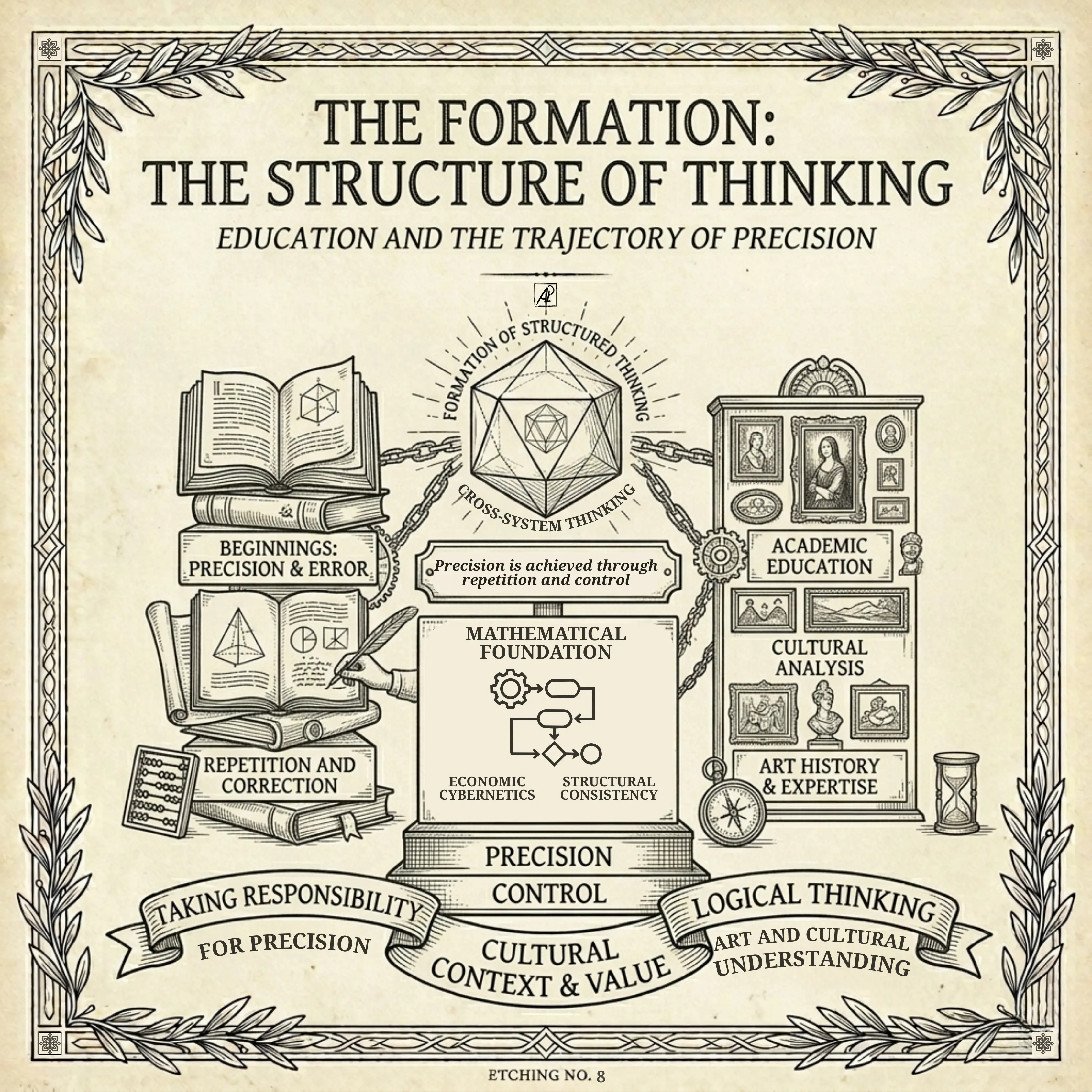
To visualize the formation of thinking, a complex composition is used, combining stages of learning, repetition, and systematization of knowledge.
At the center is a geometric structure symbolizing the formation of structured thinking and the ability to operate across systems. It connects all elements into a unified logic.
The left side represents the early stage — encounters with precision and error. Books, notes, and rewriting processes illustrate repetition, correction, and manual reconstruction of structure, forming the principle: precision is achieved through repetition and control.
Below, the mathematical foundation is depicted through logical scheme, representing structural thinking and the ability to manage complexity.
The right side represents academic education and cultural context: economics, management, art history, and expertise. Visual elements include books, archives, artworks, and symbols of time.
At the bottom, key outcomes are presented: precision, control, logical thinking, and cultural understanding.
The composition represents not education as a list, but the formation of a structured way of thinking.