👨⚖️ Author’s Declaration
This publication is part of an authorial research and artistic project created by an Independent Researcher and Creator (Analyst-Artist).
The material is based on the analysis of open sources and reflects the author’s personal research perspective.
Metaphors, imagery, symbols, and conceptual models may have an allegorical character and are used as tools of philosophical and systemic analysis.
This material is not a legal accusation, a journalistic investigation, or an official conclusion of any institution.
📋 Methodological Note
This series is an exercise in civilizational modeling.
The use of the present tense does not indicate an existing political reality, a prediction, or a factual statement.
The texts describe desirable systemic configurations and ethical horizons toward which societies may consciously choose to move.
The works function as architectural blueprints for possible futures rather than as descriptions of current events.
The purpose of the project is not to predict history, but to design coherent models of civilization that may serve as long-term reference systems for public reflection, institutional design, and human agency.
Every work in this series should therefore be understood simultaneously as a manifesto, a systems design exercise, and a civilizational hypothesis.
✯ Extra Credit Problem (The Asterisk Problem)
Iran – Persia: A Civilizational Transition
From the Dismantling of a Regime to the Revival of Civilization
IV. Vulnerability Point. Human Factor#
🔔 Ethical Resonance#
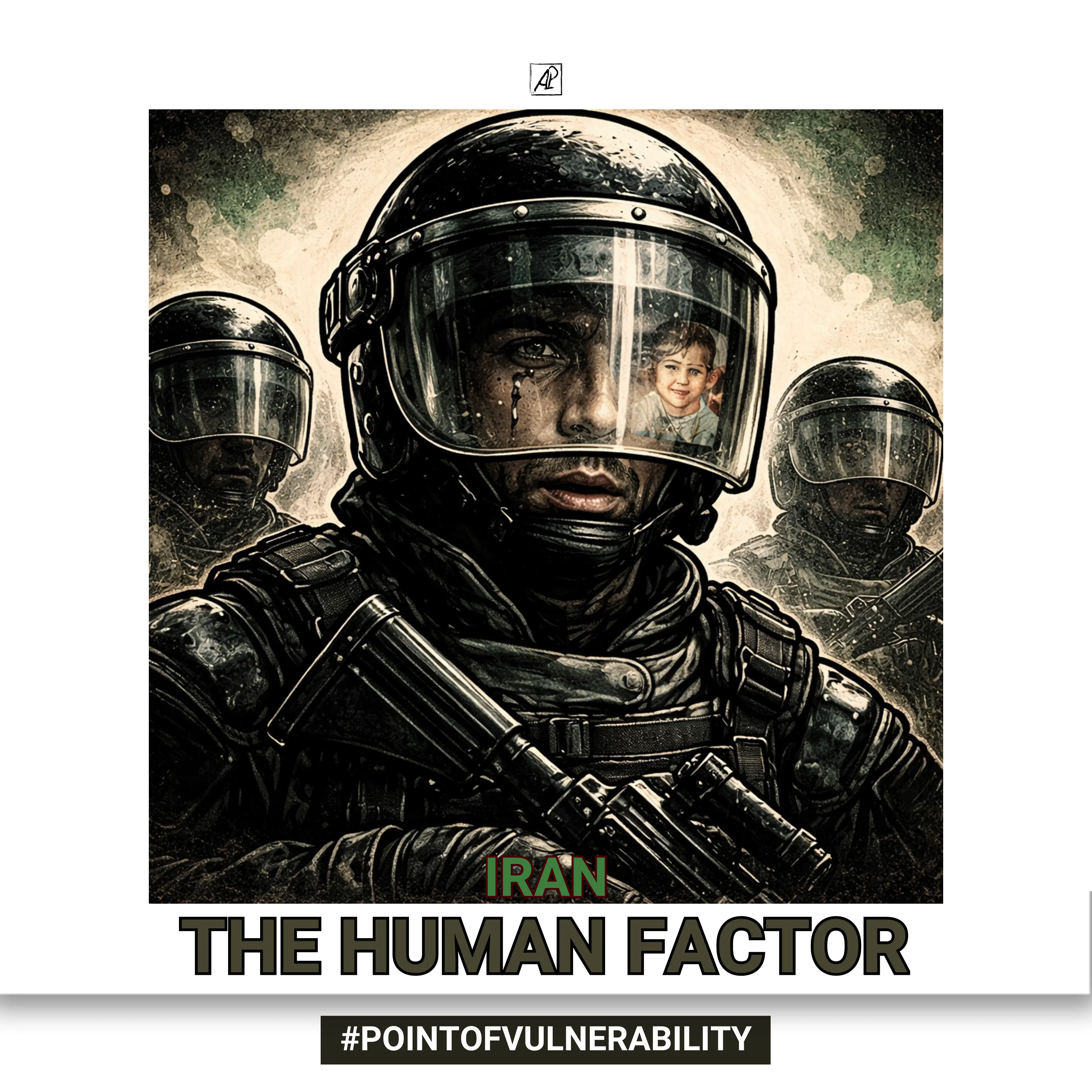
You stand in a dense line, holding your weapon. Your helmet conceals your face, making you part of an unyielding machine. But through the visor, somewhere deep in your soul, another reality suddenly flickers. It might be a tear unexpectedly rolling down your cheek, or the casually recalled face of your own child, so similar to the child standing before you now, throwing a stone.
The system has taught you to follow orders, to depersonalize the “enemy,” and to see only an abstract threat. But humanity cannot be fully depersonalized. The loss of humanity is a process, not a single act. And somewhere in this process, there is a breaking point where pressure from above conflicts with the last spark of conscience, with the memory of who you were before you became a “cog.”
At this point, a person feels the fragility of their armor. It is the state of a sensor registering the mismatch between the order and an internal sense of truth. The fear of punishment from the top suddenly becomes less than the fear of oneself, less than the disgust with one’s own actions.
The system is no stronger than the doubt of the last executor.
📐 Systemic Solution Manifesto#
[GIVEN]:#
The Iranian regime relies on a vast apparatus of executors—from rank-and-file Basij members to IRGC officers. Each is a “cog” carrying out orders. But every “cog” has a human face hidden beneath a helmet.
Facts: During the crackdown on protests in January 2026, despite the brutality, there were isolated cases where security forces refused to shoot or helped protesters. These isolated “malfunctions” in the system confirm: indoctrination is not absolute. In moments of extreme tension, when an order directly conflicts with a moral compass or personal fears, even the most loyal executor can succumb to doubt.
[PARAMETERS OF ASYMMETRY]:#
- Order vs. Conscience: A direct order for violence conflicts with internal convictions, creating a crack.
- Helmet vs. Face: The anonymity of the uniform disappears when a personal tragedy or the realization of a crime appears behind its visor.
- System vs. Individual: Collective responsibility erodes when a specific victim or one’s own family comes into view.
[ANALYSIS]:#
The “Human Factor” is a point of vulnerability where the system’s fragility is revealed not in facades or resources, but in the souls of its executors. We are not looking for heroes, but for moments of hesitation, weakness, and weariness from lies. The dictatorship believes its apparatus is flawless, but even one “cog” rusted by doubt can stop the entire mechanism. This is internal sabotage that begins with a single tear or a glance at a child’s photograph.
Key Phrase: “The system is no stronger than the doubt of the last executor.”
[CONCLUSION]:#
We diagnose:
the regime has an internal, uncontrollable vulnerability.
This is an unavoidable crack in everyone who wears a uniform.
Every act of violence, carried out thoughtlessly, is deposited in the soul, and one day this “sum of sins” will outweigh the fear of the top leadership.
Alt-text:
Face of an Iranian security officer wearing a helmet. Through the transparent visor, a tear or a photograph of his child. He stands in formation holding a weapon, surrounded by other officers.
✯ Extra Credit Problem (The Asterisk Problem). Iran – Persia: A Civilizational Transition.
IV. Vulnerability Point. Human Factor. AP | Pivtorak.Studio. 21.01.2026
© Anna Pivtorak (Kostyuk)
🛡️ This publication is part of an authorial research and artistic project.
The material is based on the analysis of open sources and contains the author’s interpretations, metaphors, and conceptual models.
The described images and concepts may be allegorical in nature and do not constitute legal accusations or official conclusions regarding any individuals, organizations, or states.