Precious Metal Reference Value Calculator#
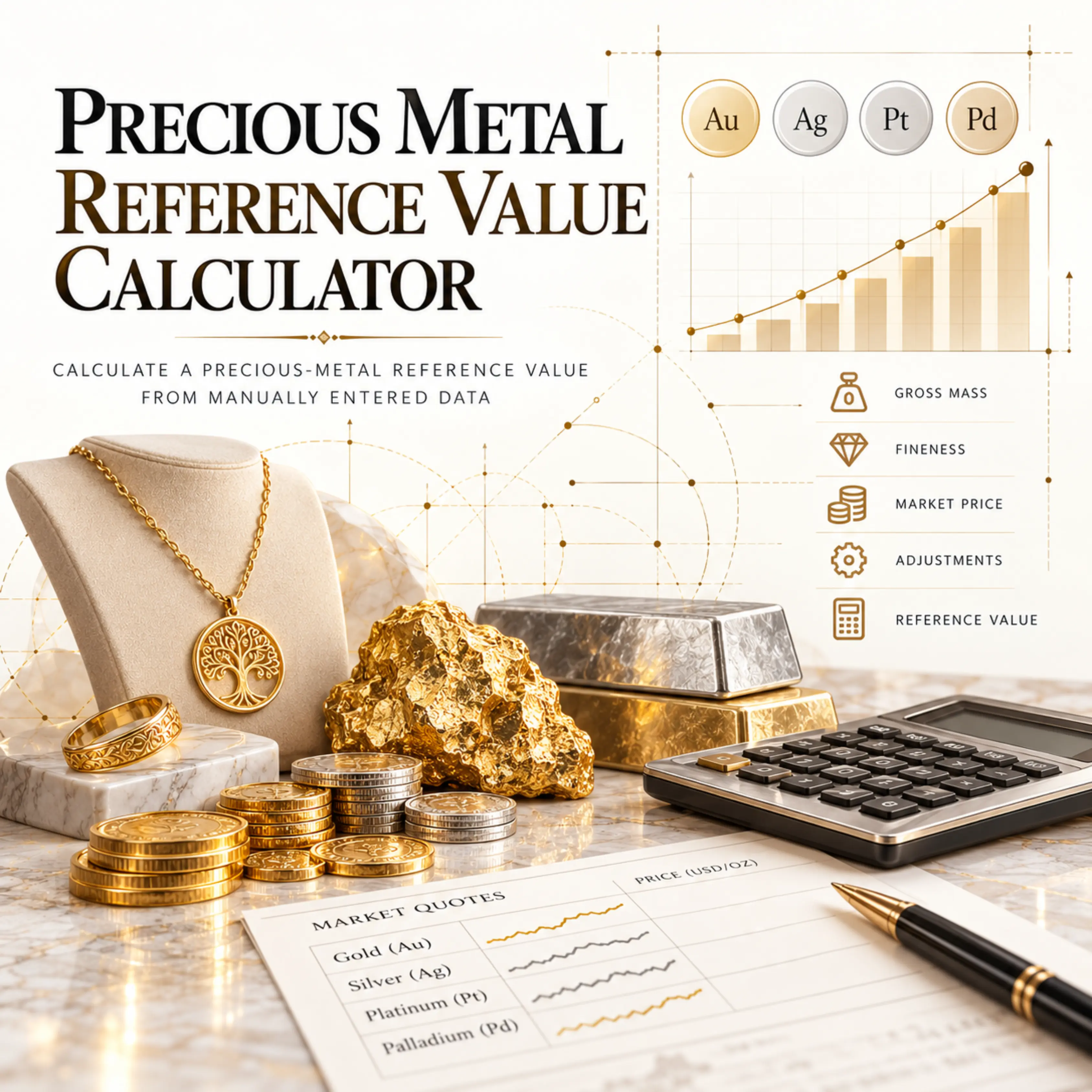
This educational page explains calculations for one gold, silver, platinum or palladium component using values entered manually by the reader. The examples distinguish a fine-metal reference value from a value after explicitly entered adjustments. No market prices or exchange rates are retrieved. Results are arithmetic based on the inputs; they are not an offer, quotation or guaranteed market value from Pivtorak.Studio.
The calculator separates the estimated value of the fine precious metal contained in an item from any additional adjustments entered by the user. By keeping the inputs explicit and the calculation transparent, it helps readers understand how mass, fineness, market price and optional adjustments affect the resulting reference value.
Model A — Normalize a reference price and calculate fine-metal reference value#
Use this model when you have a price from a market reference or dealer/supplier quotation and a verified quotation-unit mapping for that source and metal. It converts the entered price to a price per gram of fine metal, then calculates the fine-metal content and its reference value.
$$ \begin{gathered} m_f=m_g\frac{F}{1000}\\ P_g=\frac{P_u}{B_u}\\ V_r=m_fP_g \end{gathered} $$
For a verified price per fine troy ounce, $B_u=31.1034768\ \mathrm{g/ozt}$.
- $m_g$: gross component mass, in grams. Convert a different mass unit to grams using its defined factor.
- $F$: user-entered fineness in parts per thousand (‰); for example, 750 means 750‰. This is not an assay.
- $m_f$: calculated fine-metal mass, in grams.
- $P_u$: manually entered reference price, in the entered currency per the verified quotation unit.
- $B_u$: grams of reference metal represented by one quotation unit, as specified by the verified source/metal mapping. It is not editable as an arbitrary runtime conversion. For price per fine troy ounce, it is 31.1034768 grams.
- $P_g$: normalized price, in entered currency per gram of fine reference metal.
- $V_r$: fine-metal reference value, in entered currency.
Fineness applies to the component mass once. The source mapping defines the quotation basis and must not apply product purity again. Calculation is unavailable until that mapping is verified. This value excludes other alloy constituents, workmanship, stones and commercial terms.
Worked example. Hypothetical 10.00 g component at 750‰; hypothetical USD 2,000 per verified fine troy ounce:
$$ \begin{gathered} m_f=10.00\ \mathrm{g}\times\frac{750}{1000}=7.50\ \mathrm{g}\\ P_g=\frac{2{,}000\ \mathrm{USD/ozt}}{31.1034768\ \mathrm{g/ozt}}\\ =64.301\ \mathrm{USD/g}\\ V_r=7.50\ \mathrm{g}\times64.301\ \mathrm{USD/g}\\ \approx482.26\ \mathrm{USD} \end{gathered} $$
This is a reference value from hypothetical inputs, not a market quote or offer.
Model B — Apply one user-entered premium or discount#
Use this model only to show one explicitly selected adjustment to the reference value. Choose one basis: amount per gram of fine metal, amount per fine troy ounce, or percentage of reference value. Alternative bases are not stacked.
$$ \begin{aligned} A&=\begin{cases} a_gm_f & \text{per gram of fine metal},\\ a_om_f/31.1034768 & \text{per fine troy ounce},\\ V_rp/100 & \text{percentage of reference value} \end{cases}\\ V_a&=V_r+sA \end{aligned} $$
- $A$: adjustment amount, in entered currency.
- $a_g$: adjustment magnitude per gram of fine metal, in currency/g.
- $a_o$: adjustment magnitude per fine troy ounce, in currency/ozt.
- $p$: adjustment magnitude in percent; for example, 2 means 2%.
- $s$: sign, +1 to increase or −1 to decrease. Use a separate sign control or a signed input, never both.
- $V_a$: adjusted calculated value, in the same currency as $V_r$.
This adjustment is a user-entered scenario, not a recommended premium or discount. Only one basis is used per calculation. The fine-troy-ounce basis is valid only where that unit has been explicitly verified. No market convention, dealer spread or commercial term is inferred.
Worked example. From Model A’s hypothetical USD 482.26 reference value and 7.50 g fine mass, apply a hypothetical +USD 1.00/g adjustment:
$$ \begin{aligned} A&=1.00\ \mathrm{USD/g}\times7.50\ \mathrm{g},\\ &=7.50\ \mathrm{USD},\\ V_a&=482.26+7.50,\\ &=489.76\ \mathrm{USD} \end{aligned} $$
This is an adjusted calculation from user-entered values, not an offer.
Model C — Calculate user-entered charge lines#
Use this model to add or subtract explicitly entered amounts on defined bases. Each line has its own basis, rate, applicable quantity and sign. A charge is not a premium unless entered as the Model B adjustment.
$$ \begin{aligned} C_i&=q_ir_i,\\ V_c&=V_r+\sum_{i=1}^{n}s_iC_i \end{aligned} $$
- $i$: charge-line index; $n$: number of lines.
- $q_i$: basis quantity: gross grams, fine-metal grams, item count, batch count or shipment count, as selected.
- $r_i$: entered rate in entered currency per selected basis unit, such as USD/g gross or USD/item. A fixed per-item, per-batch or per-shipment amount uses the applicable count.
- $C_i$: calculated amount for line $i$, in entered currency.
- $s_i$: +1 to add or −1 to subtract the line.
- $V_c$: calculated value after entered charge lines, in the same currency as $V_r$.
All lines use the same currency as the reference value; this model does not convert currencies. Select “no charge lines” explicitly to leave the reference value unchanged. The calculation does not determine tax or accounting classification, delivery responsibility or whether a charge is already included elsewhere. Avoid entering the same component twice.
Worked example. Starting from USD 482.26, enter +USD 0.20/g gross mass and −USD 1.00/item for one item:
$$ \begin{aligned} C_1&=0.20\ \mathrm{USD/g}\times10.00\ \mathrm{g},\\ &=2.00\ \mathrm{USD},\\ C_2&=1.00\ \mathrm{USD/item}\times1\ \mathrm{item},\\ &=1.00\ \mathrm{USD},\\ V_c&=482.26+2.00-1.00=483.26\ \mathrm{USD} \end{aligned} $$
This is a transparent arithmetic scenario only, not a commercial quotation, binding offer or guaranteed value.
Sources, input provenance and limitations#
The LBMA gives $1$ troy ounce $=31.1034768$ g in its weighing guidelines. Expressing measured gold content in parts per thousand is consistent with the scope described by ISO 11426:2021. The adjustment and charge equations are arithmetic definitions for user-entered scenarios, not universal precious-metal trading rules.
Enter the source description, quotation basis, date and time when known. Missing source or time information must be identified as “not supplied,” never inferred. Manual entry does not establish that the source’s licensing terms permit a particular use. Pivtorak.Studio does not endorse a data provider, dealer or supplier. The calculator does not retrieve prices or exchange rates and does not calculate taxes, profitability, refining settlement, other alloy constituents or quantity tiers.
Related: Precious Metal Price Calculator.
Alt-text:
Calculation of precious-metal reference value from manually entered price, mass, and fineness.
Calculators. Jewelry Calculators. Precious Metal Reference Value Calculator. AP | Pivtorak.Studio. 20.10.2026
© Anna Pivtorak (Kostyuk)