Emotions We Needed to Experience | Living Topography#
29 October 2026 | Meeting № 5 | agirE CLDS 5G, Esposende
Sometimes we don’t need to act. We simply need to allow ourselves to feel.
A theatre workshop is not necessarily about acting skills. Sometimes it becomes a space in which we can explore ourselves through movement, interaction and attention to the body. In this session, we worked with pathways, space and the qualities of movement, followed by twelve emotional states to be expressed without words. We had no professional training and were not looking for one correct way to perform. Each of us found our own approach through imagination, observation or personal experience. For me, this session became an opportunity to encounter an emotion I had been putting off for a long time and to hear what my body had already been trying to say.
DESLOCAR — Movement That Opens an Inner Space#
The fifth theatre workshop session was devoted to movement. Its title, Deslocar, means to move, to change position, to travel from one point to another.
The session’s motto was:
Todo caminho muda quem caminha.
Every path changes the person who walks it.
We began with a shared rhythm. One person established a simple pulse with their hands or feet, while the others picked it up and passed it along. The rhythm changed, accelerated and slowed down until everyone finished together.
Then we explored pathways: straight lines, curves, diagonals, changes of speed and direction. We learned to respond to other people’s movements and to let encounters change our routes.
Gradually, our attention shifted from movement itself to the way we performed it.
The Body as an Instrument of Expression#
Hugo introduced us to four components of movement, drawing on the principles of Rudolf von Laban:
- Corpo — Body: awareness of our own bodies, their parts, muscle tone, breathing and gestures.
- Esforço — Effort: weight, time and movement dynamics.
- Espaço — Space: direction, pathways and interaction with the surrounding environment.
- Forma — Shape: the architecture of the body and its ability to convey a particular state through posture, movement and interaction with space.
We explored simple physical actions: walking, jumping, stepping back, picking something up, lying down and standing up. Nothing particularly complicated, one might think. Yet even familiar movements can take on very different qualities depending on how we perform them.
Some exercises focused on space. We worked with different positions, objects and the presence of other people. Observers gave instructions, while performers translated them into specific physical actions. Then we switched roles.
The floor, walls, ceiling, a bench, the distance between people — everything could become part of a movement composition.
Space was no longer simply somewhere we occupied. It became an active part of our interaction.
When Emotions Go Beyond Words#
The most interesting part of the session involved emotional states.
Hugo had prepared cards featuring twelve different states:
- Desespero urgente — urgent despair.
- Melancolia flutuante — floating melancholy.
- Arrogância calculista — calculating arrogance.
- Euforia descontrolada — uncontrolled euphoria.
- Paranoia súbita — sudden paranoia.
- Serenidade absoluta — absolute serenity.
- Raiva explosiva — explosive anger.
- Timidez extrema — extreme shyness.
- Fascinação sincera — sincere fascination.
- Exaustão profunda — profound exhaustion.
- Ganância obsessiva — obsessive greed.
- Culpabilidade opressiva — oppressive guilt.
Each person had to draw a card and express the indicated state through body movement.
We were not professional actors. We had no formal theatre training and did not know how to act out each emotion correctly.
But perhaps that was precisely what made the exercise special.
Each of us could draw on personal experience, observation, imagination or memories. Some recreated something they had experienced before. Others tried to imagine an unfamiliar state. And some may have found an opportunity to allow themselves to experience something for which they had never previously made room.
We were not so much imitating emotions as searching for a way to make them visible.
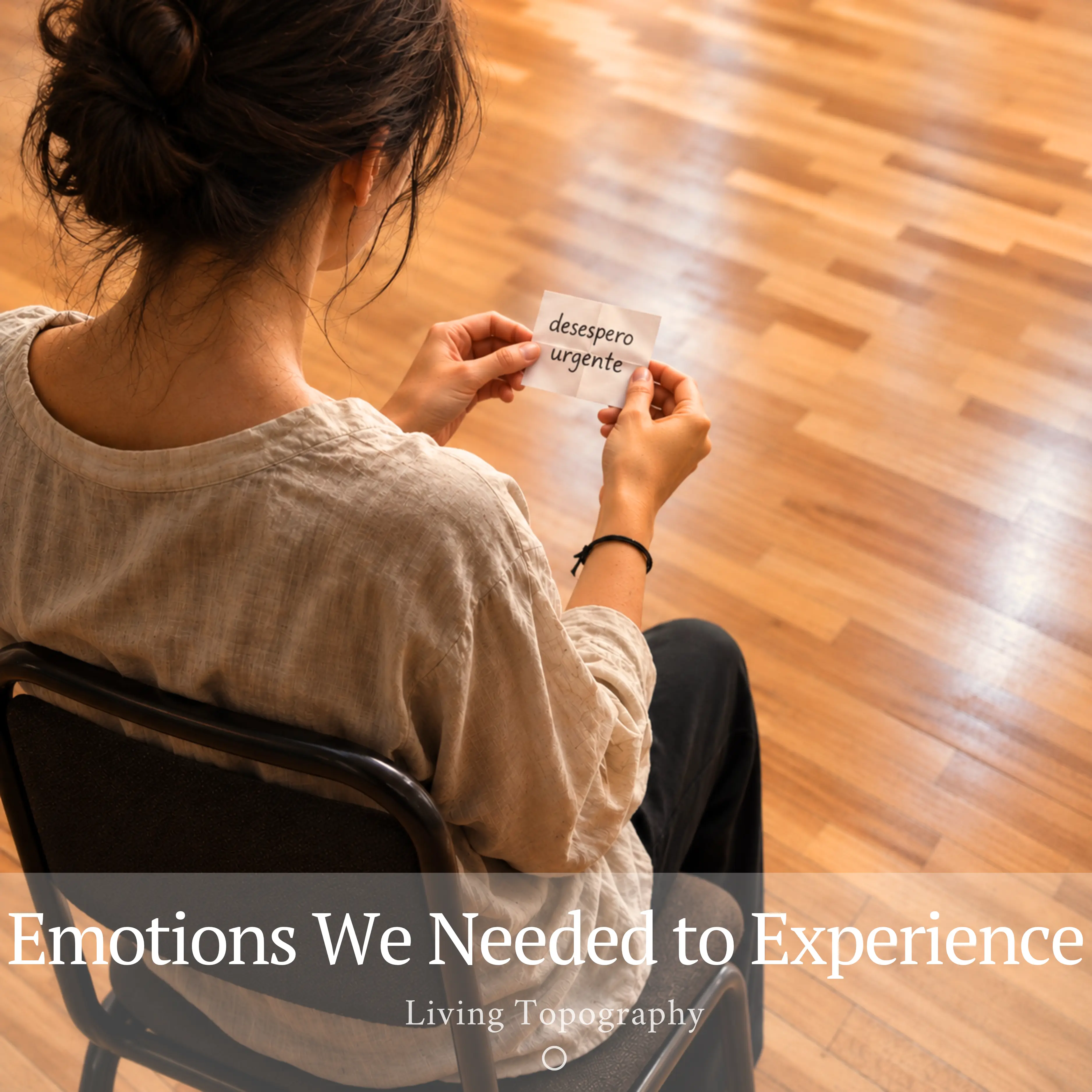
Desespero urgente — My Moment#
I drew the card marked Desespero urgente.
Urgent despair.
I had a general idea of how I might portray this state. The day before, I had finally faced information I had been putting off for a long time. Some things still had no definitive answers, but the very fact that I could no longer postpone this encounter with uncertainty already demanded an emotional response.
And then, the following day, I drew precisely that emotion.
I started moving frantically from side to side. I looked into the eyes of the other participants as if waiting for explanations. I shifted my gaze from the piece of paper in my hands to one person, then another. Back to the paper. Searching for an answer in other people’s eyes, but finding none.
Eventually, I sat down on a chair and continued staring into the emptiness.
I had even gone pale.
The participants tried to guess which emotion I was portraying. They suggested different expressions that were close in meaning. In a way, they were all right. Hugo immediately recognised it as Desespero urgente.
I had not intended to bring my personal experiences into the exercise. But it seemed my body already had its own response.
I wasn’t acting out despair. I was experiencing it through movement.
And perhaps that was precisely why the scene made sense to the others without a single word.
Later, when I received Hugo’s materials, I became curious to compare my improvisation with the parameters he had assigned to this exercise. It turned out that my spontaneous response corresponded quite closely to the four movement qualities specified for this emotional state.
| Parameter | Hugo’s instruction | My interpretation |
|---|---|---|
| Peso | Firme | A tense body |
| Tempo | Súbito | Sudden shifts of position and gaze |
| Espaço | Direto | Searching for an answer in other people’s eyes |
| Fluidez | Livre | A free, spontaneous sequence of movements |
I had not known these technical details and had not consciously tried to follow the prescribed qualities. Yet I had intuitively expressed them through my own response.
A Little Curtsy#
There is another episode from this session that I would like to preserve.
I had arrived late to the third and fourth sessions. Spanish classes had started on those same days, and before leaving I needed to prepare dinner for a large family. Sometimes that meant several different dishes, taking individual preferences into account.
The first time, I started cooking just an hour before leaving and arrived half an hour late. The next time, I tried starting an hour and a half beforehand, but still arrived late — although this time by only fifteen minutes.
This time, I almost made it. Almost meant arriving just five minutes late.
I came in and joined the circle. During a pause, Hugo called my name, and we all performed a curtsy together, just as we had during our first sessions.
It felt so lovely!
At the same time, I wanted to show the group the same respect in return — by arriving on time next time.
A small gesture, but it reminded me that a group is more than just people attending the same session. It is a space of mutual attention, where everyone matters.
Mostrar. Explicar. Sentir.#
At the end of the session, we sat in a circle. Hugo asked each person to name a verb that could describe the workshop.
I said Mostrar — to show.
Later, another word came to mind: Explicar — to explain.
Now, as I return to Hugo’s materials, reconstruct the exercises and try to understand their sequence, I feel that both words were appropriate.
First, we showed things we could not always explain. Then we tried to understand what had happened.
But there is one more word that was not mentioned at the time.
Sentir — to feel.
Finding My Way Back to Myself#
Perhaps the most important part of this session only became clear to me afterwards.
I resumed my morning walks.
I began paying closer attention to my body. I even talk to it in my mind, sometimes jokingly.
I am beginning to see it as my companion. I am learning to listen, notice and give thanks.
Sometimes the body finds a way to say what we have not yet found the words for.
And sometimes, all it takes is stepping out for a morning walk and feeling that we are moving together again.
Not every movement takes us somewhere. Some movements bring us back to ourselves.
P.S.#
Perhaps this theatre workshop helped me recognise something I had been putting off for a long time: not every emotion needs to be hidden, controlled or overcome as quickly as possible. Some emotions need to be allowed to unfold and be experienced.
Sometimes we do not know what we are feeling until we see it in our own movements.
Alt-text:
A woman with dark hair tied in a bun sits on an office chair, seen from behind, holding a small folded note with the words desespero urgente, on the wooden floor of a theatre workshop room.
Living Topography. Emotions We Needed to Experience. AP | Pivtorak.Studio. 29.10.2026
© Anna Pivtorak (Kostyuk)
Facilitator’s Note
The session was facilitated by Hugo Dias, who kindly shared his preparation notes for this meeting.
The planned activities may be adapted to the group and to the moment.