Gold Fineness to Karat Converter#
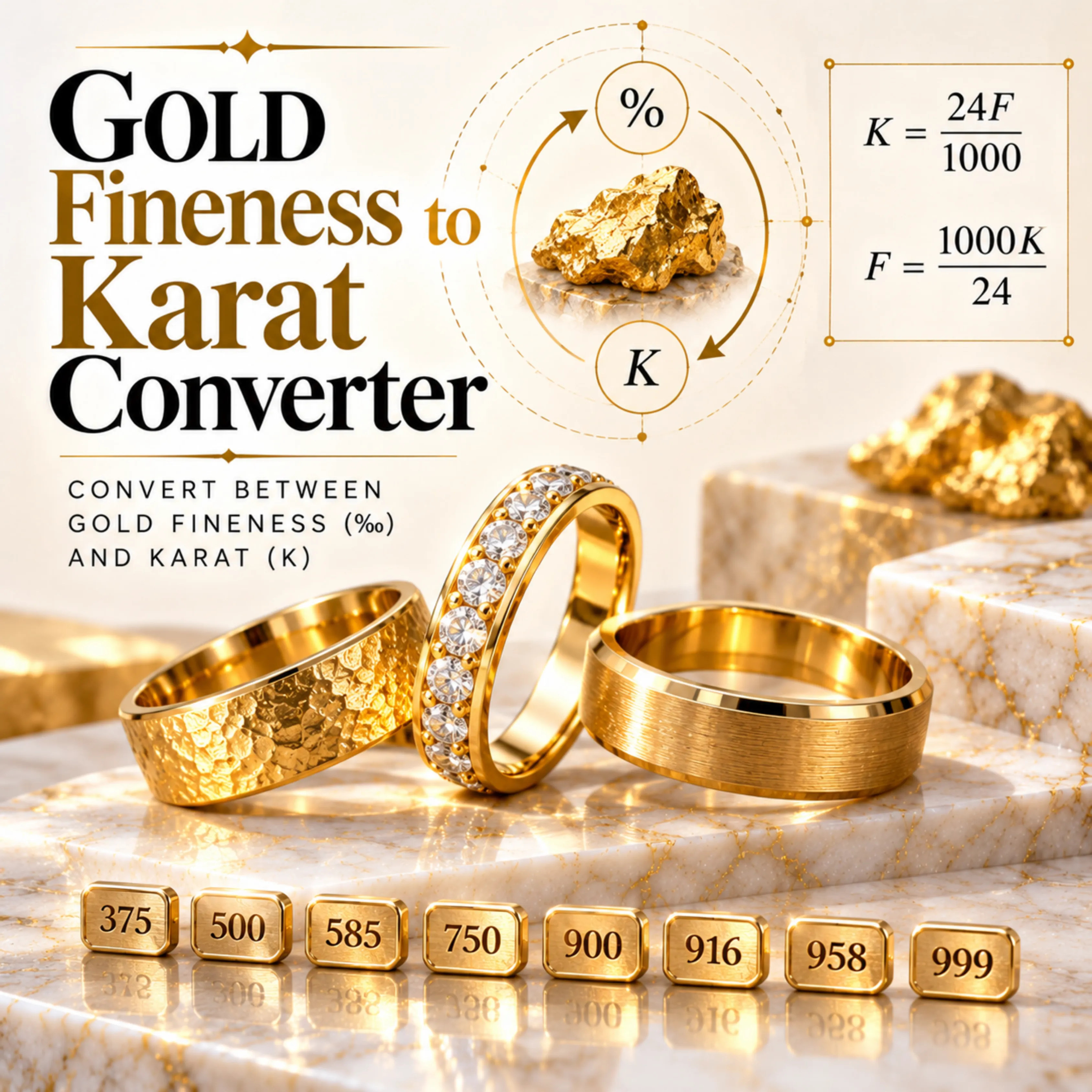
Gold purity can be expressed in two different ways: as fineness, measured in parts per thousand, or as karats, measured on a scale of 24 parts. Both systems describe the proportion of pure gold in an alloy, but they use different numerical scales. This converter allows you to calculate the equivalent value in either direction, compare standard gold purity grades and understand the difference between an exact mathematical result and a conventional gold hallmark designation.
The converter also helps interpret historical and contemporary gold fineness marks used in jewellery, including values that are no longer part of current national standards. It presents exact mathematical equivalents separately from conventional karat designations, making comparisons clearer and more reliable.
Understanding Gold Fineness and Karats#
Gold fineness indicates how many parts of pure gold are present in 1,000 parts of an alloy. It is expressed in thousandths (‰).
For example, 585 fineness means that 585 parts out of 1,000 are pure gold, while the remaining 415 parts consist of other metals.
The karat system expresses gold purity on a scale of 24 parts. Pure gold corresponds to 24 karats, while lower values indicate a smaller proportion of gold in the alloy.
Both systems describe the same physical property: the proportion of pure gold by mass.
Mathematical Conversion Formula#
The conversion between gold fineness and karats is based on the relationship between 1,000 parts and 24 parts.
Fineness to karats:
$$ K = \frac{F \times 24}{1000} $$
Karats to fineness:
$$ F = \frac{K \times 1000}{24} $$
Where:
- $F$ — gold fineness in thousandths (‰).
- $K$ — gold purity in karats (K).
Calculation Examples#
Example 1: Converting 585 fineness to karats
$$ K = \frac{585 \times 24}{1000} = 14.04 $$
The exact mathematical result is 14.04K. The conventional designation for this gold purity is 14K.
Example 2: Converting 14K to fineness
$$ F = \frac{14 \times 1000}{24} = 583.333333\ldots $$
The exact mathematical equivalent of 14K is approximately 583.33‰, not 585‰.
These values are close, but they are not mathematically identical.
Gold Fineness and Karat Reference Table#
The following table compares common gold fineness values with their exact mathematical karat equivalents and conventional designations.
| Gold fineness (‰) | Exact karat equivalent (K) | Conventional designation |
|---|---|---|
| 375 | 9.000 | 9K |
| 500 | 12.000 | 12K |
| 585 | 14.040 | 14K |
| 750 | 18.000 | 18K |
| 900 | 21.600 | No universal designation |
| 916 | 21.984 | 22K |
| 958 | 22.992 | 23K |
| 999 | 23.976 | 24K |
The exact mathematical equivalent is calculated using the 24-karat scale. Conventional designations are commonly used commercial or hallmark references and should not be interpreted as exact mathematical equivalents.
Historical Gold Fineness: The 583 Standard#
Fineness 583 is historically associated with Soviet jewellery. Resolution No. 5016 of the USSR Council of Ministers (22 December 1950), as amended on 28 May 1956, included 583 among the established gold finenesses for jewellery. This was a change within a metric fineness system: the Soviet list already expressed gold content in parts per thousand. In modern Ukraine, the established list includes 375, 500, 585, 750, 958 and 999, so 583 is not part of that current list.
The mathematical result remains exact and separate from any hallmark convention:
$$ 583\text{‰} \times \frac{24}{1000}=13.992\text{K} $$
That is different from both 14K exactly, which converts to $583.333333\ldots\text{‰}$, and 585‰, which converts to 14.04K. A historical 583 mark should not be treated as invalid solely because 583 is absent from the modern Ukrainian list. The consolidated text of Ukrainian Law No. 637/97-VR separately states that gold articles of 333 and 583 fineness bearing a state assay hallmark remain in circulation and are sold. This historical and legal context does not authenticate an individual item; the genuineness and condition of its marks require appropriate examination.
Historical Ukrainian reference material also documents gold articles marked 333 with a state assay hallmark. Its exact mathematical equivalent is $333\text{‰} \times 24/1000=7.992\text{K}$, while 8K is a conventional reference rather than the exact result. For comparison, the table gives 375‰ = 9K, 500‰ = 12K and 585‰ = 14.04K exactly.
Sources: Ukrainian Law No. 637/97-VR, current consolidated text; USSR Council of Ministers Resolution No. 5016, as amended on 28 May 1956.
Exact Mathematical Values vs Conventional Gold Markings#
An important distinction exists between the calculated purity of an alloy and the designation traditionally used to identify it.
For example:
- 585‰ corresponds mathematically to 14.04K, but is conventionally designated as 14K.
- 14K corresponds mathematically to approximately 583.33‰, rather than 585‰.
- 999‰ corresponds mathematically to 23.976K, but is conventionally designated as 24K.
This difference results from established commercial and hallmarking conventions. A conventional designation does not necessarily represent an exact mathematical conversion.
The converter displays the mathematical relationship between the two measurement systems without changing the input into a conventional hallmark designation.
Limitations and Hallmarking Considerations#
This converter performs mathematical conversions between gold fineness and karats. It does not determine the actual composition of a jewellery alloy, verify the authenticity of gold or replace laboratory testing.
Gold hallmarking requirements, permitted fineness standards, tolerances and marking practices vary between countries and jurisdictions.
The values presented in the reference table are educational and comparative. They should not be treated as confirmation that a particular fineness or karat designation is legally accepted in every country.
For commercial transactions, official hallmarking, customs documentation or legal compliance, always consult the applicable national regulations and an authorised assay or hallmarking authority.
Alt-text:
Gold Fineness to Karat Converter — gold bars representing fineness values, gold rings and a circular bidirectional conversion diagram.
Converters. Jewelry Converters. Gold Fineness to Karat Converter. AP | Pivtorak.Studio. 19.11.2026
© Anna Pivtorak (Kostyuk)