The Picture We Cannot See Yet | Living Topography#
22 October 2026 | Meeting № 4 | agirE CLDS 5G, Esposende
Sometimes we become part of something without knowing what we are creating.
We see only our own route, encounter obstacles, change direction and make decisions according to the circumstances. We do not always understand what is happening beyond our field of vision. And even less do we know what the overall result will be.
That is how the fourth meeting felt to me.
Routes, Obstacles and an Unexpected Drawing#
First, we were divided into small groups. Each group was given its own movement rule: some moved diagonally, others forwards and backwards, and others from side to side. Some were also allowed to move freely.
Meanwhile, one of the teenagers began placing masking tape on the floor, creating obstacles for those of us moving around the room.
Whenever an obstacle appeared in our path, we had to change our movement: turn back, approach it again, or walk on the spot.
I did not see the facilitator and the boy discussing in advance what kind of image they intended to create. We did not know what was gradually taking shape on the floor either. We could see only individual obstacles along our own routes.
Then, when the music stopped, an unexpected result appeared before us.
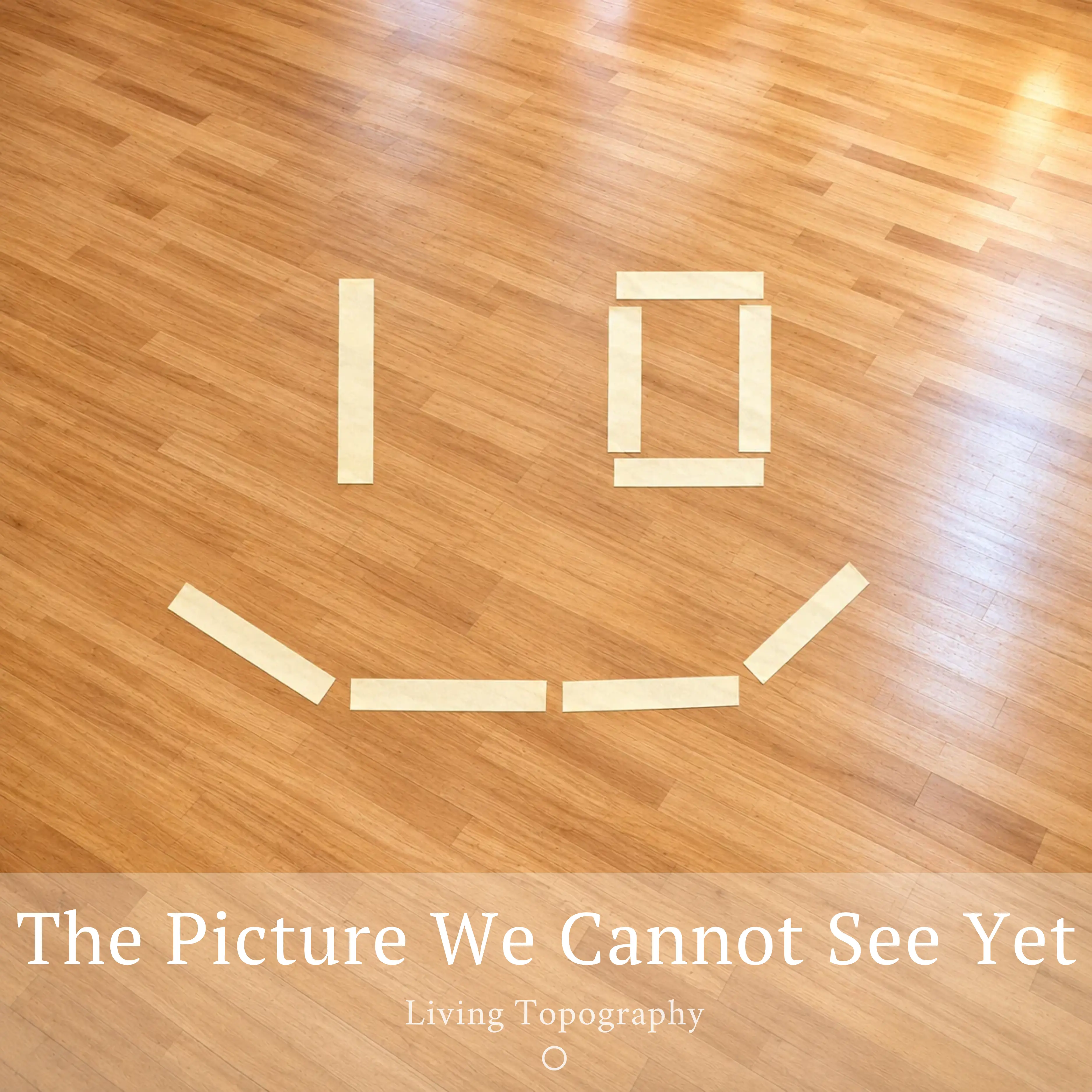
The obstacles had become parts of a large winking smiley face. 😉
But there was another detail.
The boy’s intention had been to add a second eye and create an ordinary smiling face 🙂. However, the music stopped before he had time to finish it.
The unfinished drawing thus acquired an entirely different character. Instead of an ordinary smile, we got a wink — an unexpected response from circumstances that nobody had planned: neither the participants nor the person who had created the drawing.
This was the most memorable moment of the entire meeting for me.
When Separate Figures Become a Shared Story#
In the next activity, we worked with a stage space divided into four zones: Foco, Centro and two Periferia areas (Focus, Centre and Periphery).
We were divided into two groups. First, one group became the sculptors and the other the sculptures. Then we switched roles.
The sculptors created the composition simultaneously, shaping the bodies of the other participants into particular positions. Each worked independently, without coordinating a shared storyline with the others.
I experienced this primarily as an interaction with another person, rather than as working with artistic material.
When I became a sculptor myself, I simply positioned the hands of the person who was my sculpture, without saying a word. It seemed that words were not needed at all.
And when I was the sculpture, I willingly accepted the suggested pose, trusting the other person and the process itself.
It was a kind of exchange of roles: first allowing someone else to give you a form, and then creating a form for someone else.
Two Compositions — Two Unexpected Stories#
Once the sculptures were ready, we began looking at them together and imagining what might be happening between the figures.
It was fun. Everyone immediately offered their own associations, and gradually a shared interpretation of the entire composition emerged.
The first story turned out to resemble a romantic comedy.
In one part of the composition, a love drama unfolded, involving affection, rivalry and physical confrontation. Elsewhere, an entirely different, everyday scene was taking place: a mother was walking in the park with her little daughter. The girl noticed another child and asked her mother if she could go and play with them.
In this way, separate human figures, created independently of one another, came together in one playful story.
The second composition received a completely different interpretation.
It contained figures that suggested people with different social roles and inner states: a dissatisfied person, a philosopher, someone kneeling in prayer, and someone gazing into the distance.
I created a figure — an observer who seemed to be watching everyone else. For me, this figure became important to the overall composition, even though it was positioned on the periphery.
Unexpectedly, the separate poses came together to form an image of social life.
Nobody had set out to portray society in advance. Yet that was how we collectively interpreted the composition.
And something else interesting happened: what the others saw did not contradict my own perception. Different associations naturally complemented one another, forming a shared interpretation.
The Geometric Centre Is Not Always the Centre of Attention#
During this activity, I also noticed that the position of a figure does not necessarily determine its significance to the viewer.
We can distinguish between the geometric centre of a composition, its scenic focus and its narrative focus. These are not necessarily the same thing.
A figure positioned on the periphery may prove important to the perception of the entire scene. And what happens in the geometric centre does not necessarily become the main subject of the shared story.
The Picture We Cannot See Yet#
Now, as I look back on this meeting, I can see much more in common between the two activities than I initially realised.
In one, we followed our own routes, overcame obstacles and had no idea what kind of drawing was gradually emerging from them.
In the other, we independently created human sculptures without knowing what kind of shared story they would eventually form.
In both cases, the whole became visible only after its individual elements had already been created.
And I began thinking about how often this happens in life.
We cannot always predict where our experiences, obstacles, unexpected changes of direction or decisions made in the moment will lead us.
We see only part of what is happening. Sometimes we do not even understand how our actions are connected to those of other people.
Only later, when we look back, can we begin to see the whole picture.
And perhaps what seemed like an accidental detour, an unfinished idea or an obstacle will turn out to be an important part of that picture.
We do not know in advance what we are creating through our everyday actions.
Sometimes we simply need to keep moving, even when we cannot yet see the whole picture. 😉
P.S.#
Perhaps life is also quietly drawing something while we are busy following our own paths.
Alt-text:
A winking smiley face made of masking tape on a light wooden floor, illustrating unexpected outcomes and the emerging patterns of a shared experience.
Living Topography. The Picture We Cannot See Yet. AP | Pivtorak.Studio. 22.10.2026
© Anna Pivtorak (Kostyuk)
Facilitator’s Note
The session was facilitated by Hugo Dias, who kindly shared his preparation notes for this meeting.
The planned activities may be adapted to the group and to the moment.