Immigration: Reset | Life Reconfigured#
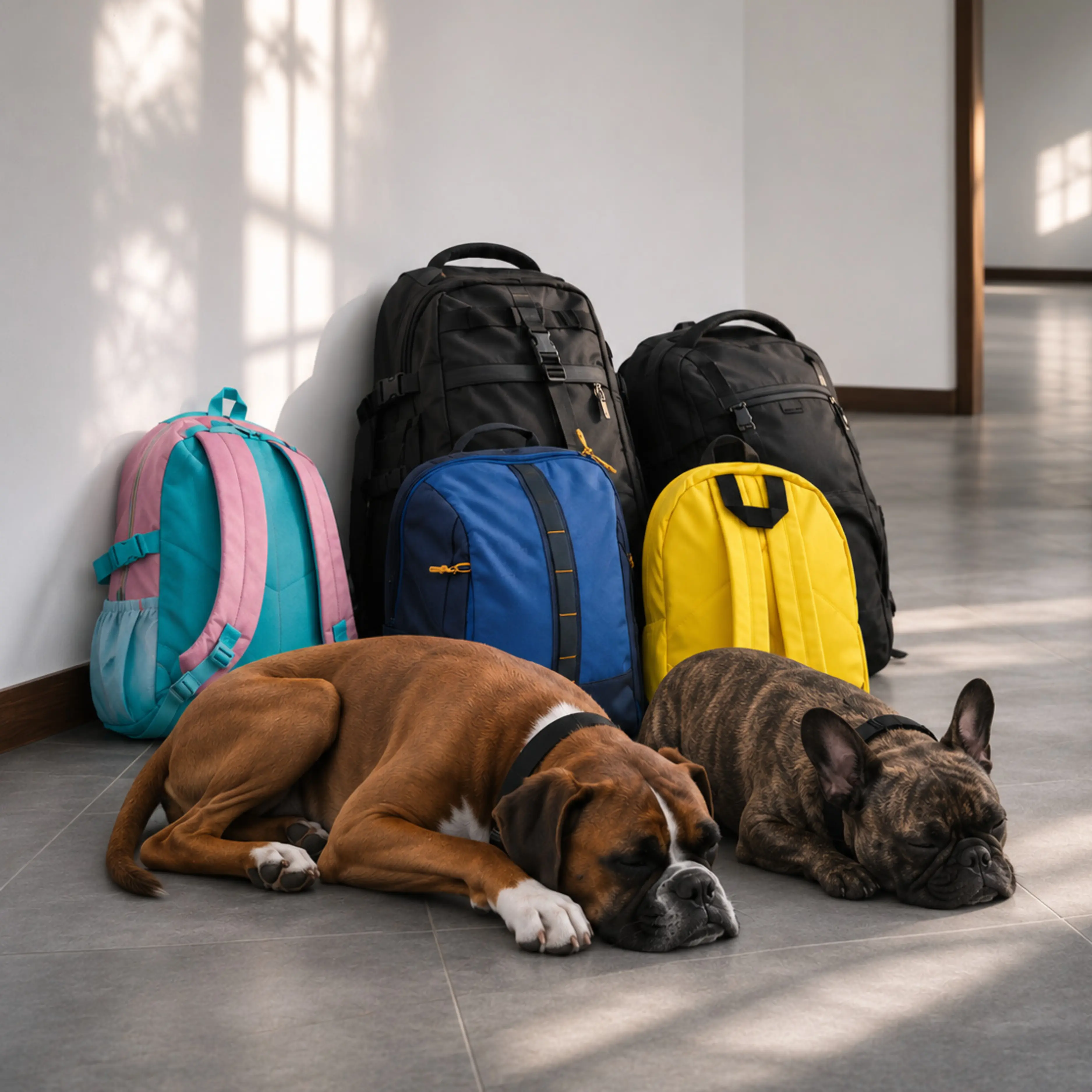
We took everything valuable with us: our children, our dogs, our documents and personal belongings.
We arrived in Portugal with just one small backpack each.
An entire life was left behind — houses, land, professions, achievements and plans.
We are not trying to rebuild everything we left behind.
Today, what matters to us is safety, peace of mind and the freedom for our children to choose their own future.
What Does Reset Mean?#
Starting a new life does not simply mean moving to another country, finding a place to live, sorting out documents and gradually settling into everyday routines. People bring much more with them than their luggage can hold: education, experience, habits, professional skills, family history and their own ideas about the future.
At the same time, all of this enters a new environment, where familiar connections no longer work in quite the same way.
What had been part of everyday life for years suddenly loses its practical foundation. Property remains in another country. Professional experience does not always have an obvious place in the new labour market. Social connections become scattered across different countries. Plans that once seemed entirely realistic no longer determine the next steps.
That is why, for us, immigration became a kind of reset.
Not in the sense of losing our identity, experience or everything we had achieved. Rather, it meant resetting the familiar system in which all those things had their place, purpose and value.
The Life We Left Behind#
We did not leave behind property alone. Those homes and plots of land represented years of work, resources and family decisions.
They were created not merely to give us a place of our own. We thought about the future, about our children and about generations to come. We imagined eventually enjoying what we had built, welcoming our loved ones and watching our children grow up and perhaps have children of their own.
It was a particular vision of life, one that seemed like a natural continuation of everything we had already accomplished.
The war changed that vision.
Today, although we have kept the property documents in order, we can no longer regard those assets as a guaranteed material foundation for the future. They may regain practical value one day, but we do not make our plans on that assumption.
Our children also know that they should not base their plans on what remains in Ukraine. They are free to imagine their own futures and decide independently where and how they want to live.
We are not trying to restore our previous way of life. Not because it was bad or lacked value. Simply because its time and circumstances have changed.
Professional Identity Beyond a Job Title#
One of the most noticeable aspects of immigration is the change in professional status.
A person may arrive with a university degree, years of experience, management expertise and professional achievements. Yet their previous position does not necessarily receive the same formal recognition in a new country.
Language barriers, local requirements, the particularities of the labour market and the absence of familiar professional networks can create a considerable distance between who a person was in their professional environment and the work they do now.
Sometimes that distance is considerable.
Previous education does not disappear. Experience is not erased. The ability to organise work, make decisions, recognise systemic errors, take responsibility and manage processes does not vanish when someone moves to another country.
However, the new environment may not have the opportunity — or the willingness — to make proper use of those competencies.
It is important here to distinguish between three things: professional experience, formal position and professional identity. They no longer necessarily coincide.
A person may hold a job that bears little resemblance to their previous level of responsibility. They may temporarily work outside their field. Or they may not seek a local employer at all, choosing instead to continue developing their own projects.
In our immediate Ukrainian circle in Esposende, we see different approaches to this kind of adaptation. Quite a few people continue working on their own ideas and projects without tying their professional fulfilment exclusively to the local labour market. Of course, this is an observation from our local circle, not a basis for drawing conclusions about all Ukrainians in Portugal.
But it illustrates one important point: professional identity does not necessarily need a local employer in order to continue existing.
Sometimes it is preserved most clearly not through a job title, but through a way of thinking — the habit of creating, organising, analysing and seeing an idea through to completion.
Even the people closest to us may recognise this inner continuity more clearly than formal documents do. Children continue to see their parents through the lens of their experience and the roles they have always known, rather than merely through their current job titles.
Formal status can change. That does not mean a person has become someone else.
A Family Without a Shared Geography#
Immigration changes more than professional and material circumstances. It changes the geography of a family.
Children grow up, start families of their own, choose countries and build their lives wherever they see opportunities. Our older children already live in different countries. The younger ones are at school in Portugal.
We are not trying to bring everyone together in one place, nor do we believe that closeness must be measured by sharing the same address.
The world in which today’s children are growing up is much wider than the geography familiar to previous generations. They have access to information and can see different countries, cultures and ways of life. They can assess opportunities for themselves and make their own decisions.
We do not think we need to explain to them how to live their lives. Nor do we expect them to shape their futures according to our plans.
If one of them wants to stay in Portugal, that is fine. If they decide to move to Canada or another country, that is also their choice.
What matters more to us is that they have that freedom than that they all remain nearby.
Perhaps this is one of the greatest changes in our own understanding of family: its wholeness no longer depends on everyone living under the same roof, or even in the same country.
What It Means to Have Everything#
We do not consider ourselves to be suffering.
Our present life comes with many limitations. It is not the life we once imagined for ourselves after the age of fifty. We do not enjoy all the opportunities we had before, and we cannot restore our former material standard of living.
But that does not mean our lives are without meaning or that we constantly feel deprived.
We have what we need.
The children attend a good school. My husband has a job and a regular monthly income. I look after the family and work on my own creative projects, which bring me fulfilment.
We have safe days and peaceful nights. There is sunshine, a park, open fields, the ocean, a forest and fresh air. Sometimes it rains; sometimes there are storms. We can go for a walk, spend time in nature, return home and not have to wonder whether we will need to find a safer place to spend the night.
Portugal has become a comfortable environment for us. We have met many kind people here who have helped us sincerely, without unnecessary explanations or conditions.
We do not see this country merely as a temporary refuge where we must wait for a difficult period to pass. This is where our lives are happening now.
And perhaps that is what has gradually helped us change our understanding of what it means to have everything.
Previously, that idea might have included a considerable number of material and professional elements: property, achievements, stability, plans and opportunities. Today, we look at it differently.
Not because what we had before has lost its value. Simply because we no longer need everything we once considered essential to living a full life.
Not to Rebuild, but to Rethink#
We could call this process starting from zero. But even that is not quite accurate.
We are not starting from an empty place. We have lived our lives, and we carry knowledge, experience, professional skills, family history and memories with us. All of this remains, even if it no longer has the same material or social expression.
The reset does not take place inside the person. It takes place around them — in the system of connections, statuses, opportunities and familiar points of reference.
And that raises a question: which parts of all this do we really need to carry into our new lives?
Not everything we once had needs to be rebuilt. Not every previous plan has to be fulfilled at any cost. Not every professional role needs new formal confirmation. Not every family dream must remain unchanged simply because it once seemed right.
Immigration does not bring only new circumstances. It also forces us to reconsider the very criteria by which we evaluate our lives.
For us, this reconsideration has not become a story of rejecting the past or heroically overcoming hardship. We have simply come to accept, gradually, that we now live differently.
We are not obliged to rebuild everything we left behind. We are not obliged to recreate our former way of life. And we should not determine our children’s futures for them.
We took everything valuable with us.
The rest we left as part of our past — without denying it, but also without allowing it to determine everything that comes next.
Immigration: Reset is not necessarily about losing everything. Sometimes it is about changing our very understanding of what we need in order to live.
Alt-text:
Five travel backpacks arranged against a white wall beside a sleeping Boxer and a brindle French Bulldog in a clean, empty apartment. A quiet moment of arrival and the beginning of a new life.
Immigration: Reset | Life Reconfigured. AP | Pivtorak.Studio. 12.11.2026
© Anna Pivtorak (Kostyuk)