🕊️🪶⚙️ The Cost of Complicity | Peaceful Life#
When society becomes a willing resource of war, complicity becomes part of the machinery of destruction.
War does not sustain itself through weapons and military decisions alone. Behind every military campaign stands a system that requires resources, labour, money, and public cooperation. Its machinery continues to operate not only because those in power demand it, but also because people and institutions willingly provide what keeps it moving.
When society accepts these demands without questioning their purpose or consequences, participation can become a form of complicity. Resources that could support life, education, healthcare, and peaceful development are redirected towards destruction. And the cost of what is willingly given rarely ends with what society intended to surrender.
What We See#
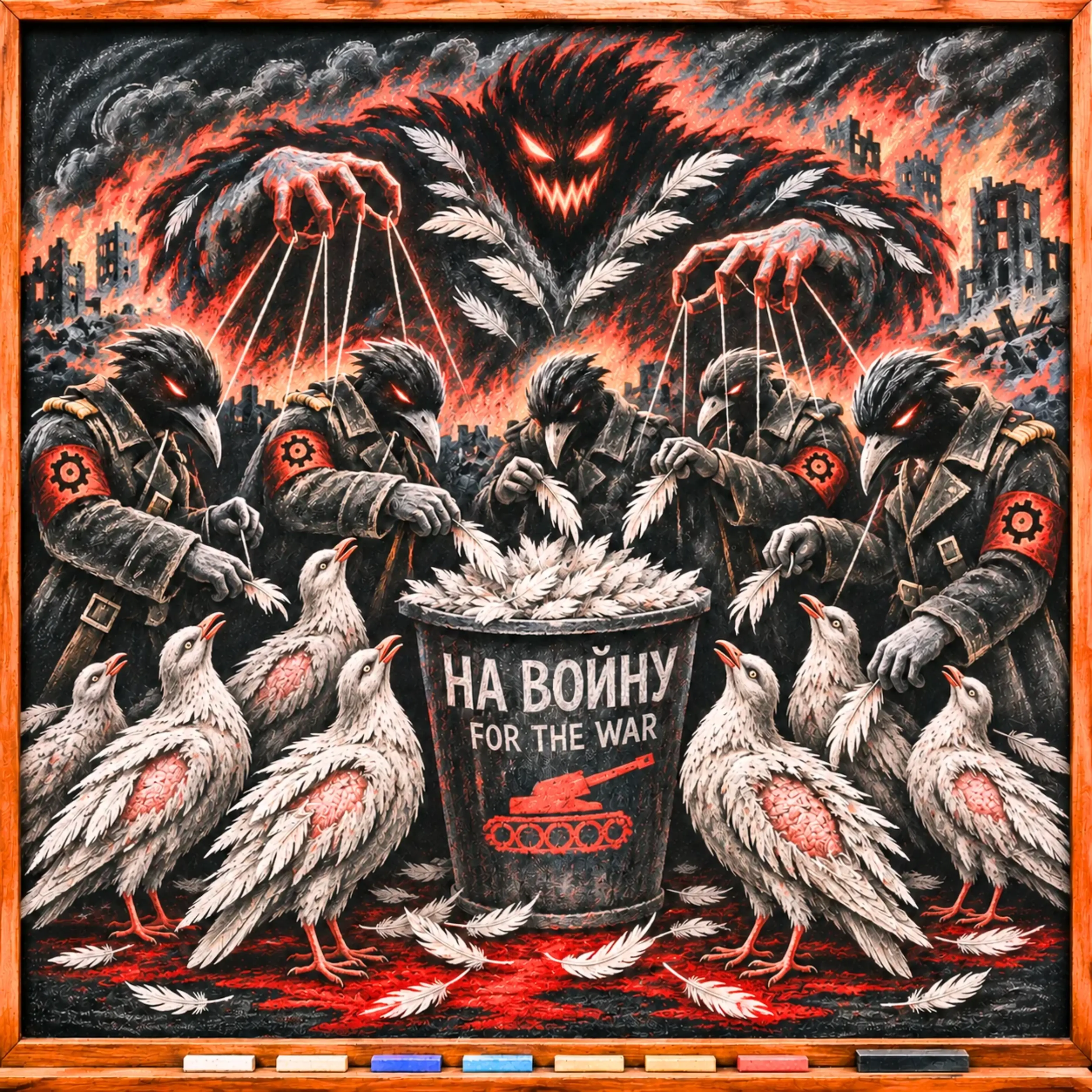
A dark figure towers above a devastated landscape, controlling a group of sinister, bird-headed clones. They operate like obedient servants, plucking feathers from grey, dust-covered birds.
The birds do not resist. Some willingly offer their feathers, while others stand with their heads raised, accepting what is happening. Their beaks and feet are stained red: they have stepped into the blood of war.
In the centre stands a container marked “НА ВОЙНУ” (FOR THE WAR). The collected feathers fall into it, becoming a symbolic contribution to the machinery of destruction. The dark figure itself is already covered with feathers taken from others.
The image presents a disturbing exchange: society gives, the system collects, and war consumes.
What It Reveals#
War requires more than military equipment, soldiers, and natural resources. It also requires financing, social consent, institutional cooperation, and a continuous supply of resources.
Taxes, labour, economic activity, public funds, and individual decisions can all become part of a country’s war economy. When these resources are willingly directed towards sustaining aggression, society becomes involved in the system that makes it possible.
Complicity does not always look like direct violence. It can take the form of approval, indifference, obedience, financial participation, or the refusal to question where collective resources are going.
The plucked feathers represent what society gives away. The red stains represent the consequences of entering the war. The container represents the mechanism through which individual contributions accumulate into collective support for destruction.
But the system does not stop taking when society has given enough. It takes more.
What We Choose#
A peaceful society requires responsibility for collective decisions and the use of public resources.
Paying taxes does not automatically mean supporting every decision made by a government. Citizens must be able to question how public money is spent, distinguish defence from aggression, and demand accountability from those who exercise power.
Peaceful coexistence begins with recognising the consequences of our choices. It requires refusing to normalise aggression, rejecting the glorification of war, and protecting the dignity and freedom of others.
We cannot always control the decisions of those who govern us. But we can preserve our ability to question, distinguish, and take responsibility for our own actions.
War takes what society willingly gives — and more.
What happens when a society willingly gives its resources to a system that feeds on war?
Complicity · War Economy · Public Resources · Taxpayers · Social Responsibility · Aggression · Accountability
Before: Resources, consent, and collective participation sustain the machinery of war.
After: Society recognises its responsibility and questions the use of its resources.
Transition: Awareness replaces unquestioning participation.
Important distinction: Collective responsibility does not mean collective guilt. People who resist aggression, oppose war, or are forced to live under an oppressive system cannot be equated with those who willingly support it.
The price of complicity is never limited to what is willingly given. It also includes everything that war takes in return.
A war economy is sustained by more than the decisions of those who command it. It also depends on the resources and participation that reach it from society. And when the consequences become impossible to ignore, the human cost of war comes into view.
Alt-text:
A dark puppet-master figure controls raven-headed soldiers who pluck feathers from grey, willing birds and collect them in a container marked “НА ВОЙНУ” and “FOR THE WAR”. Red stains cover the ground beneath them, while a devastated, burning landscape fills the background. The entire scene is drawn on a school chalkboard.
Peaceful Life. The Cost of Complicity. AP | Pivtorak.Studio. 01.11.2026
© Anna Pivtorak (Kostyuk)