Devotion to What Holds Value | Living Topography#
12 November 2026 | Meeting № 7 | agirE CLDS 5G, Esposende
There are gatherings after which we remember particular words, movements or voices. And then there are those that leave us with something much deeper — an awareness of how much can emerge between people when everyone comes not merely to be present, but to contribute wholeheartedly.
This time, I was struck by the 100% attendance, the 100% preparedness, and the natural devotion to our shared endeavour that no one had demanded. In this, I recognised a special form of respect: for the facilitator, for the other participants, and for what we were building together.
When No One Has to Ask#
No one was late. And no one arrived without having completed their homework. Everyone had prepared their text, and everyone was ready to share a part of their own world.
No one had asked us to do this. We had received no reminders about the importance of the session, no emphasis on the need to prepare, and no additional motivation.
Everyone came. Everyone was ready.
I was struck by this 100% attendance. Not as a measure of discipline or organisation, but as an expression of something much deeper. Each person had independently recognised the value of what was happening and responded through their own participation.
Each with Their Own Voice#
This time, our languages took centre stage.
We began with the poem «Casa» by Warsan Shire. Each person read their own passage in their native language.
It was an unusual experience. I noticed how different the musicality of each language could be, how familiar emotions sounded different when expressed through other sounds, intonations and rhythms.
Then we read the poem together with the facilitator. Hugo’s voice sounded in Portuguese, while we joined him in turn, each in our own language.
We were not simply listening to translations of the same text. We were experiencing how one story could take on different voices without losing its essence.
Stories We Brought with Us#
Later, each participant presented a prepared text — a short essay or a poem by an author from their own country.
I was the first Ukrainian to present my text. We therefore agreed that, so everyone could understand, I would read each sentence in two languages: first Ukrainian, then Portuguese.
My text consisted of just five sentences:
Ми взяли із собою все цінне: дітей, собак, документи й особисті речі.
Trouxemos connosco tudo o que era importante: os nossos filhos, os nossos cães, os documentos e os objetos pessoais.Ми приїхали до Португалії з одним невеликим рюкзачком на кожного.
Chegámos a Portugal com apenas uma mochila pequena para cada um.За плечима залишилося ціле життя — будинки, земля, професії, досягнення та плани.
Ficou para trás uma vida inteira — casas, terrenos, profissões, conquistas e planos.Ми не намагаємося відновити все, що залишили.
Não estamos a tentar reconstruir tudo o que deixámos para trás.Сьогодні нам важливі безпека, спокій і можливість дати дітям свободу обирати власне майбутнє.
Hoje, o que importa para nós é a segurança, a tranquilidade e a liberdade de os nossos filhos escolherem o seu próprio futuro.
We took everything precious with us: our children, our dogs, our documents and personal belongings.
We arrived in Portugal with just one small backpack each.
An entire life remained behind — houses, land, professions, achievements and plans.
We are not trying to rebuild everything we left behind.
Today, what matters to us is safety, peace of mind, and the freedom to let our children choose their own future.
These sentences were short, but each carried an entire story. A story of departure, loss, a new beginning, and the gradual reassessment of what truly matters.
My text turned out to be deeply moving. Overall, everyone read their prepared pieces with great emotional involvement. Some stories were so personal that listeners could not hold back their tears.
Everyone spoke in their own voice. And this time, we could especially feel how attentively we were able to listen to one another.
Between Different Languages — Something We Share#
We worked with the words Casa, Viagem and Pertença — home, journey and belonging.
We created a small dictionary in which these concepts found their expression in different languages.
At first glance, it seemed like a simple task: find equivalents, pronounce the words, hear them in another language. Yet this was precisely when I noticed something we do not always pay attention to in everyday communication.
Language is not just about the meaning of words. It is also about their musicality, rhythm and sound. Even a word we understand can sound completely different to our ears and prove difficult to pronounce.
Each language retained its own intonation, yet all of them could become part of the same space.
Every Word Matters#
At the end, we created a collective text. Hugo began a sentence, and each participant took turns adding just one word.
No one knew in advance what the result would be. Each person contributed a small part, and gradually something emerged that belonged to none of us individually.
Each word mattered. Without any one of those contributions, the collective sentence would have been different. It was a simple illustration of how an individual contribution becomes part of a shared result — something no one could have created alone.
Devotion That Brings People Together#
What makes a group a genuine community?
Is meeting regularly enough?
Do people need to share the same interests, opinions or life experiences?
Perhaps not.
We can be very different. Speak different languages, have different pasts and different reasons for finding ourselves in the same place. And yet, gradually, we can begin to recognise the value of what happens between us.
I saw how respect for Hugo was expressed not only through words or our attitude towards him as the facilitator, but also through everyone’s willingness to support the shared work.
No one demanded 100% commitment from us. And yet, everyone brought their own 100%.
Perhaps this is one of the most meaningful expressions of respect: not waiting for someone to ask us to do more, but independently understanding why what we are creating together deserves our attention, time and effort.
We did not become the same. We did not abandon our languages, stories or personal experiences.
We simply learned to be together while remaining ourselves.
Sometimes genuine solidarity begins precisely here: when each person independently recognises the value of what is shared.
P.S.#
Genuine togetherness begins when everyone understands, individually, the value of something shared.
Alt-text:
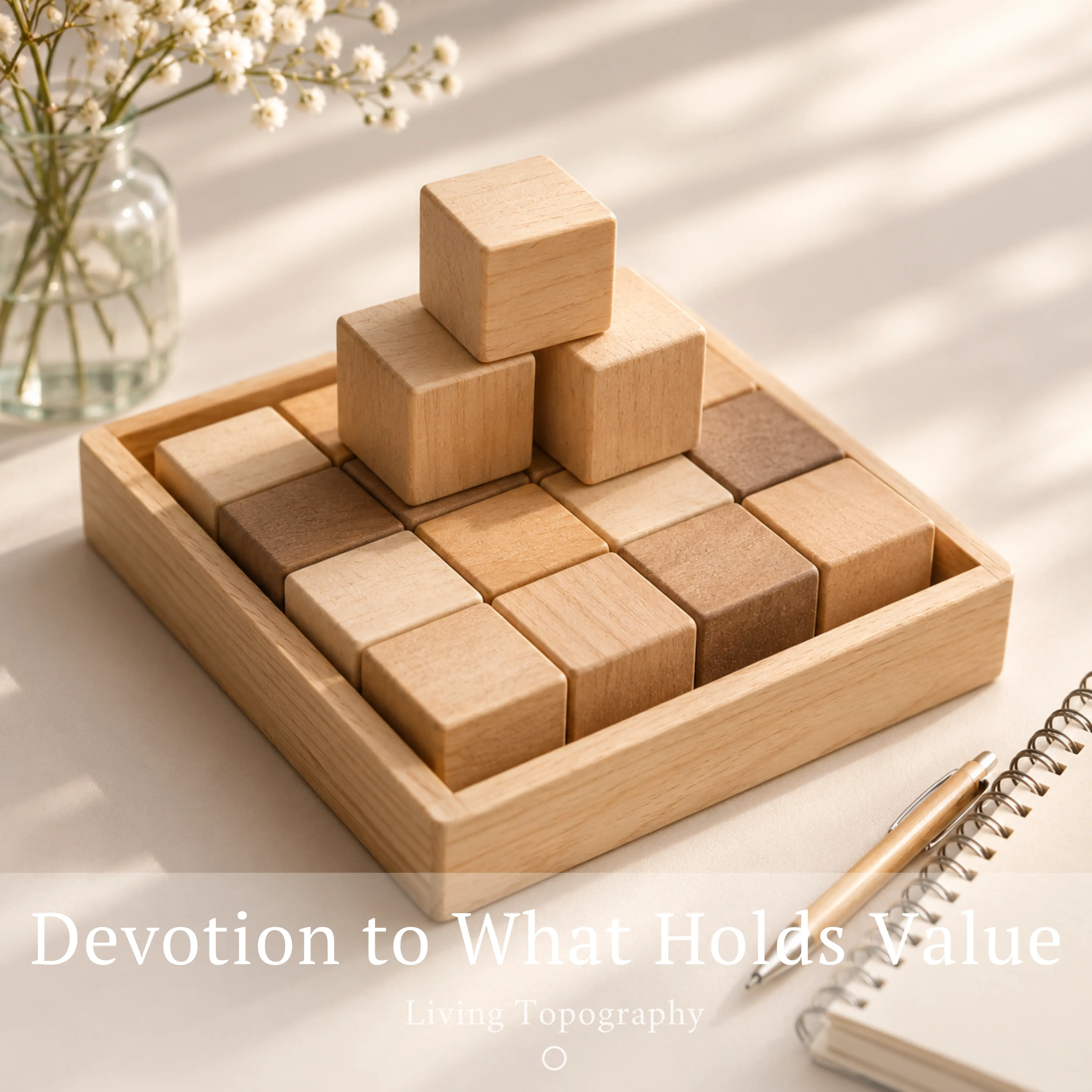
A collection of natural wooden cubes rests within a shallow wooden tray, with several pieces carefully arranged above the others. Each cube has its own grain, tone and character, yet all belong to the same composition.
The tray represents a shared space — a group that brings individuals together without taking away their individuality. The wooden cubes symbolise the people who contribute to that shared space. None stands outside it, and none is lost within it.
The arrangement reflects the idea that genuine cohesion does not require uniformity. It emerges through individual contributions, mutual respect and a shared sense of value.
Living Topography. Devotion to What Holds Value. AP | Pivtorak.Studio. 12.11.2026
© Anna Pivtorak (Kostyuk)
Facilitator’s Note
The session was facilitated by Hugo Dias, who kindly shared his preparation notes for this meeting.
The planned activities may be adapted to the group and to the moment.